
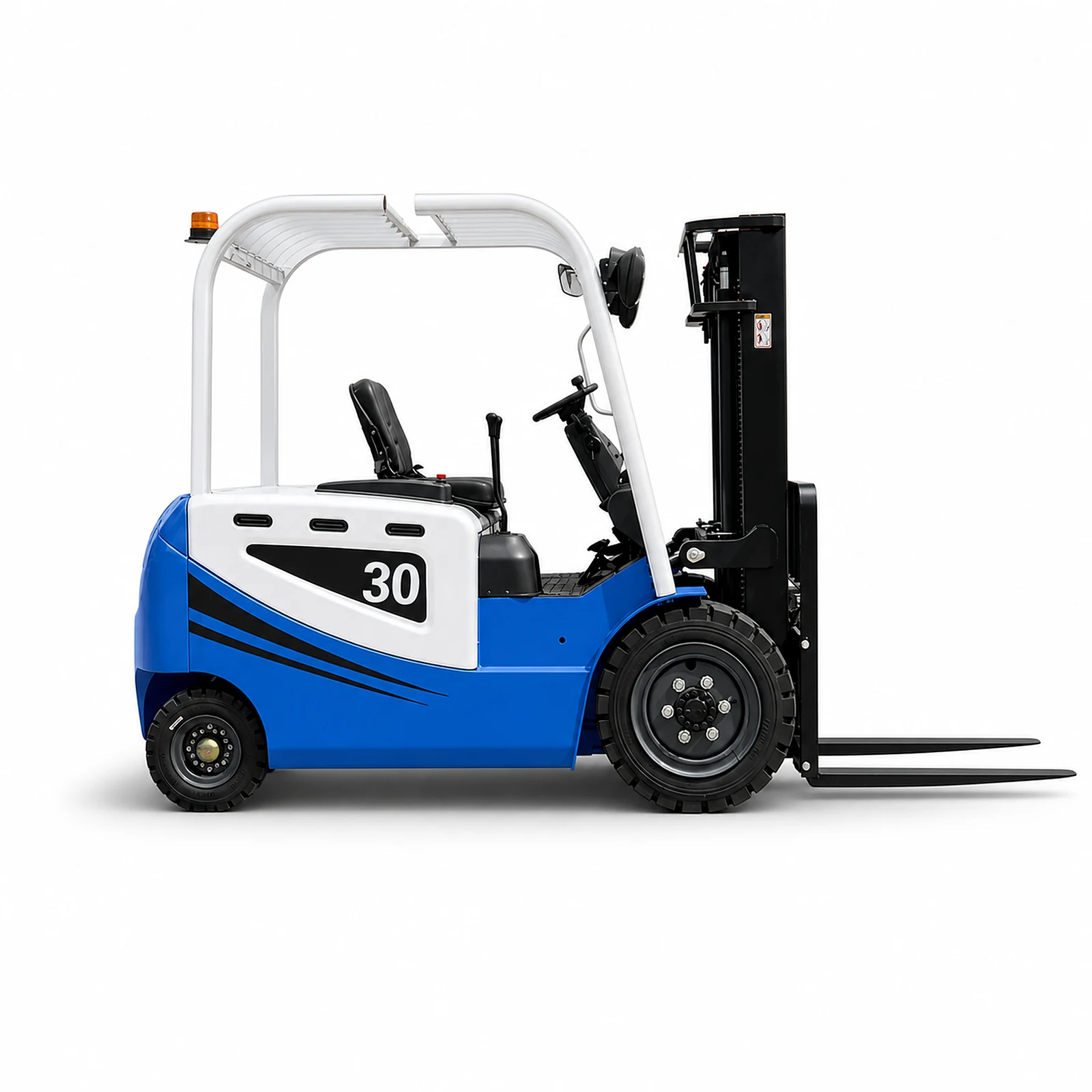
Listed configuration: 3,000 kg rated capacity at a 500 mm load center · 1,225 mm truck width · 4,150 kg service mass with battery · 3,000 mm maximum lift height.
The HLC30 is Hongli Machinery’s seated, counterbalanced electric forklift offered in a 3-ton rated class. The reference sheet describes a lead-acid configuration with a 2,300 mm turning radius and a 3,000 mm maximum lift height. Those figures describe a particular configuration, not every mast, battery, fork or attachment that can be quoted. Before ordering, match the truck to the actual pallet, aisle, doorway, floor and charging arrangement.
Planning a purchase? Send us your heaviest load and its dimensions, pallet size, required lift height, measured aisle width, narrowest doorway, floor conditions, destination country and expected quantity. We can check the proposed configuration before preparing a quotation. Request an HLC30 configuration and price.
The number buyers miss: truck width is not aisle width
A 1,225 mm body width does not mean the HLC30 can stack pallets in a 1,225 mm aisle. The truck must turn while carrying a load, keep the pallet clear of the racking and leave room for the operator to position the forks. The reference sheet gives a 4,300 mm right-angle stacking aisle for a 1,000 × 1,000 mm pallet and 4,500 mm for a 1,200 × 1,200 mm pallet. Both figures are stated with 200 mm clearance in the sheet’s test condition. They should be checked against the buyer’s real pallet, load overhang, rack layout and site rules.
Ask us to check the HLC30 against a simple site sketch before discussing price. Include pallet dimensions, the position of columns and rack ends, aisle width at the tightest point, door width, turning areas and intended attachment. A drawing and a few measured photos are more useful than the statement “standard warehouse aisle.” If the geometry does not work, a reach truck or a different layout may be the right answer even when the HLC30’s load rating is sufficient.
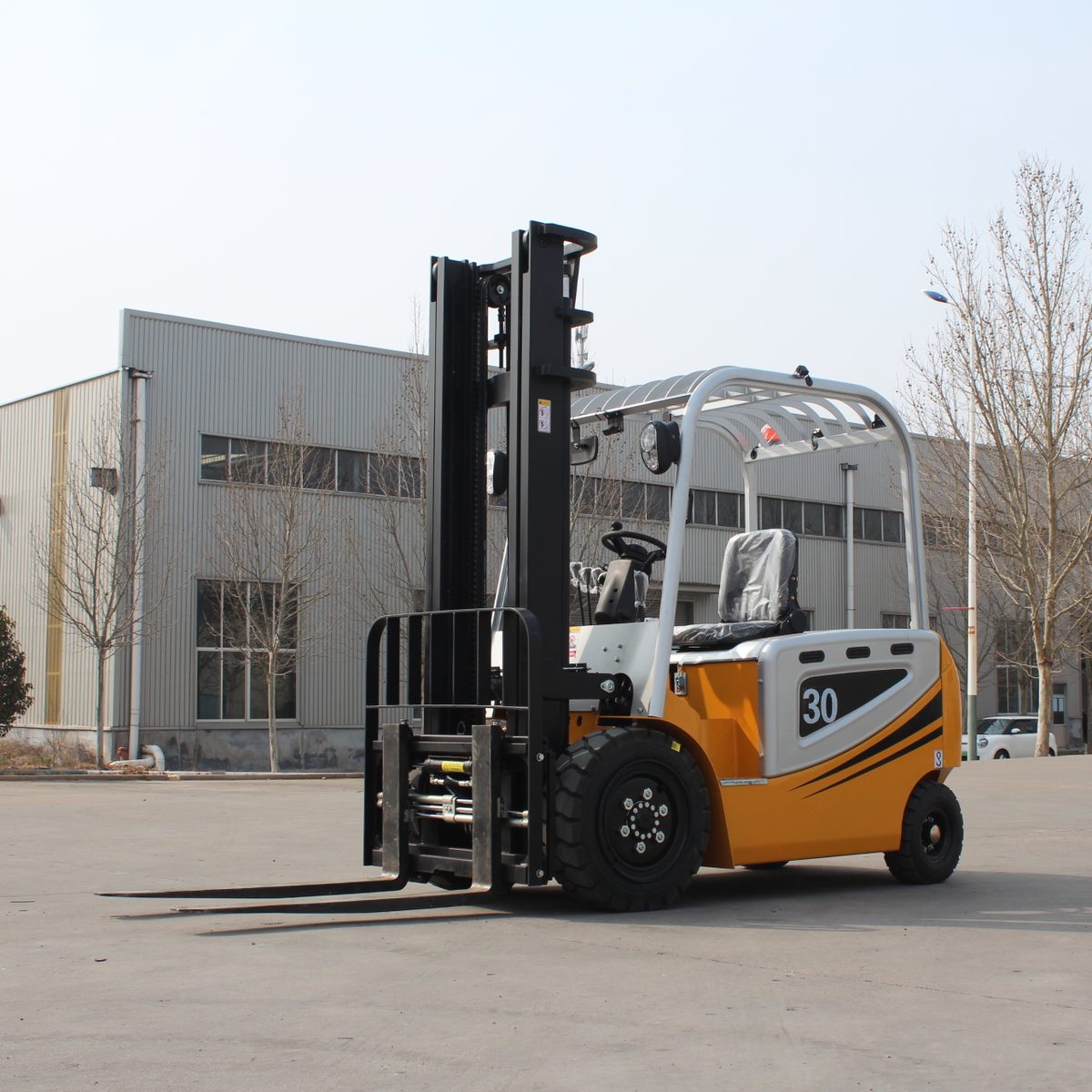
Factory example of a 30-marked forklift. Confirm the mast, battery and nameplate of the truck on your order separately.
What the 3-ton rating actually covers
The reference configuration lists 3,000 kg rated capacity at a 500 mm load center. The load center is the horizontal distance relevant to how the load acts on the forks. A long crate carried lengthwise, an unevenly loaded pallet or an attachment that moves the load forward can make a 3,000 kg nameplate number unsuitable for the actual lift. The truck’s capacity plate for the specified mast and attachment is the document to use for the final decision. OSHA’s forklift nameplate guidance illustrates why capacity, load center, lift height and attachments must be read together; local operating rules must be checked for the destination.
Tell the seller the maximum weight of the complete lifted unit, including pallet, container and contents. Give the load’s depth in the direction of the forks, how its weight is distributed and the highest position at which it will be handled. Ask for the proposed truck’s capacity plate and any attachment rating before paying a deposit. Do not assume that an HLC30 with a taller mast or a clamp has the same usable capacity as the reference configuration with standard forks.
The source sheet gives a 3,000 mm maximum lift height, 2,057 mm mast-lowered height and 2,200 mm overhead-guard height. For a doorway, check both the mast and guard, plus any sign, pipe, cable tray or uneven threshold. For a rack position, ask whether the stated lift height and the residual capacity meet the real top-beam height with the actual load. “Three meters of lift” alone cannot answer that question.
HLC30 reference specifications
These figures are from the supplied CPD30-C reference sheet associated with the HLC30 listing. They describe the listed configuration and should be checked against a signed order specification.
| Item | Listed figure | Why to check it |
|---|---|---|
| Rated capacity | 3,000 kg | Applies with the stated load-center and capacity-plate conditions |
| Load center | 500 mm | Confirm load depth and weight distribution |
| Operator arrangement | Seated | Check operator access and intended shift pattern |
| Listed power source | Lead-acid battery | Confirm battery, charger and charging site together |
| Service mass with battery | 4,150 kg | Relevant to floor, ramp and transport planning |
| Overall truck width | 1,225 mm | Check doorways, travel routes and side clearance |
| Body length, excluding forks | 2,600 mm | Check turning and staging space |
| Wheelbase | 1,850 mm | One part of the maneuvering envelope |
| Turning radius | 2,300 mm | Not a substitute for right-angle stacking aisle data |
| Right-angle stacking aisle, 1,000 × 1,000 mm pallet | 4,300 mm | Sheet assumes 200 mm clearance |
| Right-angle stacking aisle, 1,200 × 1,200 mm pallet | 4,500 mm | Sheet assumes 200 mm clearance |
| Maximum lift height | 3,000 mm | Confirm required rack height and capacity at height |
| Mast-lowered height | 2,057 mm | Compare with travel and doorway clearance |
| Overhead-guard height | 2,200 mm | Check the whole truck’s passage height |
| Ground clearance below mast | 82 mm | Check thresholds, ramps and damaged floor sections |
| Fork dimensions, listed reference | 1,070 × 122 × 45 mm | Confirm fork length for the load and pallet |
The sheet also lists a 120 mm free-lift height and 5°/10° forward/back mast tilt. These are reference values, not a promise that every ordered mast will share them. Record the chosen mast type and its actual height, free lift, tilt and capacity plate in the order documents.
Where the HLC30 fits—and where it does not
The HLC30 is worth assessing for pallet handling on a suitable industrial floor when the actual load fits the specified capacity plate, the aisle geometry works, the lift height is enough and the charging arrangement can support the schedule. Its listed 82 mm clearance below the mast makes floor condition a practical question. A shallow threshold or broken concrete may matter more to daily use than a brochure’s top speed. Walk the complete route from unloading to storage, not just the cleanest aisle in the building.
Do not choose the HLC30 solely because the heaviest load is “about three tons.” If that load is long, offset, carried with a clamp or lifted high, get the capacity for that exact combination first. Do not choose it for an aisle narrower than the verified turning and stacking requirement, or for a site with rough, soft ground that needs a different type of truck. If the duty cycle cannot accommodate the specified charging process, the offered battery package may also be wrong. We would rather propose another configuration—or tell you this model is unsuitable—than sell a rating that does not solve the job.
Battery, charger and service-mass checks
The reference sheet identifies a lead-acid powered truck and gives 4,150 kg service mass with the battery included. The battery is part of the truck’s configured mass, and a change in battery type or weight must not be treated as a simple plug-in substitution. Ask the factory to specify the battery chemistry, approved weight range, rated capacity, voltage, connector and charger as one package. Then compare the charger input with the power available at the destination and confirm the planned charging location meets local requirements.
Battery and charger specifications must be confirmed for each order rather than inferred from the model code. If a lithium configuration is offered, request its own engineering approval and capacity documentation; do not infer performance or counterweight equivalence from the lead-acid reference truck.
For transport and floor planning, keep rated load separate from service mass. The HLC30’s 3,000 kg load rating is not the weight of the forklift. The reference service mass is 4,150 kg with the listed battery. Add the load, pallet and any attachments when checking a floor or ramp with the responsible site engineer. Check the loaded route, turning area and loading dock—not only the warehouse slab’s general rating. Shipping gross weight and packing dimensions require a packing plan for the particular order.
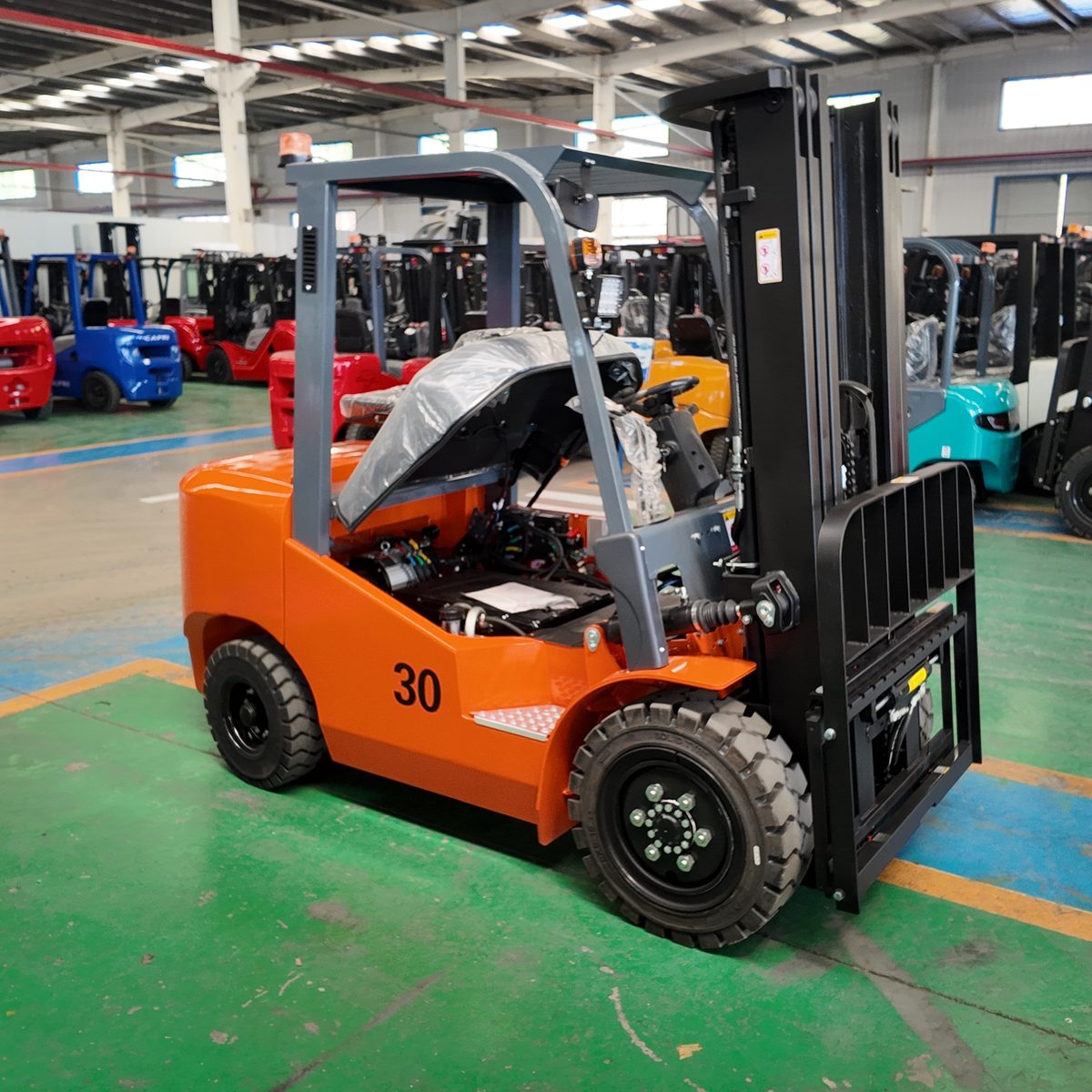
Rear view of a factory example. The “30” body marking alone does not verify rated capacity or the battery configuration.
Options to specify rather than assume
A side shifter, nonstandard fork length or different mast can improve one task and create a new constraint elsewhere. Send us the load drawing and required stacking height before selecting an attachment. An attachment adds weight and may move the load farther from the truck; ask for the resulting capacity information on the proposed configuration. Confirm the fork section and usable length for the pallet without assuming the listed reference forks will suit every load.
For charging, specify the battery and charger together. Ask for photos of their labels and the installed connectors on the actual truck before shipment. Agree on spare parts, service documentation, operator instructions and the destination’s required certificates in the quotation. Any certificate or market compliance claim should be tied to the ordered configuration and destination, not a generic model name.
What to verify before the truck leaves the factory
The photos on this page show a model example. They are useful for discussing the truck’s layout, but they do not prove what was built for your purchase order. Agree a specification record before deposit: model reference, capacity and load center, mast, forks, attachment, battery, charger, tires, destination requirements and expected quantity. Before shipment, ask for the built truck’s nameplate, battery and charger labels, mast and attachment photos, and packing or loading evidence linked to that order.
Our separate 3-ton electric forklift buying checklist explains the two verification gates in detail. Use it alongside this HLC30 page: this page gives the model’s reference geometry and suitability checks; the checklist helps you compare a signed configuration with the finished unit. If either document disagrees with the actual nameplate or factory evidence, resolve the difference before dispatch.
Frequently asked questions
Will an HLC30 fit a 1,225 mm aisle?
No aisle decision can be made from the 1,225 mm truck body width alone. The source sheet lists 4,300 mm for right-angle stacking with a 1,000 × 1,000 mm pallet, and 4,500 mm with a 1,200 × 1,200 mm pallet, under its stated 200 mm clearance condition. Check the actual load, racks, columns and attachment before ordering.
Can it lift 3,000 kg to the top of a 3,000 mm mast?
Do not infer that from the two headline numbers. The listed rated capacity uses a 500 mm load center, while usable capacity at the required height depends on the specified mast, forks, attachment and load geometry. Request the capacity plate for the ordered truck and check the required lift point against it.
Is 3,000 kg the weight of the HLC30 itself?
No. It is the listed rated load. The reference sheet gives 4,150 kg service mass with the battery included. Transport, ramp and floor checks must use the correct truck mass together with the real load and any additional equipment.
What battery and charger come with the truck?
The reference sheet identifies a lead-acid configuration. Ask for the signed battery and charger specification, connector details and photos of the actual labels. Do not use an assumed voltage to order electrical work at your site.
Is the HLC30 suitable for rough outdoor ground?
That cannot be established from a capacity rating. The sheet lists 82 mm clearance below the mast, and the route must be checked for soft ground, broken pavement, steep transitions and water. A rough-terrain truck or a different operating route may be more appropriate.
What should I send for a useful quotation?
Send the heaviest complete load, load depth, pallet dimensions, highest stacking point, aisle and doorway measurements, floor conditions, daily operating schedule, charging supply, destination country, required certificates and expected quantity. State whether you need a sideshifter, longer forks or another attachment. We can then confirm what the proposed HLC30 configuration can actually do.
Request a configuration checked against your site
Send your load drawing or pallet dimensions, aisle sketch, doorway height, lift height, charging information, destination and expected quantity to Hongli Machinery. Ask for the current signed specification and unit-specific evidence before shipment. If the HLC30 is the wrong fit, we will say so and discuss a more suitable truck type or configuration.
About the Author: Avicii Meng is Head of Technical Engineering at Tai’an Hongli Machinery Equipment Co., Ltd. He works on export equipment configurations and technical purchasing questions for international buyers.