
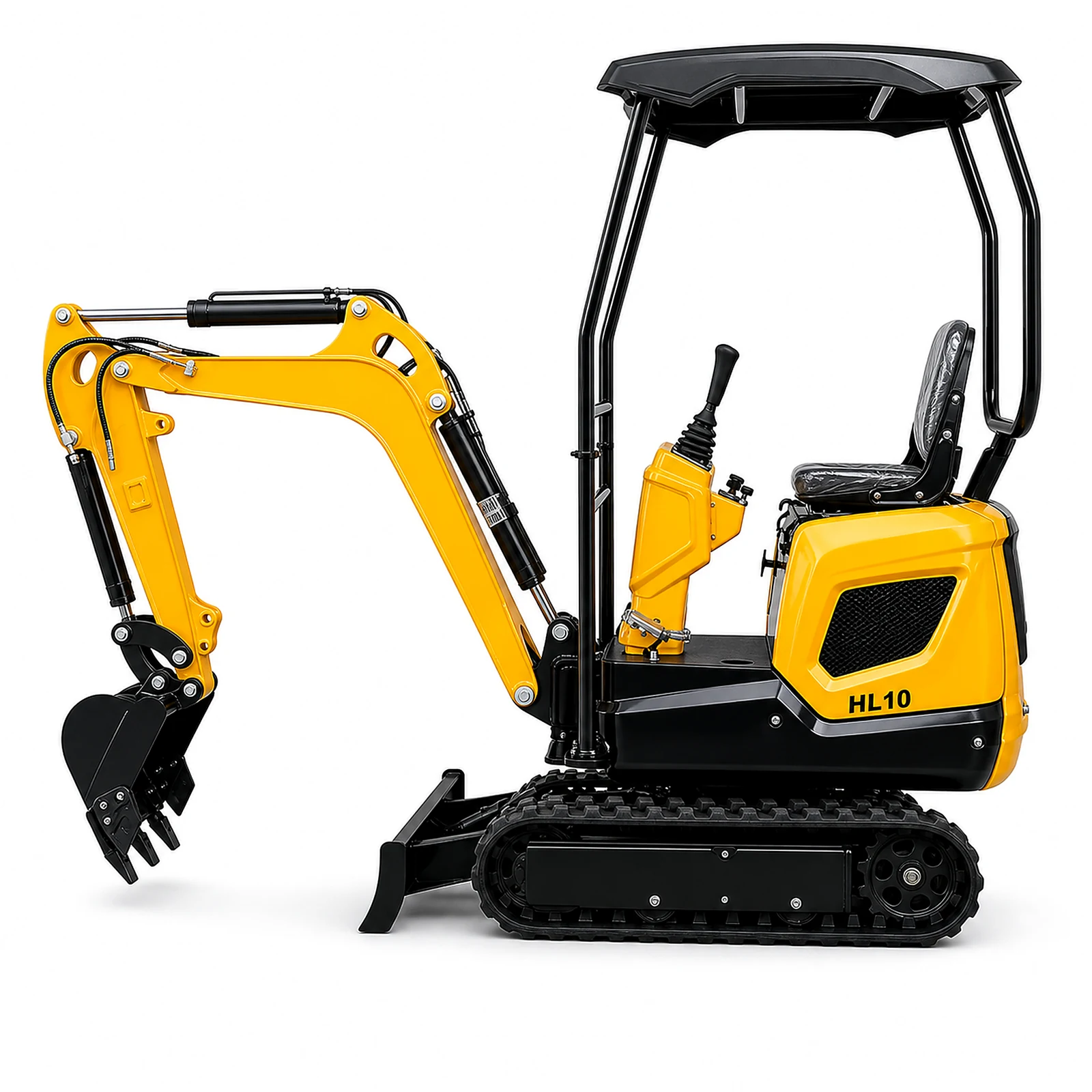
850 kg catalog operating weight · 935 mm overall width · 1,560 mm maximum digging depth · 0.018 m³ bucket
The Hongli HL10 is a micro excavator with a catalog operating weight of 850 kg and an overall width of 935 mm. It has a listed maximum digging depth of 1,560 mm, maximum digging radius of 3,172 mm and a 0.018 m³ bucket. Its catalog overall dimensions are 3,118 × 935 × 2,157 mm. Tai’an Hongli Machinery Equipment Co., Ltd. offers engine, enclosure and undercarriage choices that must be identified in the current quotation.
Send your narrowest clear opening, required excavation depth, destination country, preferred configuration and expected quantity. Request an HL10 access and configuration review before choosing a machine for a restricted site.
Access: The Specification That Decides Everything Else
For a buyer whose work is behind a narrow entrance, access deserves checking before a digging-depth comparison. A machine that cannot reach the working position will not solve the task, even if its catalog depth looks suitable. Once the route is feasible, check the actual excavation geometry and the space available to work.
Getting access right involves more than comparing one number with a gate width. Four checks matter: complete machine width, optional undercarriage dimensions, height along the route, and the space needed to rotate and use the attachment.
1. Overall width is the number that stops you at the gate
The HL10 catalog lists 935 mm overall width. Use that as an initial access figure, then request the actual width of the offered build in its travel arrangement. Include the blade, attachment and any projections that could determine the widest point.
The catalog’s 400 mm bucket is narrower than the listed machine width. That does not mean every attachment is narrower, or that a wider opening automatically gives adequate clearance. Measure the complete route, including gate hardware, bends and obstructions beyond the entrance.
For example, a hypothetical 1,000 mm opening leaves 65 mm of total nominal clearance around a 935 mm machine. That arithmetic is a first screening check, not approval to pass. Actual dimensions, alignment and route conditions still need review. Do not reserve all of the nominal difference for driving error or a projecting component.
2. Retracted width is what you actually order against
The HL10 catalog lists a telescopic undercarriage as an option. If that option is important to the route, request its retracted and expanded widths, blade arrangement and the complete machine dimensions in each relevant position.
The supplied catalog does not give both widths or establish that 935 mm is the minimum retracted setting. Do not substitute the 934 mm body-width entry for a retracted-track dimension. The configuration drawing should identify which measurement applies to access.
Ask for the operating instructions for the actual build as well. A narrow setting intended to help entry does not automatically establish the permitted working arrangement. We do not specify a safe digging or lifting envelope for retracted tracks without the corresponding manufacturer information.
3. Height governs indoor and covered work
Catalog overall height is 2,157 mm. Check the lowest opening along the route and the height of the delivered enclosure, rather than assuming the canopy and enclosed-cab options have identical dimensions.
Ramps, thresholds and changes in slope alter the machine’s position relative to overhead structures. Evaluate the route geometry rather than simply adding a ramp height to the catalog machine height. Photographing the opening and showing the approach can make the configuration review more useful.
Indoor access also needs a separate assessment of the surface’s load capacity, the work and engine exhaust. Passing through a doorway does not establish that an engine-powered excavator is suitable for operating inside that building.
4. Swing radius decides whether you can work once you are in
The catalog lists an 850 mm body swing radius and a 1,680 mm minimum swing radius. These are different labeled measurements. Neither should be interpreted from the 934 mm body width alone, and the figures do not establish a zero-tail-swing classification.
Request the rear swept envelope and the required boom-and-attachment clearance for the selected build. A backyard the machine can enter may still lack room to rotate, dig or place spoil. Our zero tail swing vs conventional mini excavator guide explains the separate clearance checks.
Putting it together
- Compare the narrowest opening on the route with the complete configured machine width.
- Check the lowest opening against the configured height and actual approach geometry.
- Check the working position against rear-body, boom, attachment and unloading clearance.
- Compare the required excavation geometry with the documented working envelope.
These checks help determine whether the HL10’s compact dimensions address the job. They also identify when another machine or a different work method needs consideration.
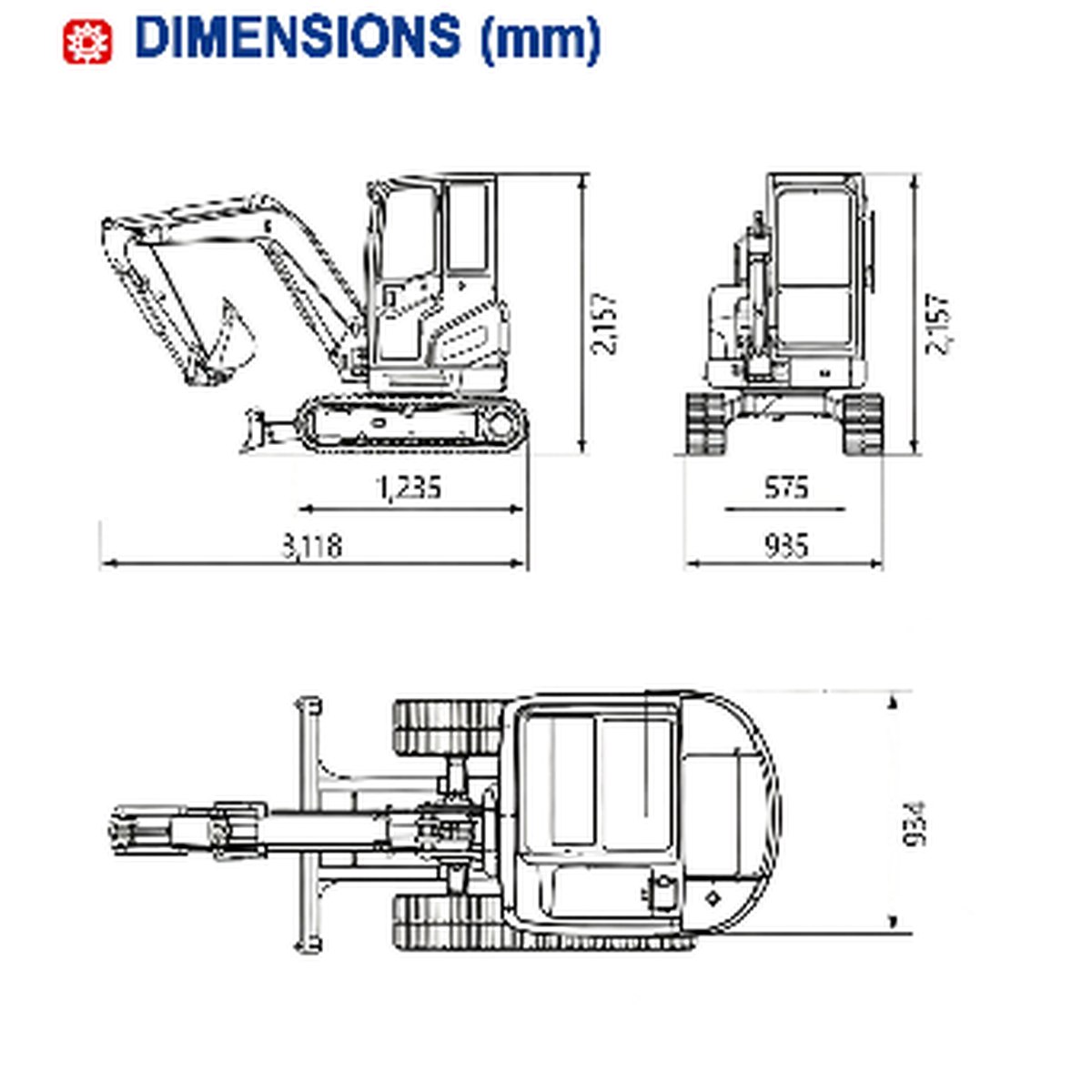
Full Technical Specifications
The following values come from the supplied HL10 catalog. Confirm the specification of the exact build, particularly optional undercarriage dimensions, enclosure height and transport weight.
| Specification | Catalog value |
|---|---|
| Model | HL10 |
| Operating weight | 0.85 t / 850 kg |
| Bucket capacity | 0.018 m³ |
| Bucket width | 400 mm |
| Overall length | 3,118 mm |
| Overall width | 935 mm |
| Overall height | 2,157 mm |
| Body width | 934 mm |
| Body swing radius, catalog label | 850 mm |
| Body rotation angle | 360° |
| Boom swing angle, left/right | 43° / 19° |
| Maximum digging radius | 3,172 mm |
| Maximum digging depth | 1,560 mm |
| Maximum digging height | 2,283 mm |
| Maximum unloading height | 1,698 mm |
| Minimum swing radius, catalog label | 1,680 mm |
| Maximum dozer-blade digging depth | 209 mm |
| Maximum dozer-blade lifting height | 153 mm |
| Track type | Rubber tracks |
| Individual track width | 180 mm |
| Track length | 1,235 mm |
| Fuel tank capacity | 6.6 L |
| Hydraulic tank capacity | 10.9 L |
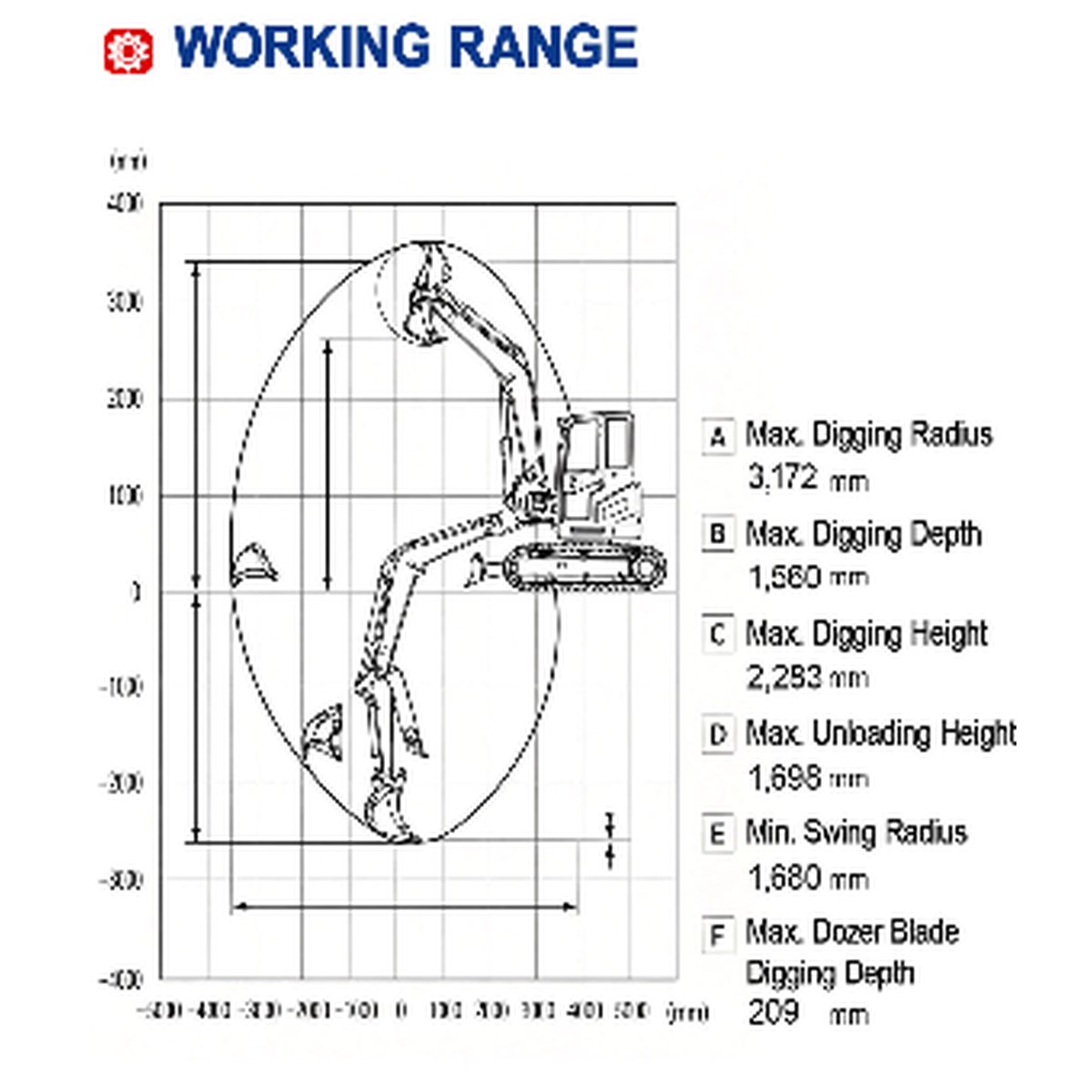
What the Working Numbers Mean on Site
1,560 mm maximum digging depth: Compare this with the actual task rather than a universal trench-depth allowance. The documents do not provide vertical-wall digging depth. A foundation-side trench or a specified wall profile needs checking at the required horizontal offset. Burial requirements depend on the project and location; the catalog does not establish a universal depth for drainage, utilities or frost protection.
3,172 mm maximum digging radius: This describes a working-envelope limit. It is not a guarantee of reaching that distance at maximum depth or maximum unloading height. Show the machine position, excavation and spoil location when requesting a task review.
43° / 19° boom swing: The listed angles are asymmetric. If working beside a boundary depends on one direction, confirm the left/right orientation and the equipment offered. Boom swing does not establish rear clearance or guarantee that every wall-side trench is feasible.
0.018 m³ bucket and 400 mm width: These describe the catalog tool. Match its cutting profile and interface to the trench and material. Bucket volume alone does not establish digging force or output per hour. Our bucket compatibility guide explains the checks for alternative tools.
180 mm track width and 1,235 mm track length: These are catalog dimensions. Track length is not a supplied measurement of actual ground-contact length, so multiplying them does not establish ground pressure. Rubber tracks also do not guarantee damage-free passage over turf or finished surfaces.
209 mm blade digging depth and 153 mm lifting height: These describe blade movement. They are not lifting-capacity ratings or a guarantee of completing every backfilling task.
6.6 L fuel tank: Tank capacity does not provide an hourly fuel-consumption figure or establish the length of a shift between refueling stops. Obtain application-specific operating information if fuel planning is material to your purchase.
Who This Machine Suits
The HL10 is worth assessing for landscaping, planting, irrigation and maintenance tasks where its narrow dimensions solve a measured access constraint and its working envelope suits the excavation.
Property owners and smallholdings can compare it for occasional excavation, but should check transport arrangements, operator training and the actual job rather than assume the small size makes towing or operating unrestricted. Rental fleets need the same checks for the intended customers and applications.
Interior renovation is a separate case. Confirm structural loading, ventilation and equipment suitability for the work before treating compact dimensions as permission to operate inside a building.
Where a larger machine is the better buy
If the required task falls outside the HL10’s verified geometry, or access is generous and a different size better suits the work, consider another model. We do not set an unsupported fixed “comfortable digging depth” below its catalog maximum or claim that all tasks within that depth are feasible.
The HL18 catalog lists 1.4 tonnes, 1,100 mm overall width, a 0.04 m³ bucket and 2,258 mm maximum digging depth. It is 165 mm wider than the HL10 and has a different working envelope. These figures support a site comparison; they do not prove a production-rate or lifting-capacity advantage.
Buy the HL10 when its access dimensions solve your constraint and the task fits. If access is not the constraint, compare the work before paying for a compact configuration whose benefit you may not need. The mini excavator size chart provides the broader measurement framework.
Options Worth Specifying
Telescopic undercarriage: Investigate this option when access requires it. Request both width settings and the operating instructions before using the option in a site plan.
Engine: The existing product information describes Koop and Kubota choices, while the catalog cover identifies Kubota and lists Koop among its options. The current quotation should identify the exact engine offered. Request rated speed and the power definition when comparing power, and the applicable destination documentation rather than assuming compliance from a brand. Our engine buying checklist explains what to request.
Enclosed cab and air conditioning: Confirm availability, installed height and weight, and the equipment included. The catalog option list does not establish a particular protective certification or prove that every enclosure has the same dimensions.
Rubber or steel tracks: Describe the working surface and request the appropriate configuration. Rubber tracks can still mark or disturb a surface. Do not choose either track type on an unconditional damage claim.
Coupler, controls and powered attachments: The catalog lists hydraulic quick-coupler and pilot-control options. Confirm the actual equipment and attachment interface. A powered tool also needs available flow, pressure and return arrangements matched to its requirements; a 10.9 L hydraulic tank does not establish those ratings.
Emission Compliance
Tell us the destination and intended use, then request the applicable documents for the exact engine and machine configuration. Engine identity, version and supporting documentation must agree with the quotation. A brand name or a canopy photograph does not establish regulatory compliance.
Our engine buying checklist is a starting point for that document request. We do not label every base configuration as compliant or noncompliant without the relevant evidence.
Frequently Asked Questions
Will the HL10 fit through a garden gate?
Its catalog width is 935 mm. Measure the complete clear route and obtain the actual configured width, with adequate passage clearance. The documents do not provide a minimum width for the optional telescopic undercarriage.
How deep can the HL10 dig?
The catalog maximum is 1,560 mm. That is not a supplied vertical-wall digging-depth figure or proof of reaching the maximum radius at that depth. Compare the required trench geometry with the selected build.
Can the HL10 work inside a building?
The listed height is 2,157 mm and width is 935 mm. Entry, working clearance, structural loading, engine exhaust and equipment suitability need separate assessment. Confirm the height of the offered enclosure.
Will it damage a lawn?
Rubber tracks do not guarantee damage-free operation. Surface condition, machine movement and loading matter. No tested ground-pressure or turf-damage result is supplied here.
What engine does it have?
Koop and Kubota choices appear in the available product information. Request the exact engine included in the current quotation and its supporting documents; do not assume all builds share a standard engine.
Is 850 kg the weight I should use for trailer loading?
It is the catalog operating weight. Obtain the configured machine’s transport weight and include tools and other equipment carried with it. Confirm your complete loading arrangement before choosing a trailer.
Tell Us the Access Route and the Task
Send Tai’an Hongli Machinery Equipment Co., Ltd. your access width and height, route photographs, excavation geometry, surface conditions, intended attachments, preferred engine and enclosure, transport arrangement, destination country and expected quantity.
Request an HL10 configuration and quotation, email hongli@hongli-mach.com, or contact WhatsApp +86 131 0548 1184. We can review the proposed configuration against those constraints, including identifying when another model is a better fit.
About the Author
Avicii Meng, Head of Technical Engineering | Hongli Machinery
Avicii Meng works with Tai’an Hongli Machinery Equipment Co., Ltd. on machinery configuration information and buyer guidance. Contact the Hongli team for order-specific dimensions, equipment and documents.