
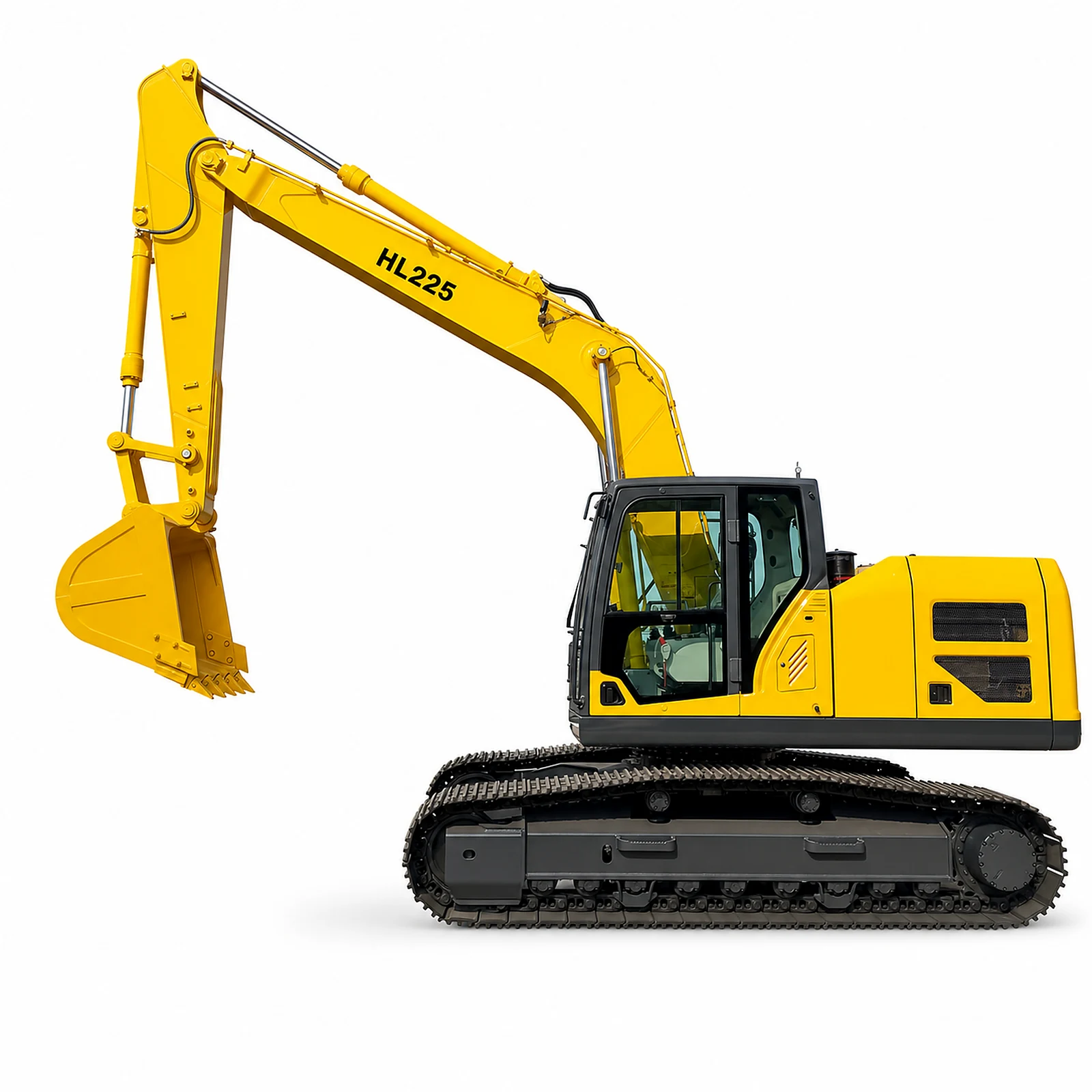
Reference catalog configuration — bucket capacity: 1.1 m³ | Maximum vertical-wall digging depth: 5,925 mm | Maximum digging depth: 6,480 mm | Overall width: 2,980 mm
The Hongli HL225 is a medium excavator offered by Tai’an Hongli Machinery Equipment Co., Ltd. Its reference catalog lists a 1.1 m³ bucket, 2,980 mm overall width, 6,480 mm maximum digging depth and a separately stated 5,925 mm maximum vertical-wall digging depth. The supplied catalog does not state operating weight. Confirm the actual machine mass and exact engine specification in the quotation before committing to transport or a configuration-dependent purchase; the HL225 name does not establish a 22.5-tonne weight.
Send your destination country, excavation depth and wall profile, machine setback, material, loading position, transport constraints and expected quantity. Ask Hongli to assess the HL225 for your project.
Maximum Digging Depth Does Not Describe a Full Vertical Cut
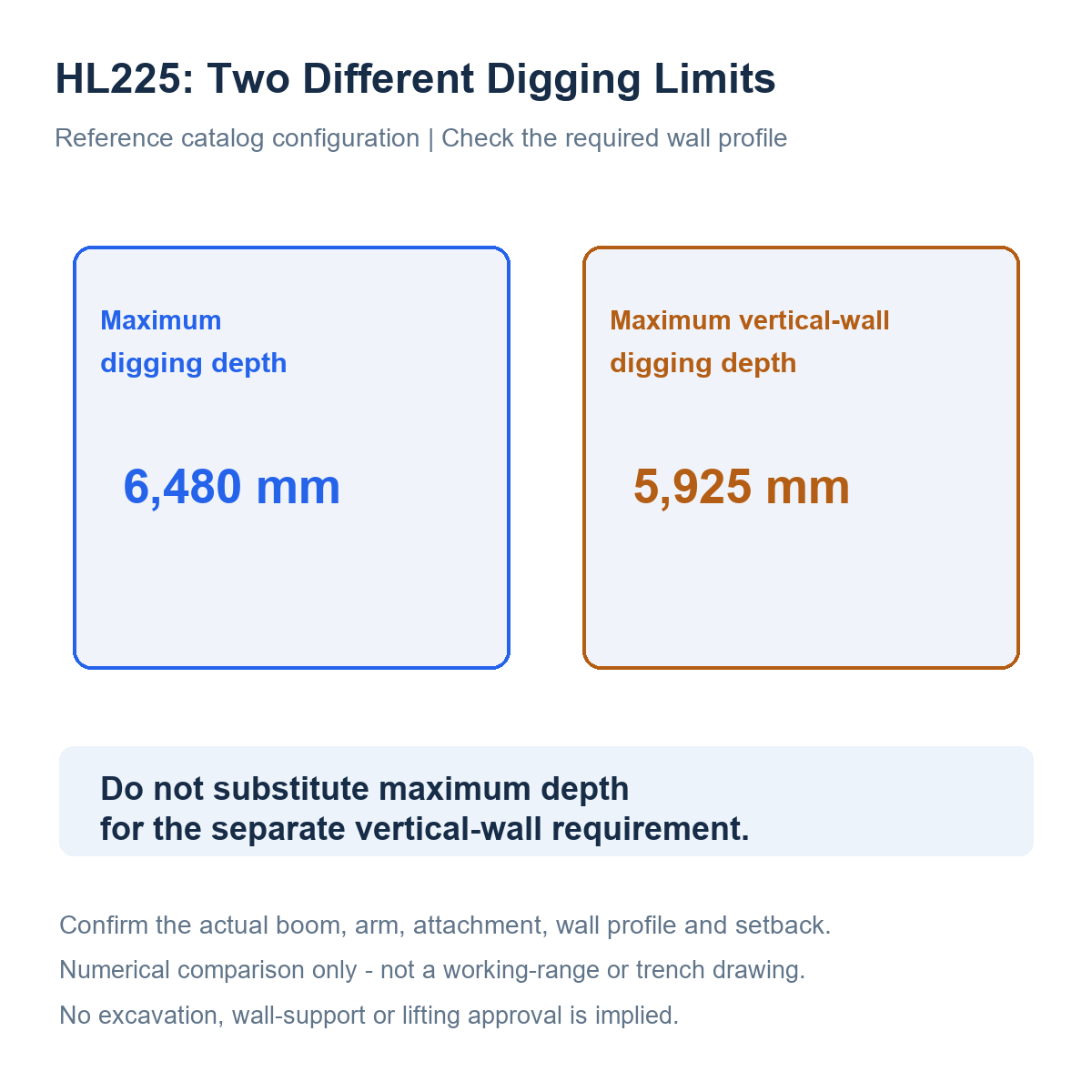
The two digging-depth entries answer different questions. The 6,480 mm maximum indicates a depth boundary in the reference working envelope. The 5,925 mm vertical-wall figure describes a separate catalog limit relevant to the shape of an excavation. They must not be treated as interchangeable.
If a specification calls for a vertical wall, selecting the machine from maximum depth alone can miss the actual requirement. Provide the required wall profile and where the excavator can stand. Then check the working-range drawing for the proposed front end, bucket and machine position.
For example, a requirement beyond the listed vertical-wall limit cannot be approved simply because it remains below the maximum digging-depth figure. Nor does a requirement below 5,925 mm automatically fit: the actual setback, attachment and available movement still need confirmation. These catalog dimensions do not establish an excavation support design or permission to leave a wall unsupported.
This gives the HL225 a specific place in the selection conversation. It is worth assessing for projects where the required wall profile makes vertical digging geometry a deciding factor, rather than choosing by bucket volume or an assumed weight class. The listed vertical-wall value provides a starting reference to verify, not a guarantee for every position.
Request one consistent configuration record. A different boom, arm, bucket or coupler should be assessed using the corresponding working-range information, not by carrying the reference 5,925 mm value into another front-end arrangement.
When the HL225 Is Worth Assessing
Assess the HL225 when the job requires a defined wall profile and the reference vertical-wall depth merits a detailed geometry check. It is also a candidate when the proposed work needs a 1.1 m³ bucket reference or a loading position within the confirmed envelope, and the site can accommodate the actual machine.
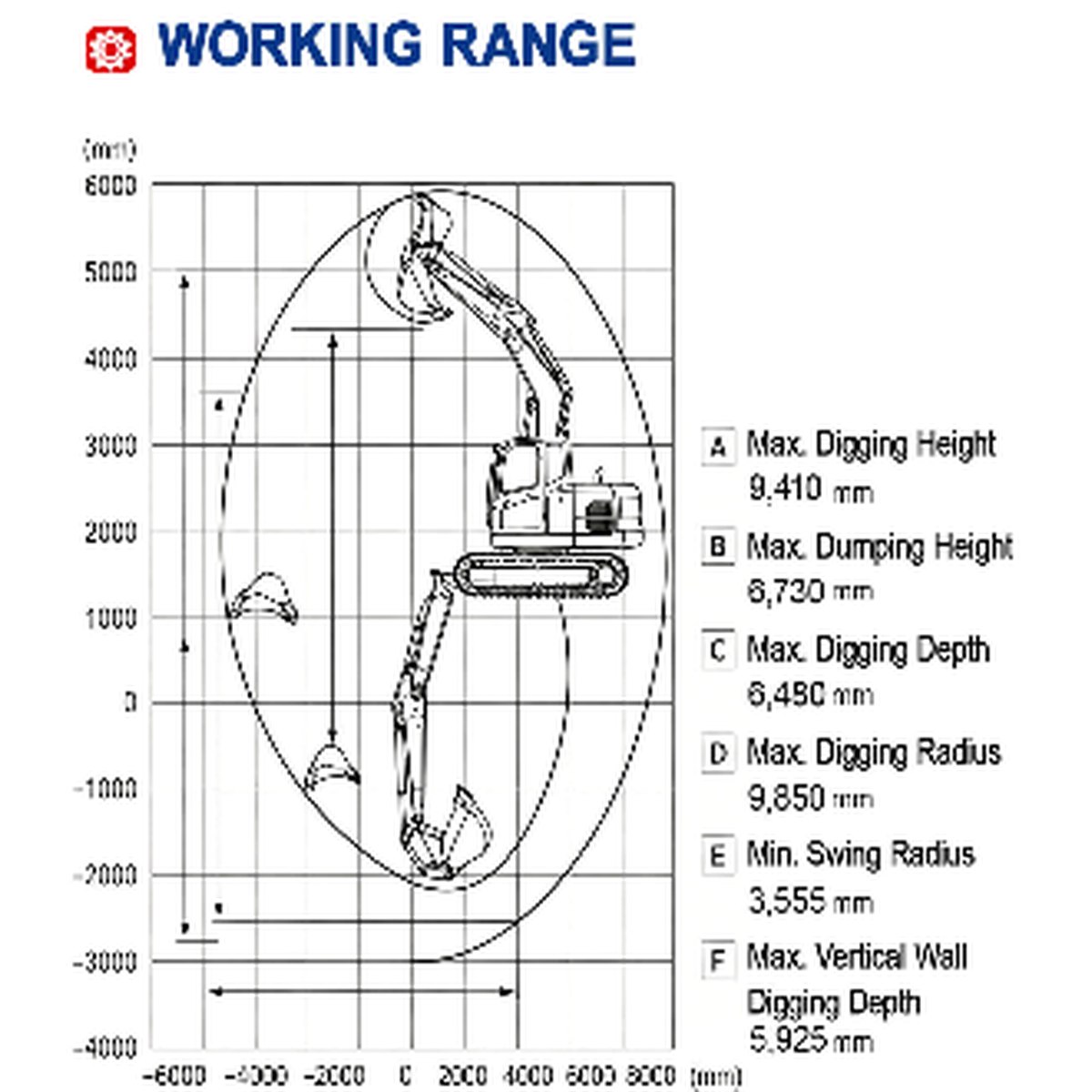
For vehicle loading, the catalog lists 6,730 mm maximum dumping height. Compare the required discharge point and machine location, not just the height of the truck side. Maximum height and maximum radius are separate boundaries.
Do not select it as a presumed intermediate weight step between the HL200 and HL260. The model number and bucket size do not supply the missing operating weight. Obtain the mass of the quoted configuration and its definition before making a transport-based comparison.
Do not choose it if a narrower model already covers the job and the additional width offers no necessary benefit. The HL225 reference width is 2,980 mm, compared with 2,780 mm for the HL200. A reference dimension is not a route-access or transport approval.
If the decision depends on lifting objects, hourly production or continuous powered-attachment duty, obtain the relevant configuration-specific evidence. The available catalog figures alone do not approve those requirements. A different machine or front-end arrangement may be more appropriate.
HL225 Reference Specifications
The table keeps the supplied catalog’s distinct measurements separate. Values apply to its reference specification and must be confirmed for the actual quoted build.
| Item | Catalog reference | Purchasing interpretation |
|---|---|---|
| Model | HL225 | Model digits are not an operating-weight specification |
| Operating weight | Not stated | Obtain actual configuration mass and weight definition |
| Bucket capacity | 1.1 m³ | Volume, not payload or production |
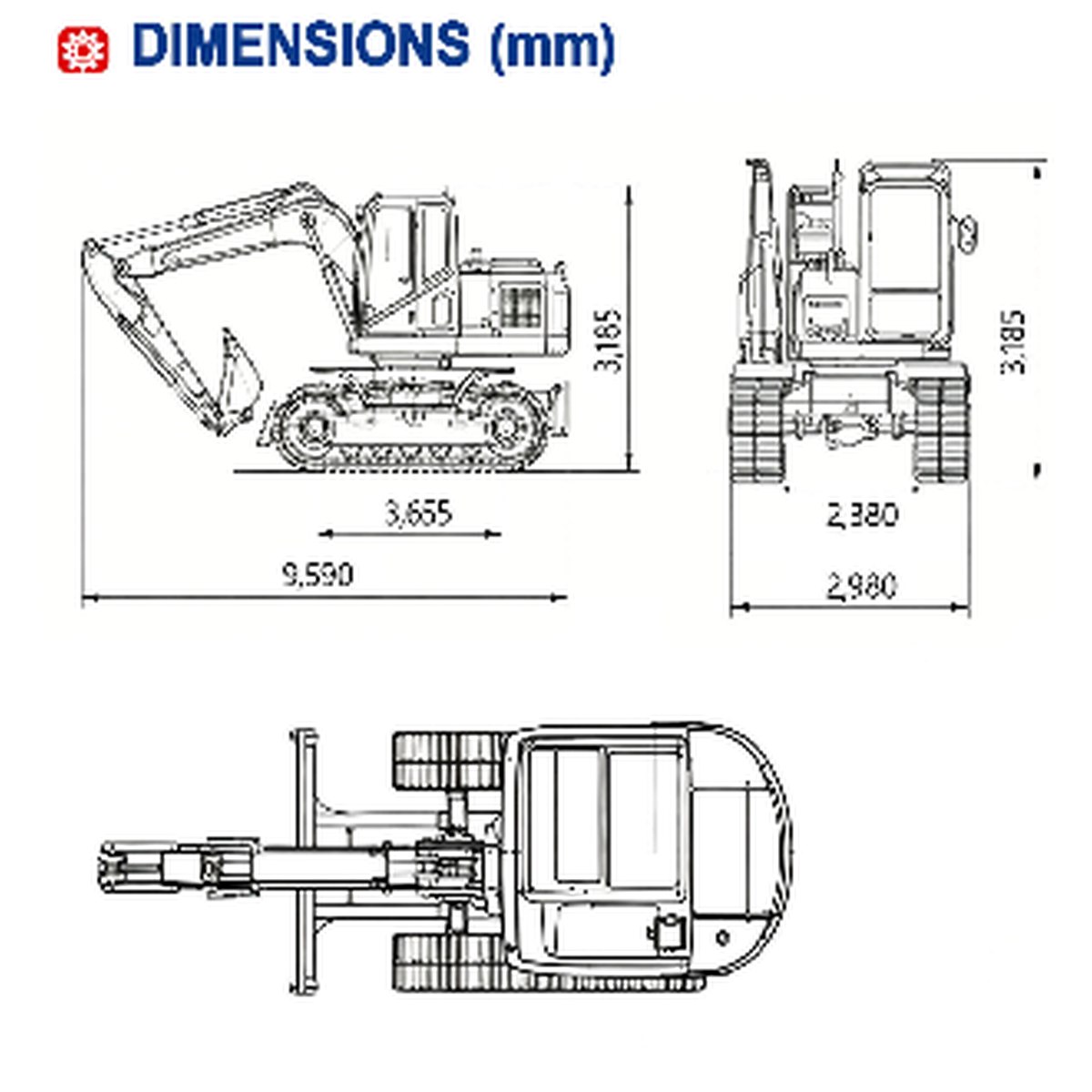
| Overall dimensions, length × width × height | 9,590 × 2,980 × 3,185 mm | Confirm the actual transport position and attachment |
| Cab height | 3,060 mm | Separate from the listed overall height |
| Maximum digging height | 9,410 mm | Working-envelope boundary, not lifting capacity |
| Maximum dumping height | 6,730 mm | Confirm the actual discharge position |
| Maximum digging depth | 6,480 mm | Different from vertical-wall depth |
| Maximum vertical-wall digging depth | 5,925 mm | Confirm wall profile, setback and front end |
| Maximum digging radius | 9,850 mm | Not simultaneous with every other maximum |
| Minimum swing radius | 3,555 mm | Different measurement from tail swing radius |
| Tail swing radius | 2,880 mm | Check rear clearance for the actual configuration |
| Maximum bucket digging force | 140 kN | Not a lifting rating |
| Maximum arm digging force | 99 kN | Separate digging action; do not add to bucket force |
| System pressure | 34 MPa | Does not specify auxiliary attachment flow or complete circuit suitability |
| Swing speed | 11–13 rpm | Does not establish a complete excavation cycle time |
| Minimum ground clearance | 470 mm | Does not approve a ramp or obstacle |
The supplied information does not establish a complete engine variant, operating weight, bucket width or attachment-flow specification. Obtain those details for an order that depends on them. The catalog dimension drawing and the tabulated overall-height entry also carry different height labels; obtain the confirmed drawing and measured envelope of the quoted build for clearance-critical planning.
Check the Entire Loading and Swing Position
The reference 6,730 mm dumping height and 9,850 mm digging radius do not describe one simultaneously available position. Give us the receiving-vehicle geometry, required discharge point and available machine setback. Include the selected bucket and coupler in the review.
A higher maximum than the truck side does not prove a practical bucket path over that side. Confirm useful clearance at the required reach, together with where the machine can stand. The same approach applies to excavation beside an obstruction: check the movement, not just the endpoint.
The catalog separately lists a 2,880 mm tail swing radius and 3,555 mm minimum swing radius. They are not interchangeable measurements. Neither entry alone establishes all the space needed to operate beside a wall or vehicle. Request the relevant drawing and check the full rotating outline of the actual machine.
If the front end or attachment changes, obtain the corresponding geometry. A reference drawing does not establish the working envelope or lifting capacity of an extended configuration.
Bucket Capacity, Digging Forces and Hydraulic Pressure Are Not One Capability Rating
The 1.1 m³ bucket reference identifies volume. Actual material mass depends on density and fill, while bucket and coupler mass add their own configuration requirements. The listed capacity does not establish a permitted payload or a production rate.
The 140 kN bucket and 99 kN arm entries describe separate digging actions. Do not add them together, convert them into an approved suspended load or use them as a substitute for the applicable lifting information.
System pressure is another separate entry. The 34 MPa reference does not identify auxiliary flow, return-pressure requirements, control mode or the permitted duty for a breaker, auger or other attachment. Confirm the actual attachment circuit and the tool’s requirements before ordering.
For buckets, obtain the connection type, mounting dimensions, attachment mass and suitability for the actual front end and material. The catalog does not provide bucket width, so this page does not infer one from the 1.1 m³ volume. The bucket compatibility checklist explains the mechanical interface measurements; matching those measurements is only part of the complete assessment.
Confirm the Engine, Options and Transport Package
The catalog identifies Cummins as an engine brand, but does not establish the exact model, rated power with speed and definition, or destination-market emissions documents. Request the actual engine identification, label photographs and applicable records. Use the engine buying checklist to organize that request rather than inferring compliance from a brand name.
The catalog lists a quick coupler, breaker piping, auxiliary hydraulic circuit, rubber track pads, extended boom and/or arm, and buckets in various capacities as options. The quotation should state which equipment is included and identify the configuration to which its dimensions and working range apply.
For transport, obtain the actual machine mass and what it includes, the external dimensions in the agreed position, and any separate attachment or packing-unit masses. Do not add an included bucket twice. Operating weight, loaded transport mass and packed shipping gross mass answer different questions.
The listed overall height is 3,185 mm, while cab height is 3,060 mm. Do not substitute cab height for the complete reference envelope. The actual boom position, attachment and fitted equipment must be included when measuring for transport.
Trailer gross rating is not usable payload. The carrier, axles, route and complete load need their own review. Catalog dimensions alone do not approve a trailer, container, loading ramp or securing plan, and the missing machine mass cannot be reconstructed from the model number.
HL225 Compared With HL200 and HL260
The HL200 catalog lists a 1.0 m³ bucket, 2,780 mm overall width and 6,515 mm maximum digging depth. The HL225 reference bucket is larger, but its listed maximum digging depth is 35 mm less. A larger model number or bucket volume therefore does not establish deeper digging.
The HL225’s listed maximum dumping height is 6,730 mm, compared with the HL200’s 6,580 mm. That difference is a reference-envelope comparison, not proof of better truck loading. The HL225 catalog also provides a vertical-wall depth entry that is not separately stated in the supplied HL200 sheet; this does not establish that the HL200 lacks vertical-wall capability. Request comparable working information for the actual task.
The HL260 lists 24 t operating weight, a 1.2 m³ bucket, 2,980 mm width and 6,875 mm maximum digging depth. Its reference width matches the HL225’s listed width, but that does not establish equal mass, rear clearance or transport requirements. The HL225’s operating weight remains to be confirmed.
Assess the HL225 when its confirmed wall-profile geometry, loading position and attachment meet the job. If the HL200 already covers the task, or another front end is required, establish that before choosing by bucket size. The size-selection guide provides a general method; the final choice requires the actual model and configuration records.
Frequently Asked Questions
Does HL225 mean a 22.5-tonne excavator?
The supplied catalog does not state operating weight. Obtain the weight and definition for the actual quoted machine; do not infer it from the model digits or bucket capacity.
Is 6,480 mm also the vertical-wall digging depth?
No. The catalog separately lists 5,925 mm maximum vertical-wall depth. Confirm the required wall profile, machine setback and front end; neither number alone approves the excavation.
Does the HL225 dig deeper than the HL200?
The reference maximum depths are 6,480 mm for HL225 and 6,515 mm for HL200. Those maximum values do not establish which configuration suits a specific wall profile or working position.
Can I add the 140 kN bucket force and 99 kN arm force?
No. They describe different digging actions, not a combined capability rating. Neither is an approved lifting load.
Does 34 MPa establish breaker compatibility?
No. Confirm the actual auxiliary supply and return conditions, flow, pressure, controls and permitted duty against the breaker’s requirements. A system-pressure entry is insufficient.
What must be confirmed before booking transport?
Obtain the actual machine and cargo masses, their definitions, transport position and external dimensions. For shipping, obtain the packing plan and gross mass. Do not substitute cab height for overall height or model digits for weight.
Request an HL225 Configuration Review
- Destination country and delivery location.
- Material, excavation depth and required wall profile.
- Machine setback, access and rear-clearance constraints.
- Receiving-vehicle geometry and discharge point.
- Boom, arm, bucket, coupler and powered attachments.
- Transport constraints and required weight documentation.
- Engine-document requirements, intended use and expected quantity.
Send your HL225 requirements to Hongli. Tai’an Hongli Machinery Equipment Co., Ltd. can review the reference information and identify the evidence needed for the proposed build. Resolve the actual operating weight, engine specification and task-critical geometry before committing to the order or transport arrangement.
About the Author
Avicii Meng, Head of Technical Engineering | Hongli Machinery
Avicii Meng works with Tai’an Hongli Machinery Equipment Co., Ltd. on export equipment configurations and technical purchasing questions for international buyers.