
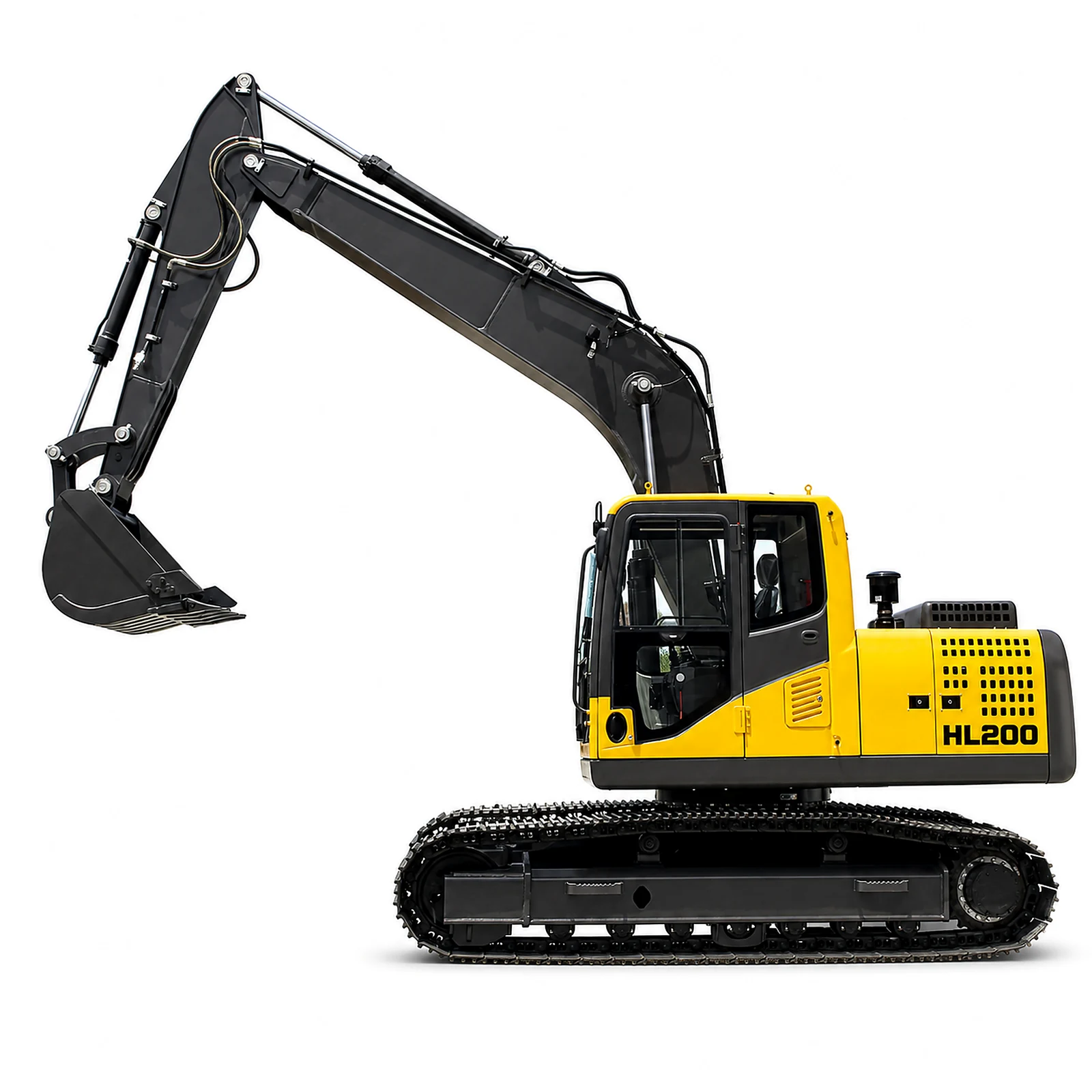
Reference catalog configuration — operating weight: 21.8 t | Bucket capacity: 1.0 m³ | Overall width: 2,780 mm | Maximum digging depth: 6,515 mm | Maximum dumping height: 6,580 mm
The Hongli HL200 is a medium excavator offered by Tai’an Hongli Machinery Equipment Co., Ltd. Its reference catalog lists 21.8 tonnes operating weight, a 1.0 m³ bucket, 2,780 mm overall width and 6,515 mm maximum digging depth. Maximum dumping height is 6,580 mm. The reference boom is 5,700 mm long and the arm is 2,900 mm. Confirm that the quoted boom, arm, bucket and equipment match these figures; the model designation does not mean a 20-tonne operating weight.
Send your destination country, material, excavation requirements, receiving-vehicle geometry, machine position, transport constraints and expected quantity. Ask Hongli to assess the HL200 for your work.
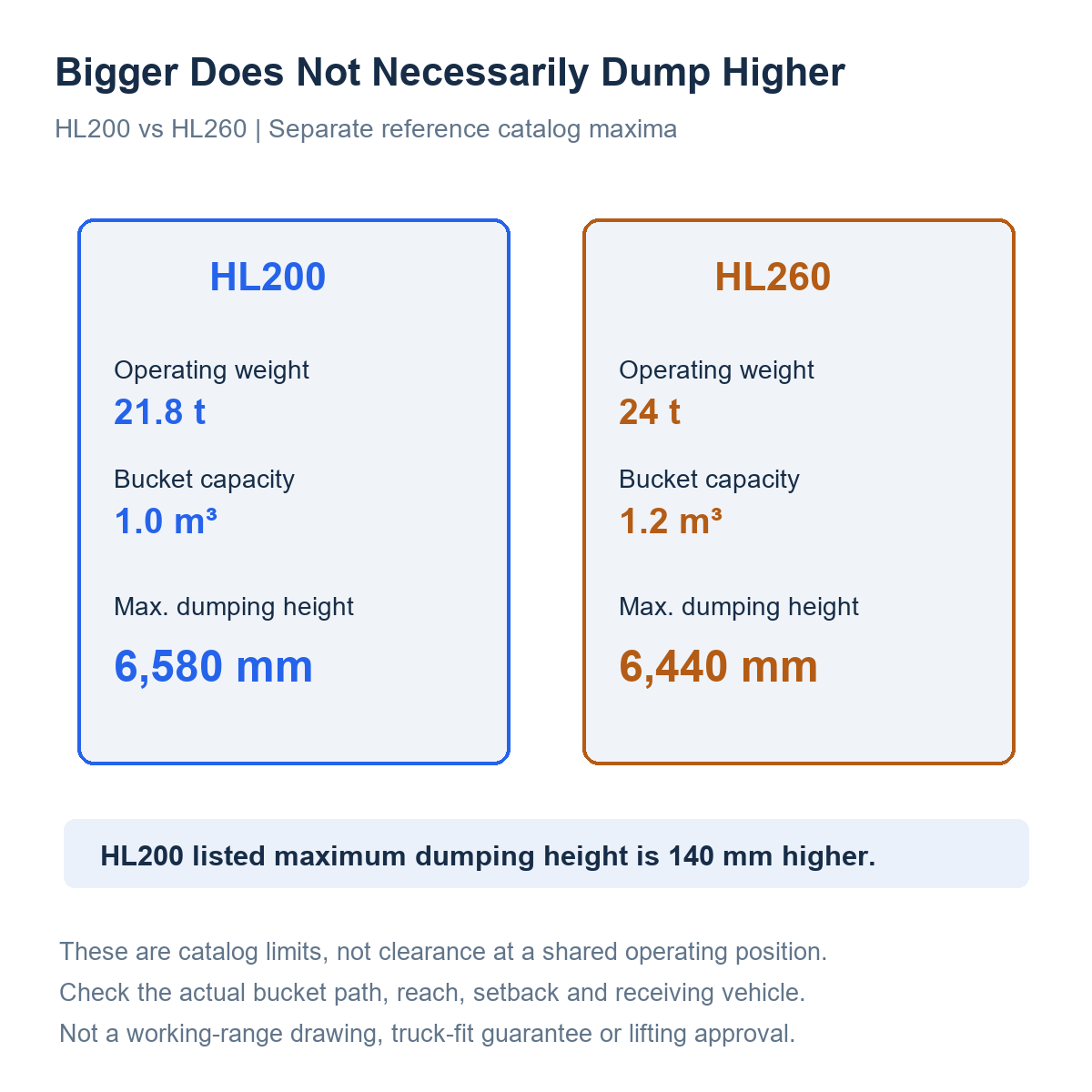
A Larger Excavator Does Not Necessarily Dump Higher
The HL200 catalog lists a 6,580 mm maximum dumping height. The larger HL260 reference lists 24 t operating weight and a 1.2 m³ bucket, but its listed maximum dumping height is 6,440 mm. The HL200’s reference maximum is therefore 140 mm higher despite its lower operating weight and smaller bucket.
That does not establish that the HL200 loads a particular truck better. It shows why choosing by machine size alone can miss the dimension that matters. Maximum dumping height is one boundary of the reference working envelope, not clearance available at every reach or bucket position.
For an actual loading task, identify the top of the receiving side, the required discharge point, the space between machine and vehicle, and where the excavator can stand. Include the selected bucket and coupler. Check the bucket path at that position rather than comparing truck height with one maximum figure.
The HL200’s 9,865 mm maximum digging radius is a different limit. Do not assume it can also dump at 6,580 mm while operating at that maximum radius. Nor should the HL260’s longer listed reach be treated as proof of a higher discharge point.
This is a useful buying reason for the HL200: investigate whether its confirmed loading geometry meets the project before accepting the larger HL260’s additional mass and width. If the HL200 cannot meet the required position, the higher maximum on a specification table does not rescue the choice. The complete working position must fit.
When the HL200 Is Worth Assessing
Consider the HL200 when the HL135’s reference envelope does not meet the project and the HL200’s 6,515 mm maximum digging depth or loading geometry merits review. The HL135 lists 5,500 mm maximum digging depth. These are initial screening values, not guaranteed vertical-wall depths or proof that every excavation at those depths is reachable from your available setback.
The HL200 is also worth investigating when a 1.0 m³ reference bucket suits the material and handling task, while a larger machine would add unnecessary access or transport demands. Ask for the actual bucket mass, cutting width, connection and suitability for the proposed front end.
Do not choose the HL200 merely because the material-handling target is expressed as cubic metres per hour. Bucket capacity does not establish fill, cycle time, vehicle positioning or production. Give us the material, excavation profile and loading arrangement before asking for a duty assessment.
Do not select it if the actual width, weight or transport configuration cannot be accommodated. Its reference 2,780 mm width and 21.8 t operating weight are machine specifications, not a road-access, trailer or site-bearing approval.
If the HL135 already covers the required work, assess it before accepting the HL200’s additional dimensions and mass. If lifting objects is part of the job, obtain the applicable lifting information and approved equipment for the actual configuration; a digging-force entry cannot answer that question.
HL200 Reference Specifications
The values below follow the supplied English catalog. They describe a reference configuration to confirm against the quoted boom, arm, bucket and equipment.
| Item | Catalog reference | Purchasing interpretation |
|---|---|---|
| Model | HL200 | Model digits are not operating weight |
| Operating weight | 21.8 t / 21,800 kg | Confirm included equipment and loaded transport mass |
| Bucket capacity | 1.0 m³ | Volume, not payload or hourly output |
| Boom length | 5,700 mm | Reference front-end arrangement |
| Arm length | 2,900 mm | Obtain new geometry for another arm |
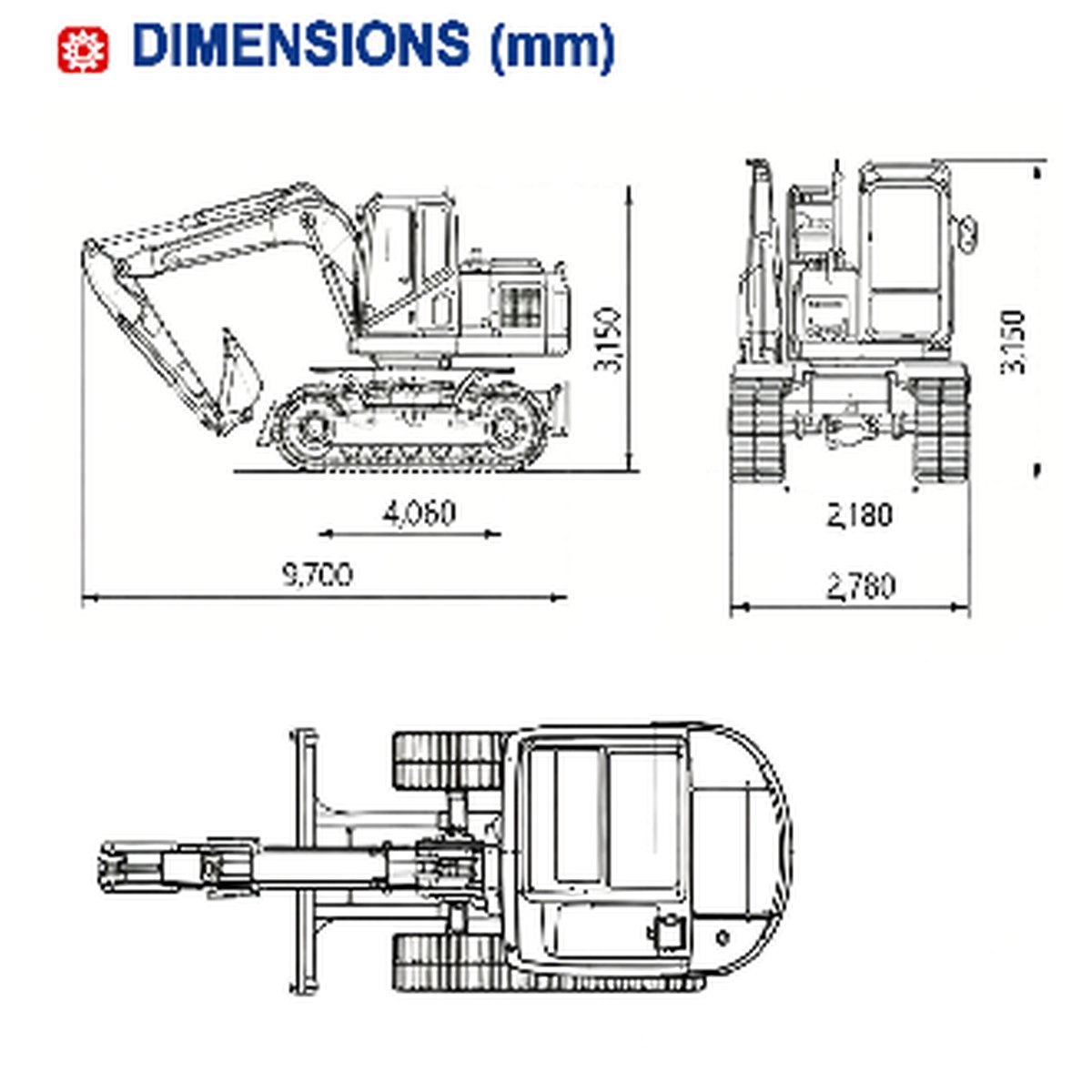
| Overall length | 9,700 mm | Confirm the agreed transport position and attachment |
| Overall width | 2,780 mm | Check the complete machine and route |
| Height to top of boom | 3,150 mm | Separate from cab height |
| Height to top of cab | 2,970 mm | Not the sole overhead-clearance dimension |
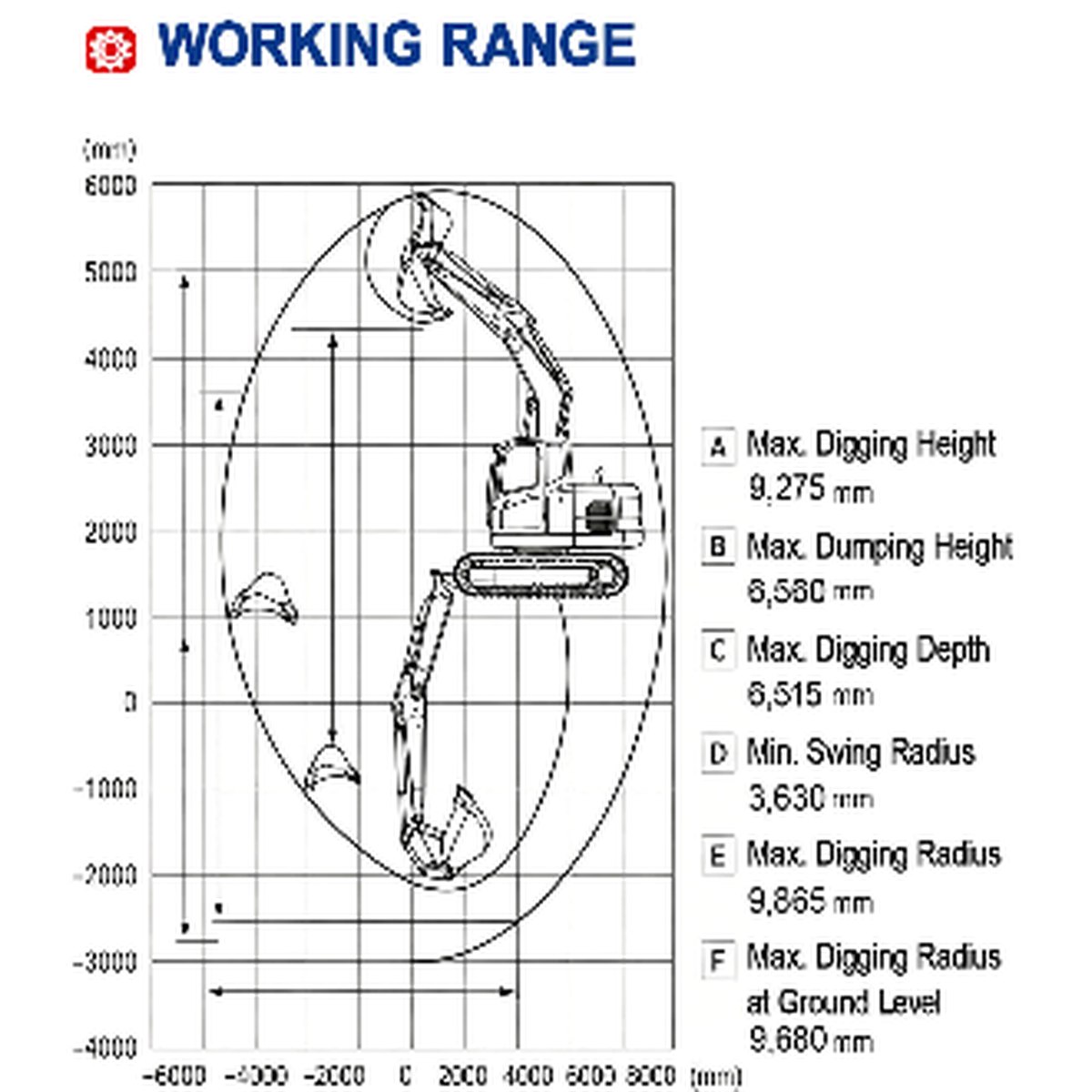
| Maximum digging height | 9,275 mm | Working-envelope boundary, not lifting capacity |
| Maximum dumping height | 6,580 mm | Verify the actual bucket path and receiving vehicle |
| Maximum digging depth | 6,515 mm | Not a specified vertical-wall digging depth |
| Maximum digging radius | 9,865 mm | Separate from the ground-level radius |
| Maximum digging radius at ground level | 9,680 mm | Confirm the relevant task and attachment |
| Minimum swing radius | 3,630 mm | Catalog label, not a complete clearance envelope |
| Maximum bucket digging force | 157 kN | Not an approved suspended load |
| Travel speed | 5.2 / 3.5 km/h | Reference values, not route travel-time promises |
| Swing speed | 11.5 rpm | Does not establish a complete excavation cycle |
| Fuel tank capacity | 420 L | Not fuel consumption or working hours |
| Hydraulic oil tank capacity | 246 L | Not total system oil volume or attachment flow |
| Catalog ground pressure | 46.5 kPa | Reference value, not a site-bearing assessment |
| Minimum ground clearance | 466 mm | Does not approve a loading ramp or obstacle |
The catalog also lists 70% gradeability. It is not 70 degrees and is not presented here as a safe working-slope or loading-ramp limit. Use the actual operating instructions and site assessment.
Bucket Volume and Digging Force Answer Different Questions
The 1.0 m³ bucket reference describes volume. The 157 kN entry describes maximum bucket digging force. Neither establishes how much material the machine can safely carry or lift at a particular working position.
Material density and resistance, bucket shape, actual fill and the attachment’s mass all matter. A bucket that physically fits the connection is not automatically suitable for every material or front-end arrangement. Confirm the bucket and coupler as part of the complete configuration.
The HL260 reference has a 1.2 m³ bucket and 172 kN maximum bucket digging force. Those different figures do not support a proportional production claim. A bigger bucket may be useful for a particular duty, but it does not establish that the machine will fill it effectively or complete the truck-loading cycle faster.
If the finished excavation requires a particular width or profile, request the approved bucket that suits it. The HL200 catalog does not provide a bucket-width value, so this page does not invent one from capacity. Our bucket compatibility checklist covers the mechanical interface information to obtain.
For a breaker, auger or other powered attachment, request the actual auxiliary flow, pressure, return arrangement and controls. The 246 L hydraulic oil tank does not establish any of those circuit requirements.
Match the Working Envelope to the Ordered Front End
The reference 5,700 mm boom and 2,900 mm arm belong with the listed working range. The catalog offers an extended boom and/or arm, but that option needs its own working-range drawing, mass, transport envelope and applicable load information. Do not attach its reach claim to an otherwise unchanged reference specification.
The same applies to a different bucket or coupler. Include the actual attachment when checking loading clearance and excavation geometry. The reference maximum digging radius of 9,865 mm and ground-level radius of 9,680 mm are separate measurements, not interchangeable promises of useful reach at any depth.
For trench work beside a structure, define the wall profile and machine setback. The maximum digging-depth number alone does not establish a vertical wall of the same depth. For loading, define the discharge point and machine position rather than relying on maximum height alone.
Ask for a configuration-specific drawing when the job depends on one of these boundaries. A reference working-range drawing is not a lifting chart or proof of production.
Confirm the Complete Transport Envelope
The reference overall length is 9,700 mm. Obtain the actual external dimensions in the agreed transport position, including the selected attachment and equipment, before requesting a carrier or shipment quotation.
Height deserves its own check: the catalog lists 3,150 mm to the top of the boom and 2,970 mm to the top of the cab. Cab height alone therefore does not cover the reference machine. Confirm the complete envelope in the position that will actually be transported.
Establish what the 21,800 kg operating weight includes before adding loose attachments or other cargo. Do not count an item twice if it is already included in a measured machine mass. Packed shipping gross mass may differ from a machine prepared for local transport.
Trailer gross rating and usable payload are different limits. The actual carrier, axle and route requirements must be reviewed for the complete load. Catalog dimensions and operating weight do not independently approve a trailer, container, ramp or securing arrangement.
Engine and Equipment: Specify the Actual Package
The catalog identifies Cummins as an engine brand. It does not provide a complete engine variant, rated power with speed and definition, or destination-market emissions documents. Ask for those records and the actual identification-label photographs before approving an order.
Use the engine buying checklist to structure that request. A brand name is not evidence that every engine offered under it meets the requirements for your destination. No exact model or emissions stage is inferred here.
The listed options include a hydraulic quick coupler, breaker piping, an auxiliary circuit, rubber track pads, extended boom and/or arm, and buckets in various capacities. The quotation should identify which items are included and how they affect the proposed configuration.
The 46.5 kPa catalog ground-pressure entry is a reference, not approval for a slab, soft ground or unsupported edge. Confirm the actual undercarriage, operating configuration and ground conditions. Track pads do not establish damage-free travel on every surface.
The 420 L fuel tank does not establish daily consumption, shift duration or operating cost. Those require a defined duty and measured fuel-use information. This page does not derive them from tank capacity.
HL200 Compared With HL135 and HL260
The HL135 lists 13 t operating weight, 2,490 mm width and a 0.53–0.64 m³ bucket range. The HL200 reference is 8.8 t heavier and 290 mm wider. Its listed maximum depth is 1,015 mm greater, but that does not establish a proportional improvement in productivity or lifting capacity.
The HL260 lists 24 t operating weight, 2,980 mm width, a 1.2 m³ bucket and 6,875 mm maximum digging depth. It is 2.2 t heavier and 200 mm wider than the HL200 reference, with 360 mm more listed maximum depth. Its maximum dumping height is lower than the HL200’s reference, as explained above.
Assess the HL200 when its confirmed geometry and attachment cover the job and the HL260’s additional mass or width offers no necessary benefit. If the HL200 cannot meet the required task, assess the appropriate configuration rather than choosing by a single favorable maximum.
Frequently Asked Questions
Is the HL200 a 20-tonne excavator?
The supplied catalog lists 21.8 t operating weight. Confirm the actual quoted configuration and what the weight includes rather than using the model digits as tonnes.
Why is its dumping-height reference higher than the HL260’s?
The two reference front ends have different listed working envelopes. Machine weight and bucket capacity do not determine dumping height by themselves. The catalogs list 6,580 mm for HL200 and 6,440 mm for HL260; neither maximum approves a particular truck-loading position.
Can it dump at 6,580 mm while reaching 9,865 mm?
Those are separate maximum values. The supplied figures do not establish that both are available at one position. Check the actual working-range drawing, attachment and discharge point.
Does the 1.0 m³ bucket or 157 kN force tell me hourly production?
No. Capacity describes volume and the force entry describes a digging action. Material, bucket fill, working geometry, cycle and vehicle positioning require their own assessment.
Can I use 4,850 mm as the transport length?
Not from the available reference alone. The catalog separately lists 9,700 mm overall length and a 4,850 mm “Transport Length (Ground)” entry whose definition is unconfirmed. Obtain measured external dimensions for the actual transport position.
Can a different arm retain the reference specifications?
Do not assume it can. Request the actual boom-and-arm working range, transport dimensions, mass and applicable load information, including the selected bucket and coupler.
Request an HL200 Configuration Review
- Destination country and delivery location.
- Material, excavation dimensions, wall profile and machine setback.
- Receiving-vehicle height and required discharge position.
- Boom, arm, bucket, coupler and powered attachments.
- Access width, overhead clearance and ground conditions.
- Transport route, carrier constraints and shipment arrangement.
- Required engine documents, intended use and expected quantity.
Send your HL200 requirements to Hongli. Tai’an Hongli Machinery Equipment Co., Ltd. can review the reference package and identify the evidence needed for the proposed build. If the HL135 already covers the project or another configuration is required, resolve that before comparing prices.
About the Author
Avicii Meng, Head of Technical Engineering | Hongli Machinery
Avicii Meng works with Tai’an Hongli Machinery Equipment Co., Ltd. on export equipment configurations and technical purchasing questions for international buyers.