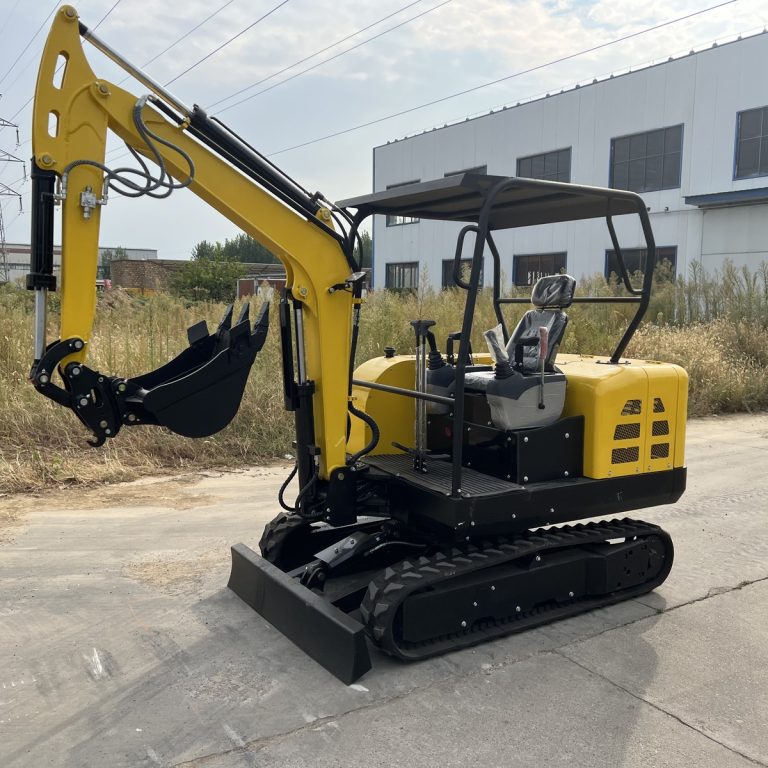
Check the mounting system, both pin diameters, pin centres and inside mounting widths before ordering a replacement bucket.
Mini excavator buckets are not universally interchangeable. Two buckets can have the same digging width and suit the same nominal machine weight while using different mounting interfaces. A compatible purchase needs the correct connection, an approved working geometry and a bucket suitable for the machine and material.
At Tai’an Hongli Machinery Equipment Co., Ltd., we recommend confirming the actual excavator and any fitted coupler before comparing bucket prices. “For a two-tonne excavator” is a starting category, not a complete fitment specification.
Send the machine model, coupler details, photographs and expected quantity to hongli@hongli-mach.com. We can review what information is available and identify the dimensions that still need confirmation before an order.
The overlooked problem: you may be measuring the wrong connection
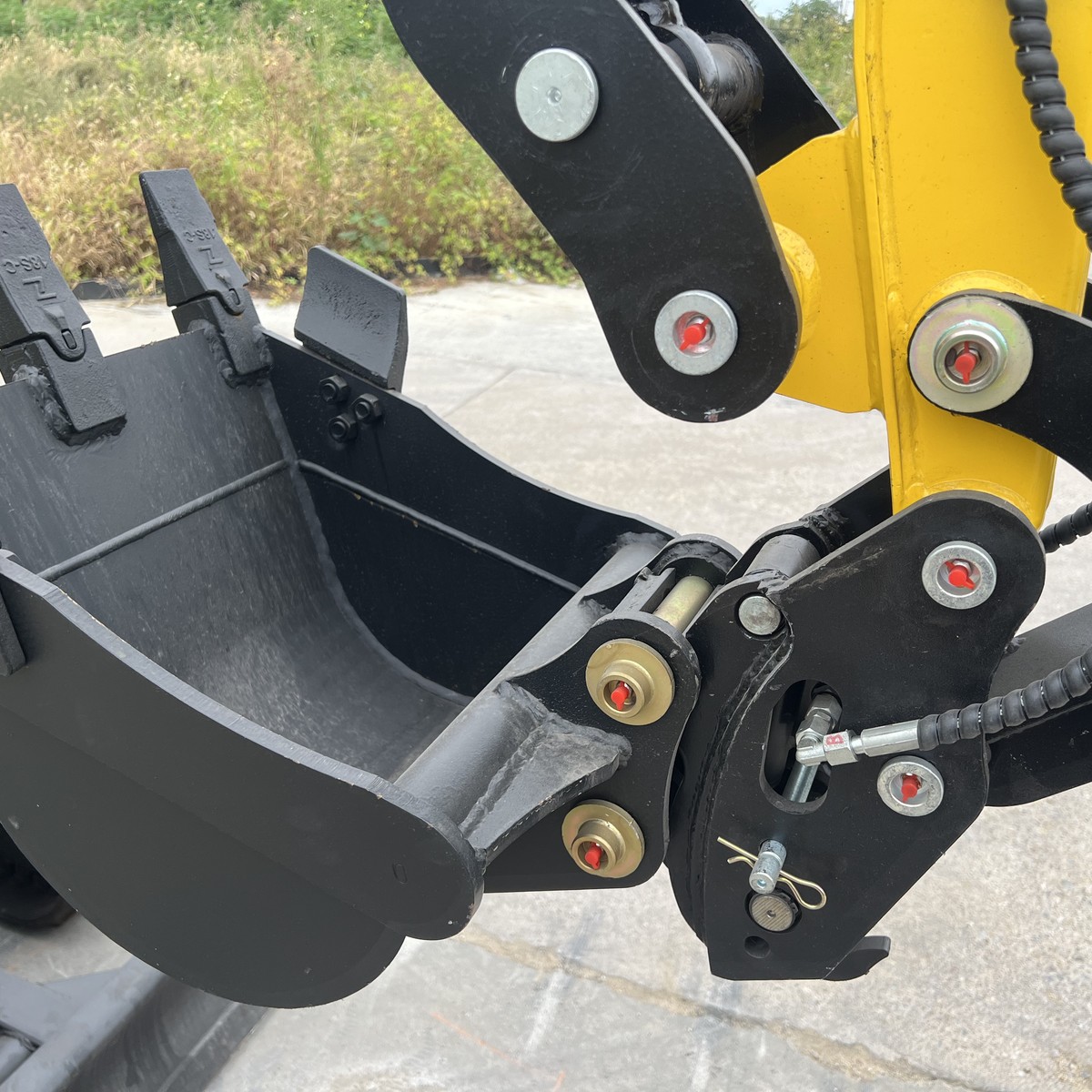
An excavator fitted with a quick coupler has two interfaces: the connection from the arm and linkage to the coupler, and the connection from the coupler to the bucket.
If you are retaining that coupler and buying another bucket, the second interface is the one the bucket supplier must match. Sending only the original machine’s direct-mount pin dimensions may describe the wrong connection.
Conversely, a bucket currently used through a coupler does not automatically provide the specifications needed to replace the coupler itself. The machine-side connection needs its own confirmation.
Write one sentence at the top of the enquiry: “The existing coupler will remain fitted,” or “The new bucket will mount directly to the arm.” If neither describes the plan, explain which parts are being changed.
That sentence can prevent a misunderstanding that a long list of unlabeled measurements does not resolve. Attach a photograph showing the complete connection, not just a close-up of one pin.
This is a different question from choosing a trenching, grading or rock bucket. Our mini excavator bucket types guide covers the task; this guide covers the information needed to verify the mounting.
Start with the mounting system
Identify whether the proposed bucket uses a direct pin-on connection, a compatible pin-grabber coupler, or a dedicated attachment interface. Do not assume that every product described as a “quick hitch” accepts the same bucket arrangement.
A dedicated system needs the corresponding approved attachment interface. For a pin-grabber design, the coupler manufacturer determines the acceptable pin dimensions and geometry. An adjustable mechanism is not permission to use any bucket that it appears able to catch.
Bobcat’s bucket guidance explicitly distinguishes pin-on and dedicated mounting systems and explains that buckets are not universal. This is a useful principle across purchasing decisions, not a claim that a Bobcat attachment is approved for a Hongli machine.
Record the coupler manufacturer, model and identification details if fitted. If the plate is missing, supply photographs and ask how the interface can be positively identified. A familiar-looking casting is not a sufficient specification.
The fitment information to put in the order
Use the supplier’s drawing references wherever possible. The labels below are an enquiry checklist, not universal engineering symbols.
| Information | What to record | What not to substitute |
|---|---|---|
| Machine identity | Make, exact model, serial/build information and relevant configuration | Nominal tonnage alone |
| Connection plan | Direct mount or exact coupler retained | “Quick hitch fitted” without identification |
| Main mounting pin | Specified diameter, with measurement location identified | Outside diameter of a pin head |
| Link-side mounting pin | Its own specified diameter | An assumption that both pins are equal |
| Pin centres | Distance between the two mounting axes | An unlabeled outside-to-outside measurement |
| Inside mounting widths | Clear widths at the relevant mounting positions | Outside width across the ears |
| Pin and retention details | Required lengths, shoulders, retainers and applicable part references | Diameter alone |
| Bucket specification | Working width, mass, capacity rating and intended material | “Fits the pins” as proof of suitability |
Ask which measurements must come from the machine, existing bucket or coupler drawing. Record units explicitly, even if every value is in millimetres.
Keep measured values separate from nominal specifications. A field measurement of a used assembly and a manufacturer’s new-part dimension answer different questions.
Gather measurements without turning guesswork into a specification
Measurements should be taken by someone competent to prepare and support the equipment safely. Follow the machine and attachment instructions for isolation and access. Do not work beneath a suspended bucket or rely on hydraulics alone to support an assembly.
This is a purchasing checklist, not a pin-removal or coupler-installation procedure. Where measurement requires disassembly, have the appropriate technician obtain it.
Record both pin diameters
Identify the cylindrical working portion of each pin or the specified bore location. Do not measure the retaining head and call that the pin size.
Aussie Buckets’ measurement guide asks buyers to check the individual mounting dimensions rather than assume corresponding dimensions are identical. It also requests written measurements alongside photographs. Use that approach when preparing an enquiry: describe what was measured, not simply “pins are the same.”
If a reading falls between expected nominal sizes, do not round it to the nearest size and place the order. Establish whether the difference comes from wear, measurement uncertainty or a different specification.
Distinguish mounting width from bucket width
Digging width describes the working end of the bucket. Inside mounting width describes the space available at the connection. These dimensions are not interchangeable.
Rhinox’s measurement guidance identifies the dipper gap as an internal measurement and highlights the smallest opening, including the area between bosses. An outside measurement across the mounting ears does not provide that clearance.
Record the location as well as the number. If the two mounting positions have different internal widths, give both. The supplier should define any permitted assembly clearance and approved spacers; the buyer should not invent a universal allowance.
Be precise about pin centres
Pin-centre distance is measured between axes. A photograph of a tape stretched across the whole mounting bracket may show a different quantity.
There is a useful geometry check when two circular pins are parallel and measurement is taken along their centre line. Let O be the distance across the far outer surfaces and I the gap between the facing inner surfaces. The centre distance is (O + I) ÷ 2.
For an illustration only, O = 180 mm and I = 120 mm gives a centre distance of 150 mm. These are invented arithmetic values, not dimensions for any Hongli machine.
The familiar shortcut of measuring from the same edge of one pin to the same edge of the other gives the centre distance only when the diameters are equal and the measurement alignment is correct. Different diameters introduce an offset.
Treat field calculations as a cross-check, not a replacement for an approved drawing. Worn, irregular or inaccessible surfaces can make an apparently precise measurement unreliable.
Why matching the main dimensions is not the whole approval
A complete purchase specification needs more than a few numbers copied into a message. Pin retention, surrounding clearances, the approved coupler interface and the bucket’s intended duty must also be addressed.
A bucket might appear to attach while still having an unsuitable operating envelope. Ask for compatibility confirmation across the permitted movement of the approved assembly. Do not discover interference by forcing the hydraulics against a contact point.
Likewise, an attachment’s empty mass belongs in the suitability review. A reinforced bucket and a lighter bucket with similar mounting dimensions do not necessarily impose the same demands.
Capacity is another separate issue. A volume rating does not identify the mass of every material that might be placed in the bucket. The machine’s applicable operating limits and the manufacturer’s approved combination remain the reference.
For powered buckets or other hydraulic attachments, mechanical fit is only one part of the assessment. Use our mini excavator attachments guide to check the separate hydraulic requirements.
Used buckets: buy the identity and condition, not just the shape
A used bucket can be worth considering when its interface, condition and intended use are documented. Ask for its identification and available drawing before arranging shipment.
Photographs should show both sides of the mounting, the working edge and any repaired areas. Ask specifically about changed mounting brackets, replacement bushes and previous modifications. A listing that names a machine model may describe its original configuration rather than the bucket as it stands today.
Do not treat a worn bore as a reliable nominal dimension. If the mounting condition is uncertain, a competent inspection may be necessary before the supplier can confirm what work or replacement parts are appropriate.
Compare the complete acquisition cost: bucket, correct pins or mounting components, approved repairs if needed, transport and time. A cheap bucket that cannot be documented may be a poor purchase even before any work begins.
This does not mean every used bucket should be rejected. It means uncertainty belongs in the buying decision rather than being passed to the operator after delivery.
When an adapter is—and is not—a sensible answer
An approved adapter may provide a route between specified interfaces. It is an engineered combination to evaluate, not a generic cure for dimensions that do not match.
Ask who approves the proposed assembly, which machine and attachment it covers, and what changes to working limits or geometry must be considered. Obtain the documentation before paying for the bucket on the assumption that an adapter can be found later.
Do not grind mounting components, substitute undersized pins or improvise locking parts to make a mismatched purchase fit. A successful physical connection is not the same as an approved attachment system.
If you rarely change attachments, a correctly specified direct-mount bucket may suit the work without adding a coupler. If you need frequent changes, compare approved options around the attachments you actually intend to use.
We would rather lose a bucket sale than recommend an undocumented conversion. Do not buy a bucket from Tai’an Hongli Machinery Equipment Co., Ltd. if we cannot confirm the proposed interface and application. A properly documented local replacement may be the better choice.
Agree on the evidence before payment
Turn the conversation into a written order specification. Identify the exact bucket, the retained machine and coupler, the approved drawing revision and any included mounting components.
Ask the supplier to state what “compatible” covers. Does the price include pins and retainers? Is a specific existing coupler assumed? Are additional parts required? Who supplies the installation and locking instructions?
A dimensioned drawing is useful only if everyone refers to the same revision. If a mounting detail changes during quotation, update the order rather than leaving the change buried in a message.
For a fleet, separate machines by actual interface. Do not order a batch on the assumption that two machines sharing a weight category share attachment dimensions. Keep a record of which bucket is approved for which machine and coupler combination.
On delivery, check identity and documentation against the order before installation. Have the assembly fitted and checked under the relevant manufacturer procedures. Do not use a generic online “tug test” as a substitute for the locking checks required for that coupler.
A fitment record is also useful when ordering the next bucket. Store the approved drawing, part references and photographs together, while noting any later changes to the machine or coupler.
Frequently asked questions
Are mini excavator buckets universal?
No. Mounting systems and dimensions vary, including between machines in similar weight classes. Identify the exact machine, retained coupler and bucket interface, then obtain confirmation for the proposed combination. Width and tonnage labels alone are insufficient.
Can I use a bucket from another excavator brand?
Possibly, if the complete interface and intended application are approved. Brand difference alone does not settle the question, and matching pin diameter alone does not prove fit. Provide the dimensions, coupler details and bucket specification to the relevant supplier.
What measurements do I need for a replacement bucket?
Start with both pin diameters, pin-centre distance and inside mounting widths, plus the exact mounting system. The supplier may also require pin lengths, retention details and additional drawing dimensions. Identify where each measurement was taken and which components will remain installed.
Is a bucket pin-size chart enough to order from?
A chart can help identify a candidate, but check its model coverage, configuration and revision. A changed coupler or modified attachment can make the listed direct-mount dimensions irrelevant to the purchase. Resolve differences before ordering rather than assuming the chart overrides the installed equipment.
Can spacers make any wider bucket mounting fit?
No. Spacers address only the conditions for which they are specified. They do not resolve every pin, geometry, retention or coupler mismatch. Use only the parts and clearances approved for the complete assembly, and ask the supplier to document them.
Does a hydraulic quick coupler make buckets interchangeable?
Only within its approved interface and operating limits. Hydraulic actuation describes how a mechanism operates; it does not mean the coupler accepts every pin spacing or bucket design. Identify the exact coupler and obtain its compatible attachment requirements.
Send the connection details before choosing a bucket
Send your country, exact machine model and identification, whether the coupler will remain, coupler make/model, current bucket photographs and labeled measurements. Add the required bucket width, material, main task and expected quantity.
Tai’an Hongli Machinery Equipment Co., Ltd. can use that information to review the proposed configuration and identify missing evidence. The aim is a bucket that is correctly specified for the machine and job, with the agreement documented before shipping.
Email: hongli@hongli-mach.com
WhatsApp: +86 131 0548 1184
About the Author
Avicii Meng — Head of Technical Engineering | Hongli Machinery
Avicii Meng works on equipment configuration and buyer guidance at Tai’an Hongli Machinery Equipment Co., Ltd., connecting purchasing specifications with the requirements of the intended job.