
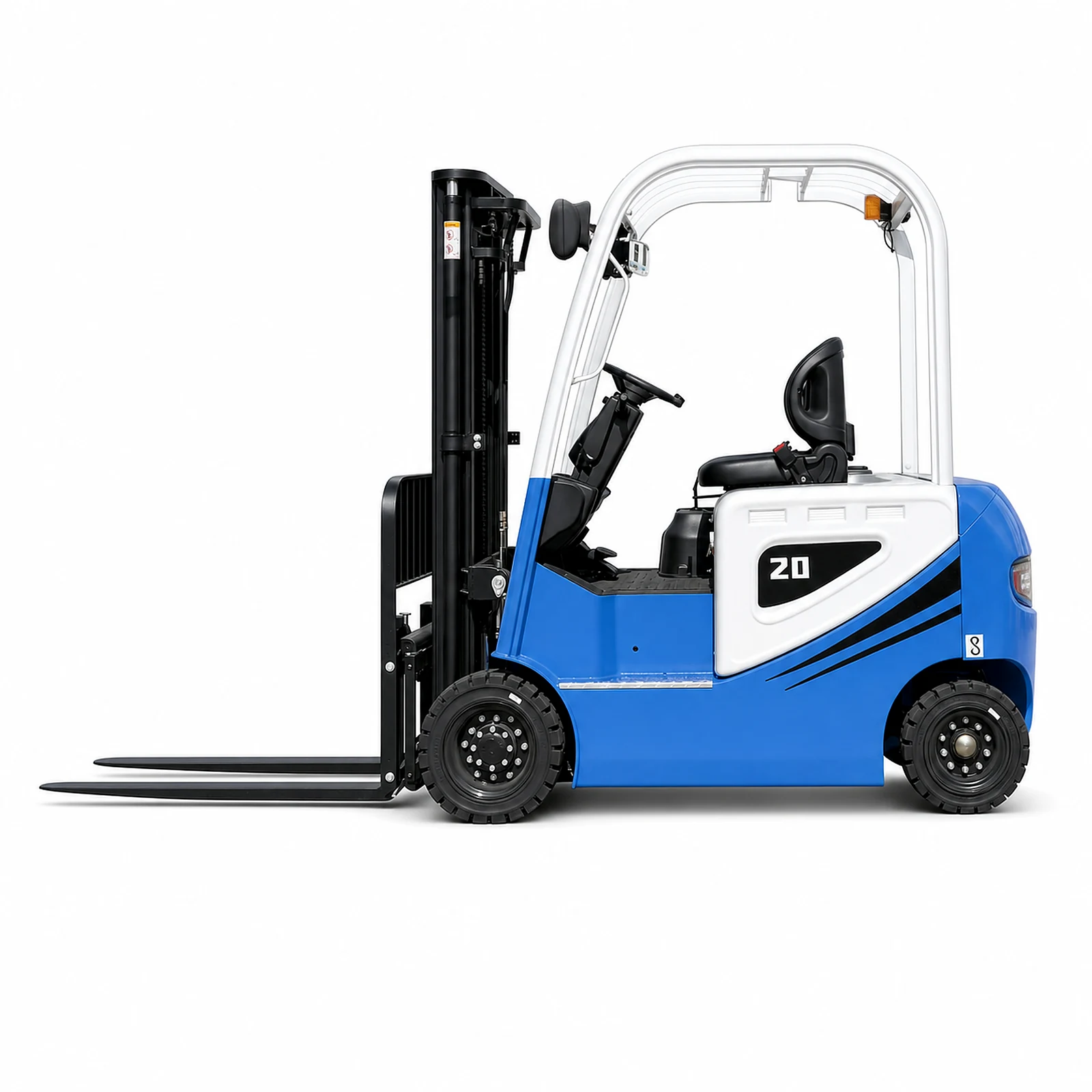
Reference catalog configuration — rated capacity: 2,000 kg at a 500 mm load center | Width: 1,100 mm | Reference battery: 60V / 210Ah lead-acid | Reference lift height: 3,000 mm
The Hongli HLC20 is a seated electric forklift offered by Tai’an Hongli Machinery Equipment Co., Ltd. The figures below describe the reference catalog configuration, not every available order specification. The supplied catalog lists 2,000 kg rated capacity at a 500 mm load center, 1,100 mm overall width and a 60V / 210Ah lead-acid battery. Reference service weight is 2,680 kg including the battery. The selected mast, attachment, load geometry and applicable capacity information must be confirmed for the ordered truck.
Send your destination country, heaviest load and its dimensions, required lift height, door and aisle measurements, shift pattern and expected quantity. Ask Hongli to assess the HLC20 for your site.
The Lowered Mast Is Not Always the Highest Part of the Truck
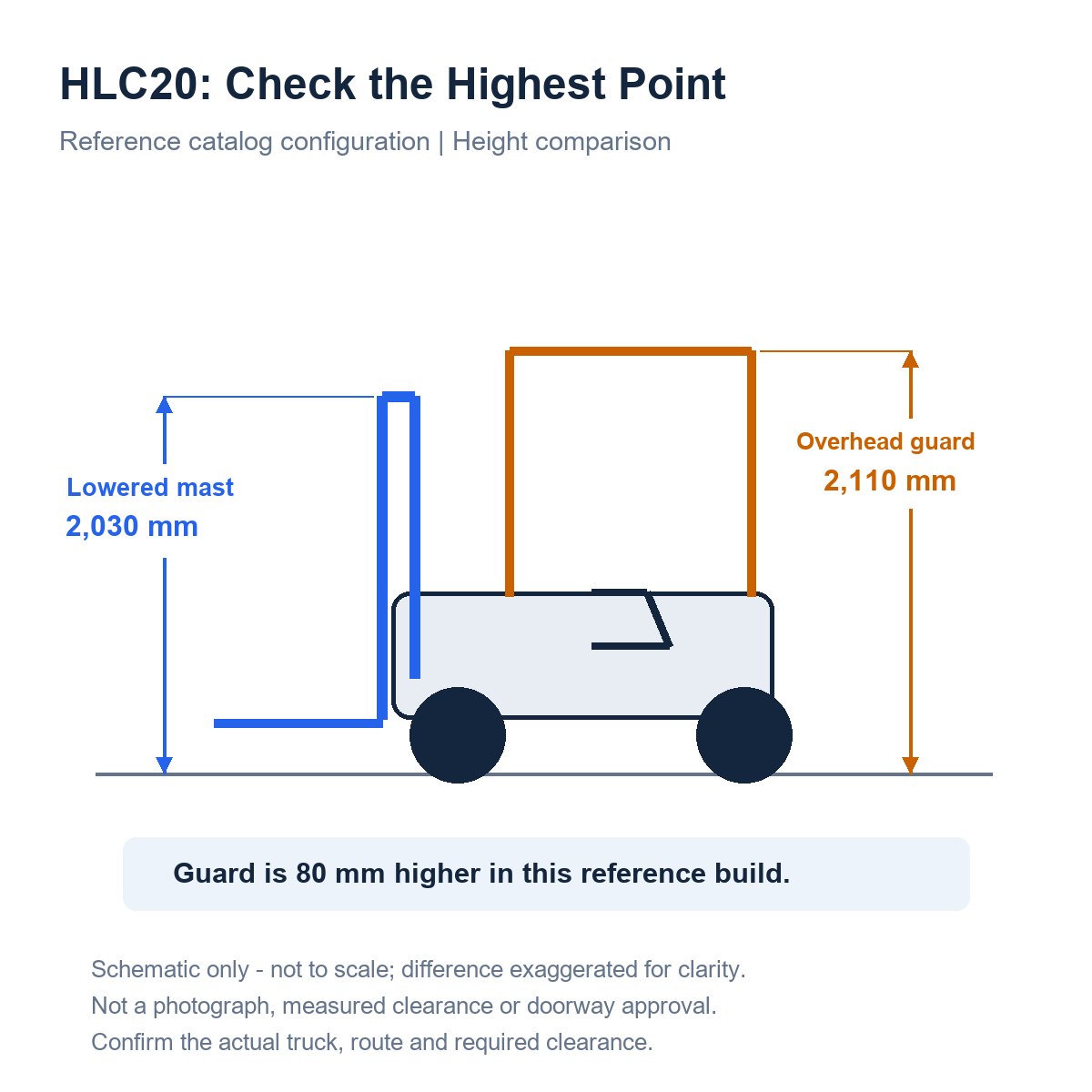
The HLC20 reference mast is 2,030 mm high when lowered. Its overhead guard is 2,110 mm high. The guard therefore stands 80 mm above the lowered mast in this reference configuration. Checking only the mast can give the wrong answer about a doorway.
For example, a hypothetical 2,080 mm opening is higher than the listed lowered mast but lower than the overhead guard. The reference truck would not fit that opening on these static dimensions. This is an illustration of which measurement matters, not a clearance allowance or approval for any other door.
Measure the narrowest and lowest points on the actual route. Include door hardware, thresholds, overhead equipment and changes in floor level. Confirm the overall envelope of the ordered truck, including any accessories. The reference difference between two truck dimensions is not a margin to use for travel.
Lifting introduces another height. The reference maximum fork lift is 3,000 mm, while the extended mast height is 4,055 mm. A rack position that is reachable by the forks can still be incompatible with overhead space. Check the required fork height, actual mast envelope and load above the forks as separate dimensions.
If the job requires lifting while the mast remains below a low obstruction, ask for the actual free-lift specification. The supplied HLC20 configuration sheet leaves that entry unspecified. Neither a 3,000 mm lift height nor the lowered-mast dimension establishes how much free lift is available.
This is a practical reason to assess the HLC20 against the building before choosing a battery or requesting a higher mast. A truck can have sufficient rated capacity and still be the wrong purchase for the route.
Where the HLC20 Is Worth Assessing
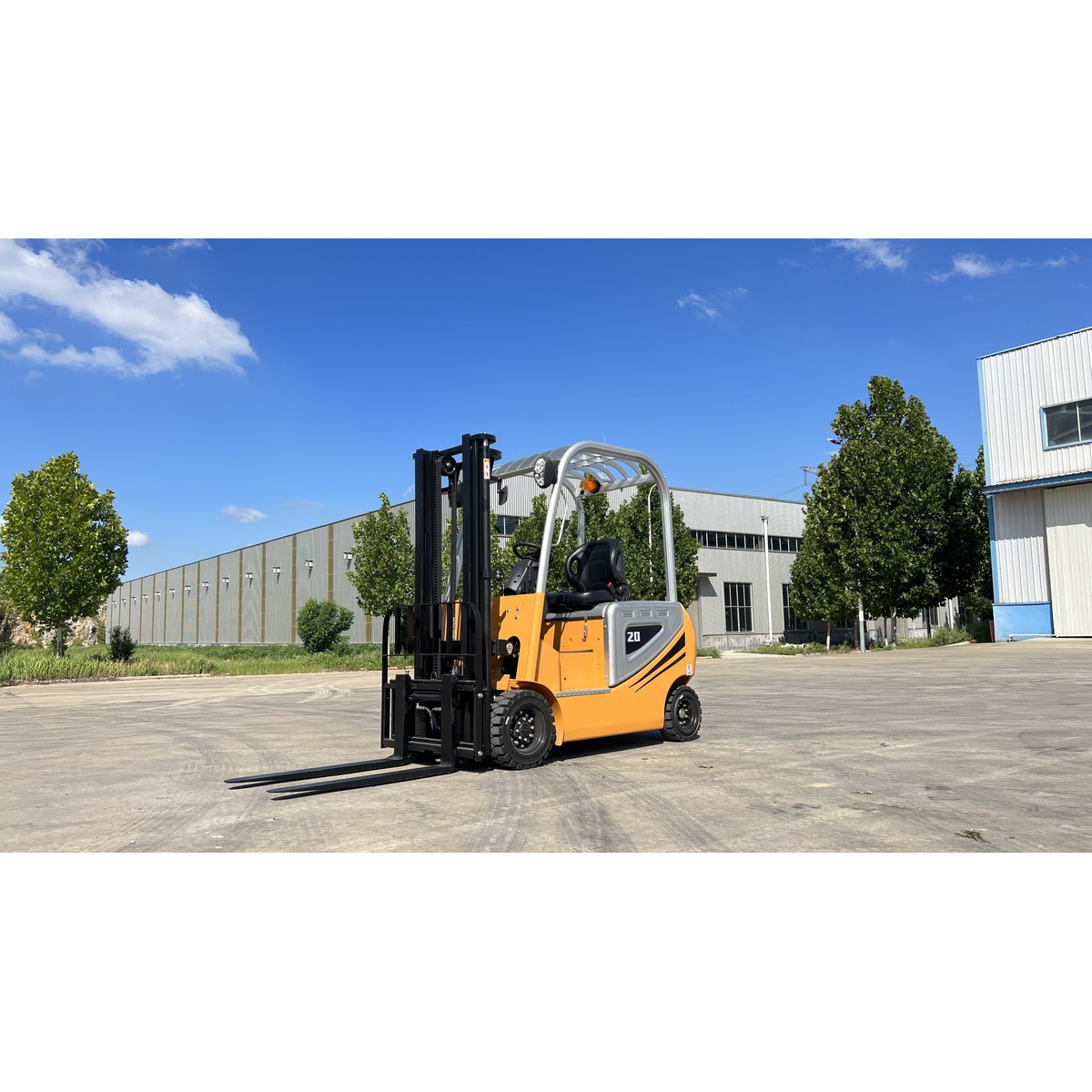
Consider the HLC20 for pallet and material handling on suitable warehouse or production-floor routes when the confirmed capacity, mast and charging arrangement cover the duty. Its 1,100 mm reference width and 2,230 mm length to the fork face are specific reasons to assess it where space matters.
Do not select it simply because the heaviest load is described as “two tonnes.” Load center, lifting height, attachments and the actual load shape must match the truck’s applicable capacity information. A long or uneven load cannot be approved by its mass alone.
Do not choose it for a site with no compatible charging arrangement or a duty that depends on an unverified full-shift runtime. The reference battery identifies a package; it does not establish working hours per charge.
If the required stacking aisle, door clearance or ground conditions are unsuitable, a different truck may be needed even when its nominal capacity appears sufficient. For a load beyond the HLC20’s confirmed capability, investigate the next capacity class with the actual load and site geometry rather than assuming the same truck can be uprated.
HLC20 Reference Specifications
The catalog and supplied CPD20-C configuration sheet agree on the principal values below. The aisle references come from the configuration sheet and apply to its stated pallet and clearance conditions. Confirm the actual ordered package.
| Item | Reference value | What to check |
|---|---|---|
| Model | HLC20 | Confirm the quoted truck and identification record |
| Operator type | Seated | Assess the actual operating environment |
| Rated capacity | 2,000 kg | Applicable load center, height and attachments |
| Load center distance | 500 mm | Actual load center must be established |
| Service weight, including battery | 2,680 kg | Not lifting capacity or a complete floor-load assessment |
| Length to fork face | 2,230 mm | Excludes projecting forks |
| Overall width | 1,100 mm | Not the stacking aisle requirement |
| Wheelbase | 1,550 mm | Reference geometry |
| Front overhang | 325 mm | One part of the truck and load geometry |
| Battery type | Lead-acid | Confirm ordered battery and charger |
| Battery voltage / nominal capacity | 60V / 210Ah | Not a runtime promise |
| Battery weight | 300 kg | Not an approved replacement-weight range |
| Mast lowered height | 2,030 mm | Guard is higher in this reference configuration |
| Overhead guard height | 2,110 mm | Check the actual travel envelope |
| Maximum fork lift height | 3,000 mm | Confirm capacity at the required lift position |
| Mast extended height | 4,055 mm | Separate from fork height and load height |
| Mast tilt, forward / backward | 5° / 10° | Reference mast arrangement |
| Fork dimensions, length × width × thickness | 1,070 × 100 × 40 mm | Confirm fit with the load and pallet |
| Fork adjustment, outside edges, max. / min. | 1,040 / 100 mm | Sheet label; confirm practical spacing for the ordered forks |
| Ground clearance below mast | 88 mm | Does not approve a ramp or uneven route |
| Turning radius | 2,280 mm | Not a stacking aisle width |
| Right-angle stacking aisle, 1,000 × 1,000 mm pallet | 3,850 mm | Sheet includes 200 mm clearance |
| Right-angle stacking aisle, 1,200 × 1,200 mm pallet | 3,950 mm | Sheet includes 200 mm clearance |
The fork-adjustment minimum is reproduced from the configuration sheet, not interpreted as a 100 mm physical gap between the forks. Request the relevant drawing if that spacing determines pallet compatibility. Free lift is not specified in the supplied sheet.
Capacity Needs the Load Center and the Actual Mast
The 2,000 kg rating is stated with a 500 mm load center. Establish the actual center of gravity of the proposed load, including uneven contents or overhang. Pallet size by itself does not prove where that center lies.
An attachment can add mass and move the load forward. A different mast can change the applicable capacity information. Request the capacity plate and relevant load information for the complete ordered configuration and required lifting height. Do not use a simple load-moment calculation as a substitute for an approved capacity assessment.
OSHA’s nameplate guidance illustrates how truck ratings are tied to stated load centers, heights and attachment configurations. It is a US reference, not a claim that one jurisdiction’s requirements apply to every destination. Confirm the rules and documents relevant to your market.
The 2,680 kg service weight includes the reference battery. It is the truck’s mass, not an additional lifting allowance. Likewise, adding truck and load masses does not establish permissible floor, dock or ramp loading: wheel and axle loads and the supporting structure must be assessed for the actual use.
A Narrow Truck Still Needs Space to Stack
The HLC20’s 1,100 mm body width does not mean it can turn and place a pallet in an aisle of that width. The configuration sheet gives 3,850 mm right-angle stacking aisle width for a 1,000 × 1,000 mm pallet, with 200 mm clearance, and 3,950 mm for a 1,200 × 1,200 mm pallet under the same stated clearance condition.
These figures are not universal minimum aisle requirements. Use them as configuration-specific references, not universal warehouse design limits. Different load orientation, attachments, overhang, racks or operating conditions can change the assessment. The 2,280 mm turning radius is another distinct measurement; it is not interchangeable with either stacking aisle figure.
Send a site layout and the actual load dimensions when space is tight. Check the approach, turning movement and placement position as well as straight travel. A narrower body is useful only if the complete movement fits the site.
Plan the Charging Window Before Ordering
The reference 60V / 210Ah lead-acid battery identifies a package, not a shift duration or charging time.
Describe travel distances, lifting frequency, load distribution, working hours and available charging breaks. Request a matched battery and charger specification, charger input requirements and the manufacturer’s operating and charging instructions. Confirm the site power supply and charging arrangement before shipment.
Do not infer a charging schedule from voltage alone or assume a short break will restore the energy used during a shift. The supplied documents do not provide a charger output, duty test or measured energy consumption from which such a promise could be made.
Battery replacement needs the approved electrical and mass requirements. A lithium option, if offered, needs its own approved configuration, compatible charger and applicable capacity documentation.
HLC20 Compared With HLC25 and HLC30
The HLC25 catalog lists 2,500 kg rated capacity at a 500 mm load center, 1,160 mm width and 2,330 mm length to the fork face. Compared with the HLC20, it is 60 mm wider and 100 mm longer on those reference dimensions. Its listed service weight with battery is 3,300 kg, compared with 2,680 kg for the HLC20.
Both catalogs list a 2,030 mm lowered mast and a 2,110 mm overhead guard. Moving to the HLC25 therefore does not resolve a low-door problem on those reference heights. Its 72V / 210Ah battery is also a different electrical package from the HLC20’s 60V / 210Ah reference; equal Ah figures do not mean the batteries or chargers are interchangeable.
The HLC30 lists 3,000 kg rated capacity at a 500 mm load center, 1,225 mm width and 2,600 mm length to the fork face. It is worth assessing when the HLC20 cannot cover the confirmed load requirement, but the larger reference dimensions and applicable site requirements must also fit. Do not choose a higher capacity class solely to avoid establishing the actual load center or attachment effect.
Frequently Asked Questions
Can the HLC20 lift any 2,000 kg pallet?
No. The reference rating is at a 500 mm load center. Confirm the actual load center, lift height, mast and attachments against the applicable capacity information. Load mass alone is insufficient.
Will it pass through a door higher than 2,030 mm?
Not necessarily. The reference overhead guard is 2,110 mm high, above the lowered mast. Measure the complete route and confirm the actual truck envelope. Neither figure is a clearance allowance.
Does a 3,000 mm lift require only 3,000 mm overhead space?
No. The reference extended mast height is 4,055 mm. The load itself and the actual working arrangement also need clearance. Ask for the chosen mast’s drawing and free-lift specification.
How many hours will the 60V / 210Ah battery run?
The available documents do not establish a runtime. Specify the shift, travel, lifting duty and charging windows, then obtain an assessment for the actual battery and charger. Voltage and Ah alone do not prove a full shift.
Can I stack pallets in an aisle only slightly wider than the truck?
Body width does not establish right-angle stacking space. The sheet’s references are 3,850 and 3,950 mm for its stated pallet sizes and 200 mm clearance condition. Verify your actual load, racks and movement.
Should I choose the HLC25 instead?
Assess it when the HLC20’s confirmed capacity does not cover the load. Check the HLC25’s extra width, length, service mass, mast and battery package. Its reference overhead-guard height is the same, so a low doorway still needs its own solution.
Request an HLC20 Configuration Review
- Destination country and delivery location.
- Heaviest load, dimensions, center of gravity and pallet orientation.
- Required fork height and any attachment.
- Door clearance, stacking aisle and site layout.
- Indoor, outdoor or mixed use; exposure to rain, dust or temperature extremes.
- Ground, dock and ramp conditions, plus the proposed charging location and ventilation.
- Shift hours, travel and lifting duty, charging windows and site power supply.
- Intended use and expected quantity.
Send your HLC20 requirements to Hongli. Tai’an Hongli Machinery Equipment Co., Ltd. can assess the reference package and identify the evidence needed for the proposed order. If the building, duty or load calls for another truck, settle that before comparing prices.
About the Author
Avicii Meng, Head of Technical Engineering | Hongli Machinery
Avicii Meng works with Tai’an Hongli Machinery Equipment Co., Ltd. on export equipment configurations and technical purchasing questions for international buyers.