
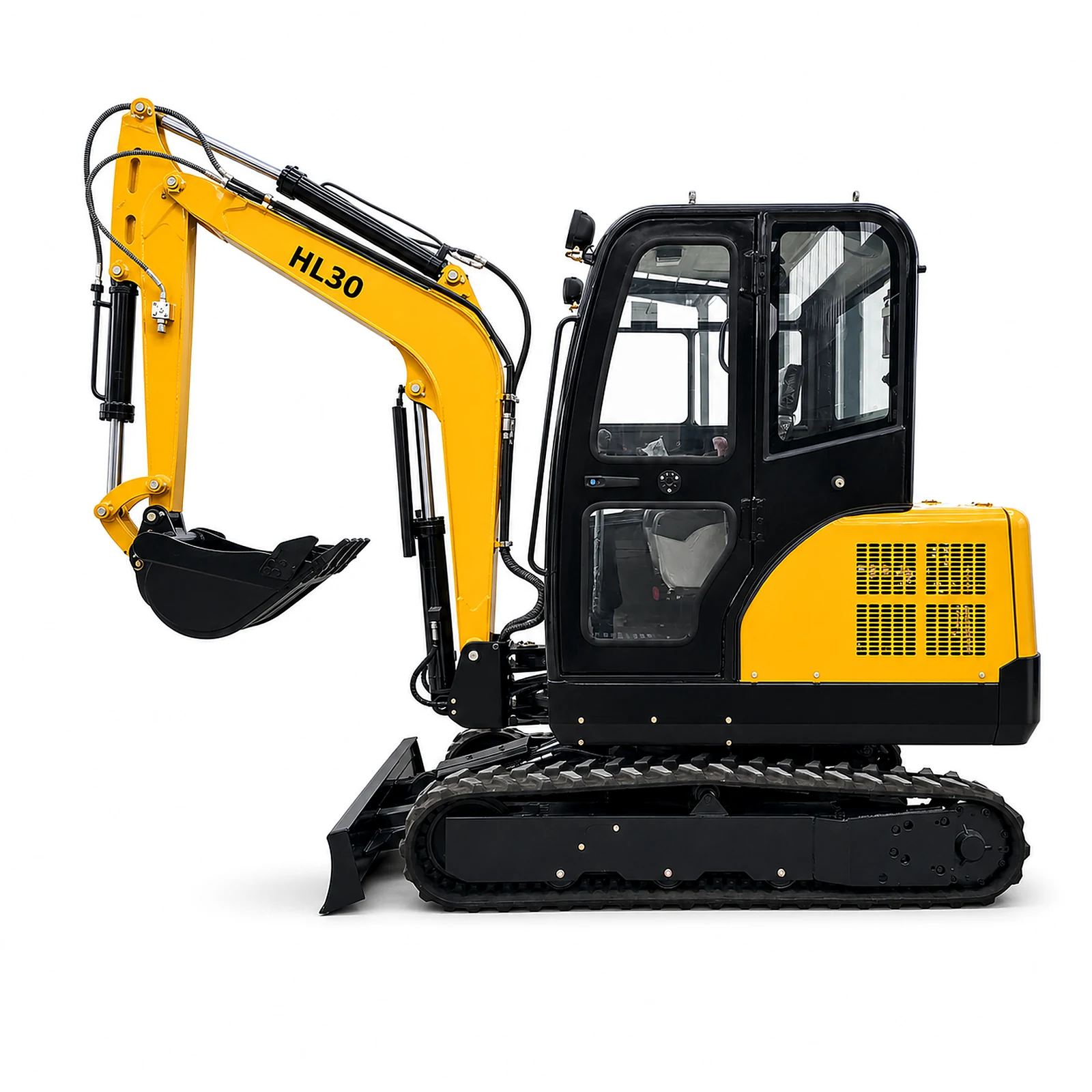
Catalog operating weight: 2.4 t | Bucket capacity: 0.1 m³ | Bucket width: 500 mm | Overall width: 1,500 mm | Maximum digging depth: 3,058 mm
The Hongli HL30 is a small excavator offered by Tai’an Hongli Machinery Equipment Co., Ltd. Its English catalog lists a 2.4-tonne operating weight, a 0.1 m³ digging bucket, 1,500 mm overall width and 3,058 mm maximum digging depth. The 500 mm bucket width is a reference dimension; the supplied configuration sheet describes it as excluding side teeth. Engine, cab, tracks and attachments must be specified for the actual order. The HL30 model name does not mean the machine weighs three tonnes.
Before requesting a configuration, send your destination country, material, required trench dimensions, narrowest access point, attachments and expected quantity. Ask Hongli to assess the HL30 for your job.
A Bigger Bucket Can Create More Work
The useful question is not simply how much the bucket holds. It is how much material the job requires you to remove, and whether that bucket can do it without unnecessary excavation.
For an illustrative rectangular trench 10 m long and 1 m deep, increasing its width from 350 mm to 500 mm increases the geometric excavation volume from 3.5 m³ to 5.0 m³. That is about 43% more material before allowing for soil expansion, irregular walls or any required working space. This example is arithmetic, not an HL30 production estimate or a trench design recommendation. A 350 mm bucket is not confirmed as an available HL30 option by this calculation.
More excavated material can also mean more spoil handling, backfill and reinstatement. If the job calls for a narrower trench, first establish the required excavation geometry with the project designer, then ask whether an appropriate bucket is approved for the machine. Changing the bucket is useful only when its mounting, weight and working geometry are suitable.
The reverse also matters. A narrow bucket is not automatically the best choice for a broad excavation or loose-material cleanup. Match the tool to the finished work, soil conditions and available space. A 0.1 m³ catalog capacity describes a bucket volume; it does not establish payload, bucket fill, cycle time or hourly output. Wet or dense material can change the load substantially.
Bucket width and mounting width are different measurements. Before ordering a replacement, confirm the connection type, pin diameters, pin centers, mounting widths and any fitted coupler. Our bucket compatibility checklist explains the measurements. A bucket described as suitable for a “three-tonne excavator” is not sufficient evidence of HL30 fitment.
Who Should Consider the HL30?
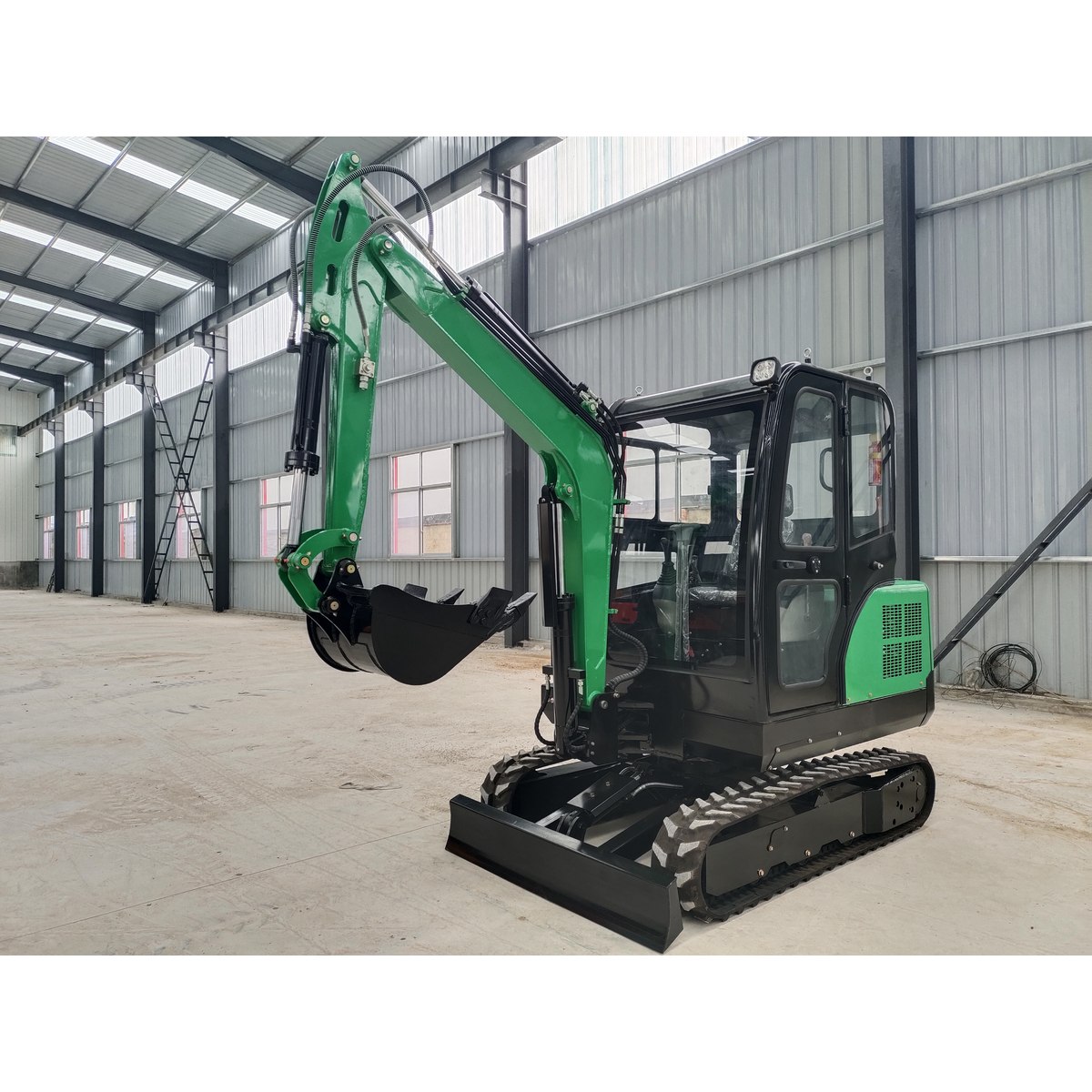
Consider the HL30 when the specified excavation, site access and transport arrangement are compatible with its confirmed configuration. Its reference bucket and working range are worth assessing for drainage, landscaping, farm maintenance and small construction tasks. These are applications to discuss, not a claim that every job in those categories fits this machine.
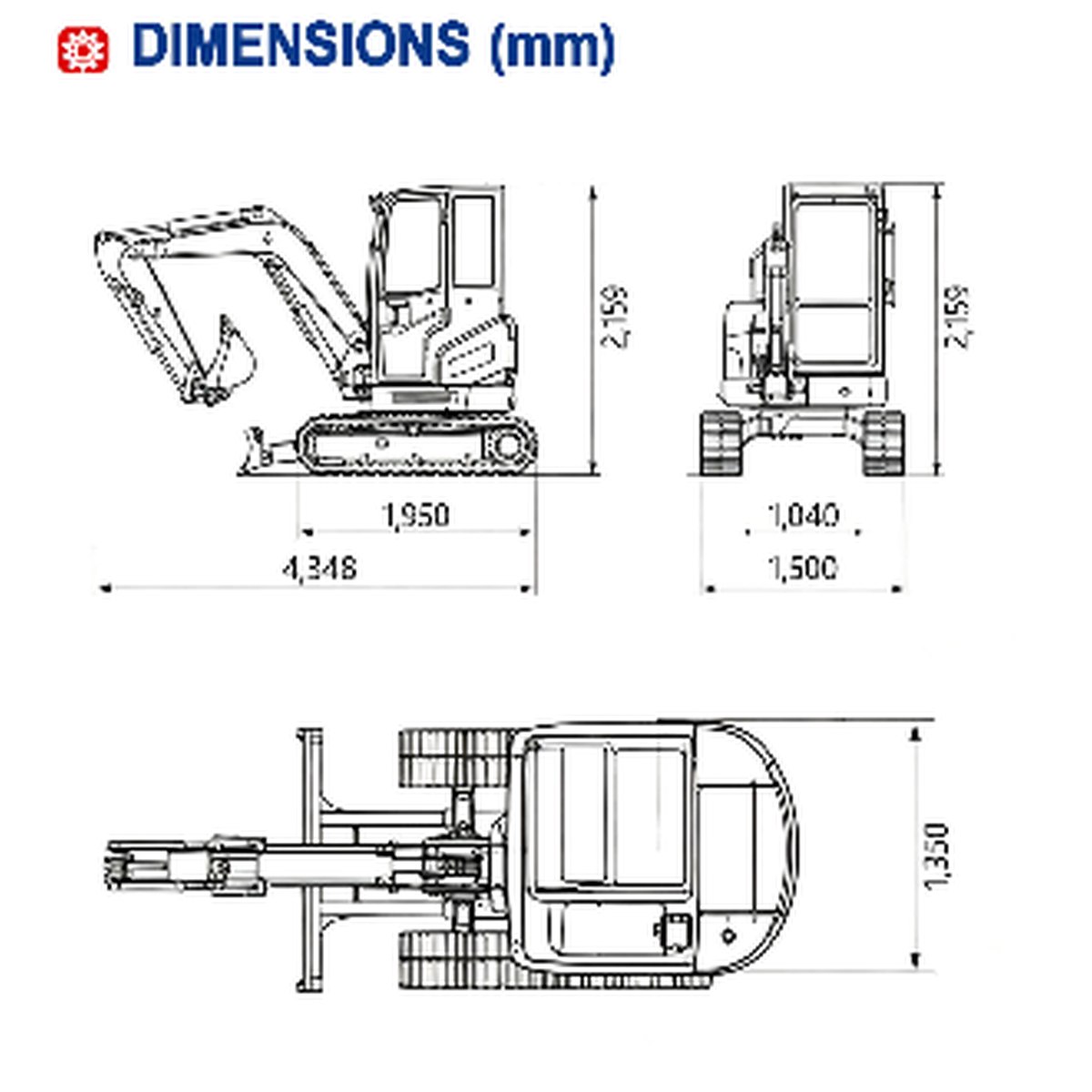
Do not choose it if the access route cannot accommodate the verified overall width and maneuvering clearance. The 1,350 mm upper-body width is not the overall width of the machine. A gate that clears the body may still obstruct the undercarriage or blade.
Do not choose the HL30 solely because its maximum depth is slightly greater than your required trench depth. Ask for the working geometry at the required depth and offset, including vertical-wall requirements. Maximum depth, maximum reach and maximum unloading height are separate limits rather than one simultaneously available position.
If the work requires lifting heavy objects, continuous hard-rock excavation, loading a high-sided vehicle or a verified zero-tail-swing machine, obtain the relevant evidence before selecting this model. We do not have an HL30 lifting chart, digging-force value or continuous-duty attachment assessment in the supplied catalog. A different machine may be the better purchase.
HL30 Reference Specifications
The following values come from the supplied HL30 English catalog, pages 11–12. They describe a reference specification. Confirm the ordered engine, attachments and measured dimensions before shipment.
| Item | Catalog reference | Purchasing interpretation |
|---|---|---|
| Model | HL30 | Model code is not a weight rating |
| Operating weight | 2.4 t / 2,400 kg | Not a confirmed transport or packing weight |
| Digging bucket capacity | 0.1 m³ | Volume, not payload or hourly output |
| Bucket width | 500 mm | Configuration sheet excludes side teeth; check actual cutting envelope |
| Overall length | 4,348 mm | Check the actual transport position and attachments |
| Overall width | 1,500 mm | Distinct from upper-body width |
| Overall height | 2,159 mm | Confirm the selected canopy or cab configuration |
| Upper-body width | 1,350 mm | Do not use this as access width |
| Body swing radius | 1,291 mm | Does not establish zero-tail-swing classification |
| Body rotation | 360° | Surrounding clearance still required |
| Boom swing, left / right | 45° / 55° | Confirm directional convention for the ordered machine |
| Maximum digging radius | 4,477 mm | Separate limit from maximum digging depth |
| Maximum digging depth | 3,058 mm | Not a guaranteed vertical trench-wall depth |
| Maximum digging height | 3,445 mm | Check geometry for the actual loading task |
| Maximum unloading height | 2,203 mm | Not a guarantee of clearance over a particular truck |
| Minimum swing radius | 2,165 mm | Catalog label; not the same as body swing radius |
| Maximum blade digging depth | 297 mm | Not a machine lifting or stabilization rating |
| Maximum blade lifting height | 230 mm | Reference blade geometry |
| Track type | Rubber tracks | Steel tracks listed as an option |
| Track width | 230 mm | Per-track reference; does not determine ground pressure alone |
| Track length | 1,950 mm | Not a confirmed ground-contact length |
| Fuel tank capacity | 20 L | Does not establish fuel consumption or working hours |
| Hydraulic tank capacity | 28 L | Not total system oil volume or auxiliary flow |
The catalog also lists 35° maximum grade ability. This is not used here as an approved working-slope or loading-ramp angle. Site slope limits require the actual operating instructions, ground assessment and configuration.
What the Working Range Actually Tells You
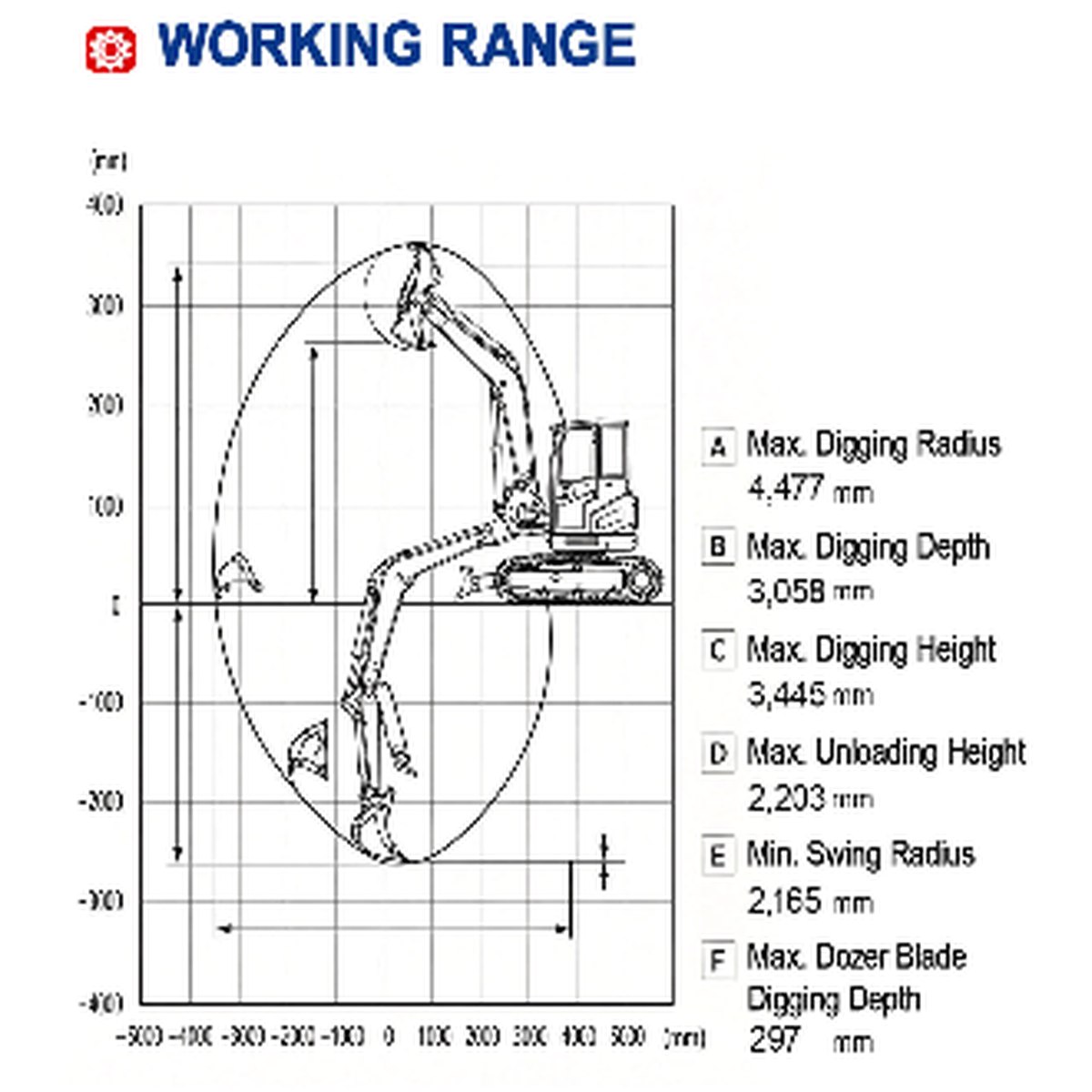
The 3,058 mm digging depth is useful for an initial screening conversation. It does not tell you whether the machine can produce the specified trench wall from a particular setback. A trench beside a building may require a different boom position from an open excavation. Establish both the excavation geometry and where the machine can safely stand.
The 4,477 mm digging radius is another separate boundary. Do not combine it with maximum depth to assume a rectangular working envelope. Use the working-range drawing and confirm the bucket and coupler installed on the machine. Attachment changes can alter the working geometry.
For loading, compare the required discharge point with the actual bucket path and clearance. The 2,203 mm maximum unloading height is not a promise that the HL30 can clear every truck body at a useful reach. Give us the receiving height, side clearance and machine position before specifying this task.
The blade dimensions do not establish how much weight the machine can lift or support. Likewise, the track dimensions do not provide ground pressure without the applicable contact area and operating mass. If ground bearing capacity is a constraint, obtain configuration-specific information rather than estimating it from catalog track length.
Engine and Optional Equipment: Specify the Actual Build
The supplied materials identify Changchai, Kubota and Yanmar engine choices. They do not establish one universally supplied engine version. The configuration sheet lists several engine and power references without a complete, consistent set of rated speeds, power definitions and emissions documents. Those numbers should not be compared as equivalent engine outputs.
Ask for the exact engine model and variant, rated power with its speed and definition, identification-label photographs, applicable emissions evidence and parts information. A brand name or an “EPA” description in a configuration list does not independently establish compliance for the delivered machine and destination. Our mini excavator engine guide explains the purchasing questions to resolve.
The catalog lists an enclosed cab, air conditioning, steel tracks and a two-speed travel motor as options. Decide whether each solves an actual constraint. Confirm cab dimensions and the supplied air-conditioning arrangement rather than assuming every cab includes cooling. Ask for the two travel speeds and fitted system before relying on faster relocation; the available material does not support a confirmed high-speed figure.
Rubber and steel tracks have different implications for surfaces and operating conditions. Neither choice justifies a promise of no surface damage. Confirm the route, surfaces, ground conditions and transport mass for the actual track configuration.
A hydraulic quick coupler and auxiliary hydraulic options should be documented with the intended attachment. Mounting fit alone does not prove compatibility. Powered attachments also need the appropriate flow, pressure, return arrangement and control circuit. Specify a breaker, auger or grapple by its actual requirements rather than assuming that all auxiliary plumbing is interchangeable.
HL30 Compared With HL26U and HL35
The HL26U is a nearby alternative to assess when dimensions and working geometry are the main constraints. Request the current configuration of both machines and compare the access envelope, digging position, attachments and transport load. A model suffix alone does not prove the tail-clearance behavior of the delivered machine.
The HL35 catalog lists 2.5 t operating weight, a 0.1 m³ bucket, 1,500 mm overall width and 3,058 mm maximum digging depth. These headline values are close to the HL30 reference; the model names do not represent a three-tonne versus three-and-a-half-tonne comparison. The catalog gives the HL35 a 41 L fuel tank, compared with 20 L for the HL30. That difference does not establish lower fuel consumption, longer working hours or superior production without the actual duty and configuration data.
If the HL30 fits the task, a higher model number is not itself a reason to change. If it does not fit, compare the actual constraint rather than choosing by the model number. Use our mini excavator size chart for the broader selection process.
Frequently Asked Questions
Is the HL30 a three-tonne excavator?
The supplied English catalog lists 2.4 t operating weight. HL30 is the model designation. Use the confirmed operating and transport weights for the ordered configuration rather than interpreting “30” as three tonnes.
Is the HL30 1,350 mm or 1,500 mm wide?
The English catalog lists 1,500 mm overall width and 1,350 mm upper-body width. A separate configuration spreadsheet labels 1,350 mm as overall width, creating a source discrepancy. We use the catalog’s explicitly separated dimensions for this reference page; confirm the actual overall width before an access-critical order.
Can I order a narrower bucket for trench work?
Ask for the available approved buckets and their mounting dimensions, weight and geometry. The reference bucket is 500 mm wide, with side teeth excluded in the configuration sheet. We do not list an unconfirmed narrow-bucket size as an available option. Provide the finished trench requirements first.
Does the HL30 dig a vertical wall 3,058 mm deep?
The catalog specifies maximum digging depth, not maximum vertical-wall digging depth. Confirm the required wall profile, machine setback and fitted attachment. The maximum depth alone cannot answer that question.
Which engine will my HL30 have?
The product materials offer Changchai, Kubota and Yanmar choices. Your quotation should identify the actual engine variant, its power rating and relevant destination-market documents. A generic engine-brand description is not a complete order specification.
Can a trailer rated for 2,400 kg carry the HL30?
The catalog’s 2,400 kg operating weight is not a verified loaded transport mass. First determine what that weight includes, then account for the actual machine, loose attachments and other cargo without double-counting. Check the trailer’s usable payload, gross limit, axle and hitch constraints and the towing vehicle’s limits. Do not select a trailer from operating weight alone.
Request an HL30 Configuration Review
To assess the machine and prepare a configuration-specific quotation, send:
- Destination country and delivery location.
- Main tasks, material conditions and required trench width, depth and wall profile.
- Narrowest access width, overhead clearance and available working space.
- Receiving-vehicle height if truck loading is required.
- Required buckets, coupler and powered attachments.
- Engine documentation needs, cab and track preferences.
- Transport constraints, intended use and expected quantity.
Send your HL30 requirements to Hongli. Tai’an Hongli Machinery Equipment Co., Ltd. can review the available reference information and identify the configuration evidence needed before an order. If your task requires a different machine class, that should be settled before discussing price.
About the Author
Avicii Meng, Head of Technical Engineering | Hongli Machinery
Avicii Meng works with Tai’an Hongli Machinery Equipment Co., Ltd. on export equipment configurations and technical purchasing questions for international buyers.