
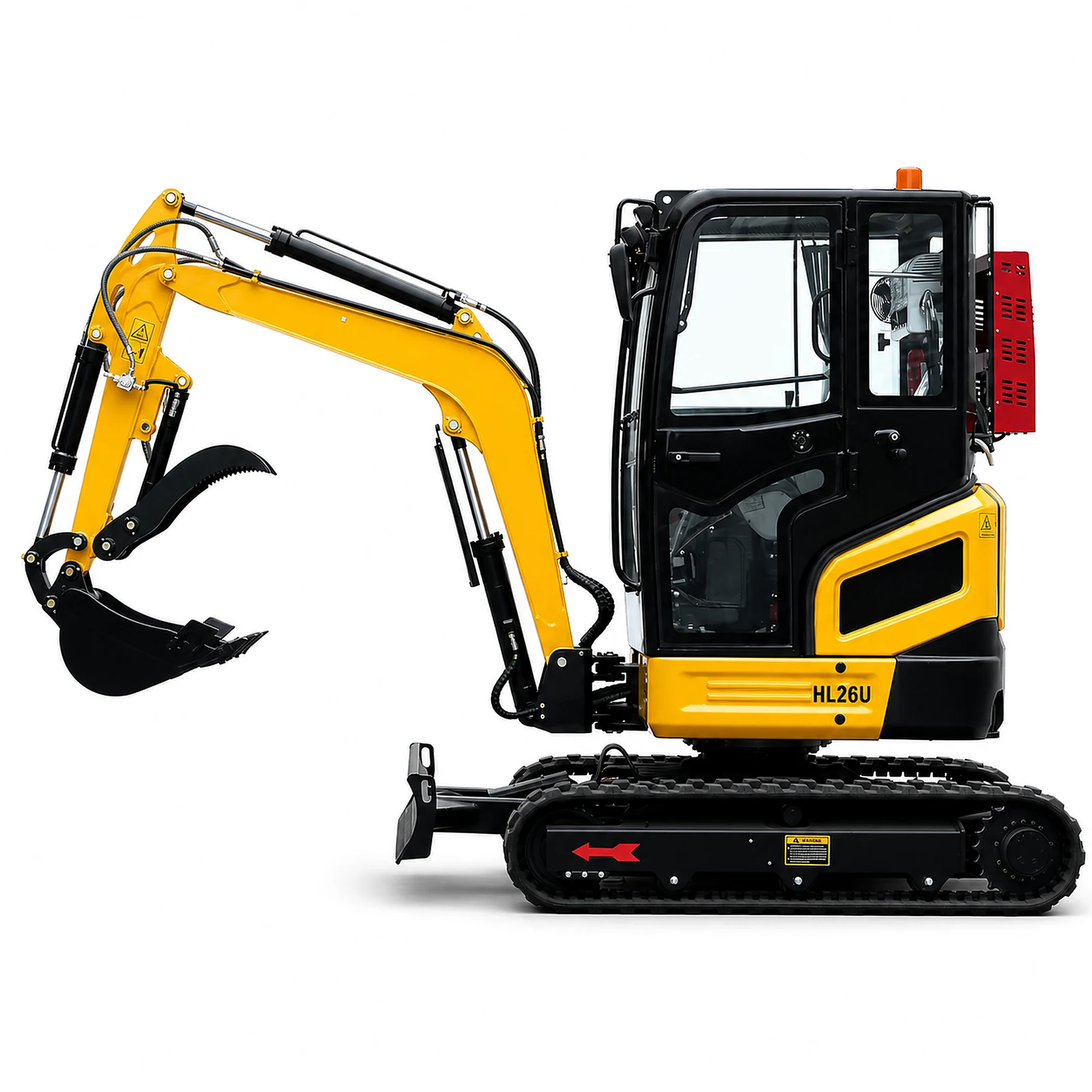
Operating weight 2,500 kg · 2,745 mm dig depth · 0.075 m³ bucket · Kubota engine
The HL26U is built around a short tail swing configuration — the “U” in the model designation. Its 892 mm body swing radius against a 1,260 mm body width means the counterweight stays close to the machine’s own footprint during rotation, which is what allows it to work alongside walls, fences, and structures where a conventional tail swing machine has to be repositioned or cannot rotate at all.
The Hongli HL26U small excavator has an operating weight of 2,500 kg, an overall width of 1,500 mm, an overall length of 4,185 mm, and an overall height of 2,280 mm with open canopy or 2,450 mm with enclosed cab. It reaches a maximum digging depth of 2,745 mm, a maximum digging radius of 4,350 mm, and a maximum digging height of 3,453 mm, with a 0.075 m³ bucket. It runs on 250 mm rubber tracks as standard, uses a Kubota engine in base configuration with Perkins and Changchai engines available as options, and is manufactured by Tai’an Hongli Machinery Equipment Co., Ltd. for export worldwide.
This page covers the full specification, what short tail swing means in practice, and which optional configurations are worth specifying.
Quick Specifications
| Specification | Value |
|---|---|
| Operating weight | 2,500 kg (2.5 ton) |
| Overall width | 1,500 mm |
| Overall length | 4,185 mm |
| Overall height | 2,280 mm (canopy) / 2,450 mm (cab) |
| Body swing radius | 892 mm |
| Max. digging depth | 2,745 mm |
| Max. digging radius | 4,350 mm |
| Max. digging height | 3,453 mm |
| Max. unloading height | 2,366 mm |
| Bucket capacity | 0.075 m³ |
| Bucket width | 500 mm |
| Engine | Kubota (Perkins / Changchai available) |
Need pricing for your market? Send us your destination country, required engine configuration, cab preference, attachments, and expected quantity — we return an itemised FOB quotation, typically within 24 hours. hongli@hongli-mach.com · WhatsApp +86 131 0548 1184
What Short Tail Swing Actually Buys You
On a conventional excavator the counterweight swings well beyond the tracks during rotation. On an open site that costs nothing. Against a wall, a fence, a parked vehicle, or an adjacent structure, it decides whether the machine can turn at all — and a machine that cannot rotate has to be repositioned for every load, which is where the working day disappears.
The HL26U’s 892 mm body swing radius against a 1,260 mm body width keeps the tail close to the machine’s own footprint through the rotation. In practical terms:
Working against boundaries. Trenching alongside a building wall, a property fence, or a retaining structure without repositioning between scoops.
Roadside and verge work. Rotating to load a truck in a live traffic lane without the counterweight swinging into the adjacent lane.
Congested sites. Urban plots, between buildings, alongside parked equipment or stockpiled material.
Reduced damage risk. Fewer opportunities to strike a wall, vehicle, or structure with the counterweight — which matters on jobs where damage claims exceed the day rate.
What it costs: short tail swing designs typically carry a modest price premium and can trade away a small amount of over-side lift capacity compared with a conventional machine of the same weight. On the work this machine is built for, that is usually the correct trade.
Who the HL26U Is For
Urban and municipal contractors. Work between buildings, alongside roads, and in confined public spaces is where short tail swing pays for itself daily rather than occasionally.
Utility crews working in live environments. Trenching alongside active roads, existing services, and occupied structures — situations where a swinging counterweight is a hazard rather than an inconvenience.
Contractors doing footings and foundations against existing structures. Extensions, boundary walls, and infill work where the machine has to operate close to what is already standing.
Landscaping contractors on established properties. Mature gardens with fences, walls, and planting to protect — although note the 1,500 mm overall width rules out gate access, so this suits properties with open or vehicle access.
Buyers who want depth and reach with rotation discipline. At 2,745 mm dig depth and 4,350 mm reach, the HL26U matches the deeper 2-tonne machines while adding the rotation advantage.
Where the HL26U Is Not the Right Machine
At 1,500 mm overall width and 4,185 mm length, this is not a gate-access machine — residential backyard work through side gates belongs to the HL18 at 1,100 mm or the HL20 at 1,060 mm. And if your sites are open ground where rotation clearance is never a constraint, you are paying for a capability the work will not use — a conventional machine at similar weight delivers the same digging performance for less.
Full Technical Specifications
Main Specifications
| Item | Unit | Parameter |
|---|---|---|
| Model | / | HL26U |
| Operating weight | ton | 2.5 |
| Digging bucket capacity | m³ | 0.075 |
| Bucket width | mm | 500 |
| Overall length | mm | 4,185 |
| Overall width | mm | 1,500 |
| Overall height | mm | 2,280 / 2,450 |
| Body width | mm | 1,260 |
| Body swing radius | mm | 892 |
| Body swing angle | ° | 360 |
| Boom swing angle (L/R) | ° | 55 / 45 |
| Max. grade ability | ° | 35 |
| Max. digging radius | mm | 4,350 |
| Max. digging depth | mm | 2,745 |
| Max. digging height | mm | 3,453 |
| Max. unloading height | mm | 2,366 |
| Min. swing radius | mm | 2,159 |
| Max. dozer blade digging depth | mm | 293 |
| Max. dozer blade lifting height | mm | 191 |
| Track type | / | Rubber tracks |
Tank Capacity
| Item | Unit | Parameter |
|---|---|---|
| Fuel tank | L | 16 |
| Hydraulic tank | L | 26 |
Track Configuration
| Item | Unit | Parameter |
|---|---|---|
| Track type | / | Rubber tracks |
| Track width | mm | 250 |
| Track length | mm | 2,044 |
Specifications are subject to change without prior notice. Confirm the specification sheet for your exact configuration before ordering.
Reading the Working Range
892 mm body swing radius is the defining number on this machine. Compare it against the 1,260 mm body width: the rotating structure stays well within the machine’s own footprint, which is the whole point of the configuration.
2,745 mm dig depth covers sewer laterals, frost-line utility burial, and deeper footings — the same depth class as the HL22, with the rotation advantage added.
4,350 mm digging radius with 3,453 mm digging height completes long trench sections per setup and loads standard trucks comfortably. The 2,366 mm unloading height is the figure to check against the sides of whatever you load into.
26 L hydraulic tank is larger than the 22 L fitted to the 2.1-tonne machines — relevant for sustained hydraulic work and heat management on long production days.
250 mm track width with 2,044 mm track length gives a longer, wider footprint than the smaller class, which improves stability through the extended working range and reduces ground pressure on soft surfaces.
Two overall height figures — 2,280 mm and 2,450 mm — correspond to open canopy and enclosed cab configurations respectively. Check the relevant figure against any height restriction on your sites, including low entrances and overhead services.
55° / 45° boom swing allows trenching parallel to boundaries without repositioning, complementing the short tail swing on exactly the work this machine targets.
Optional Configurations Worth Specifying
Fully enclosed cab with air conditioning. Base configuration is an open canopy. Note that specifying the cab raises overall height from 2,280 mm to 2,450 mm — check this against site height restrictions before ordering. For full working days on urban and municipal sites, the enclosed climate-controlled cab is generally worth it.
Hydraulic pilot control. On a machine designed for precise work in confined spaces, control precision matters more than usual. Specify pilot control unless the machine is for genuinely occasional use.
Hydraulic quick coupler. Urban and utility work alternates between attachments constantly. Seconds per changeover rather than minutes.
Retractable chassis (telescopic undercarriage). Narrows the undercarriage for transit and extends for digging stability. At 1,500 mm standard width this is worth considering for transport and constrained site entry.
Side swing boom. Extends the boom’s independent pivot range for work parallel to boundaries and obstacles.
Steel tracks. Appropriate for abrasive and rocky ground. Not appropriate for finished urban surfaces, paving, or turf — rubber remains correct for most of the work this machine is built for.
Engine options. The HL26U ships with a Kubota engine in base configuration. Perkins and Changchai configurations are available — Perkins is relevant where Caterpillar dealer infrastructure is the dominant local service network, Changchai is a lower-cost option for markets without emission documentation requirements. Confirm the exact engine model, engine family, and certification coverage for your destination market at the time of quotation. Our guide to mini excavator engine brands covers how these compare.
Engine and Compliance
Engine configuration should be settled before the order is placed. Emission and compliance requirements differ by market: machines bound for the United States require an engine configuration conforming to applicable EPA nonroad emissions requirements, machines placed on the EU market generally require configurations complying with applicable EU Stage V and type-approval requirements, and regulations elsewhere vary by country and engine power category.
An engine brand name alone does not establish compliance — the specific engine family, model year, emissions label, and certificate coverage must be confirmed for your destination market. Our guide to EPA-compliant excavators covers what documentation to request and how to verify it.
HL26U Compared With Adjacent Models
| Specification | HL20 | HL22 | HL26U |
|---|---|---|---|
| Operating weight | 2.1 t | 2.1 t | 2.5 t |
| Overall width | 1,060 mm | 1,350 mm | 1,500 mm |
| Body swing radius | 894 mm | 914 mm | 892 mm |
| Max. digging depth | 2,418 mm | 2,752 mm | 2,745 mm |
| Max. digging radius | 4,112 mm | 4,390 mm | 4,350 mm |
| Bucket capacity | 0.07 m³ | 0.07 m³ | 0.075 m³ |
| Hydraulic tank | 22 L | 22 L | 26 L |
| Track width | 230 mm | 230 mm | 250 mm |
The HL26U and HL22 reach virtually the same depth and radius. What separates them is the HL26U’s short tail swing configuration, larger hydraulic capacity, wider tracks, and 400 kg of additional operating weight for stability.
Choose the HL26U when the work happens against walls, structures, and boundaries, and rotation clearance is a daily constraint. Choose the HL22 when depth matters but sites are open enough that tail swing is not an issue. Choose the HL20 when access width is the binding constraint.
Our mini excavator size chart covers how every class compares across dig depth, width, and transport requirements.
Frequently Asked Questions
What does the “U” in HL26U mean?
The U designation indicates the short tail swing configuration. The machine’s 892 mm body swing radius keeps the counterweight close to its own footprint during rotation, allowing work alongside walls, fences, and structures where a conventional tail swing machine would need repositioning.
How deep can the HL26U dig?
Maximum digging depth is 2,745 mm, with a maximum digging radius of 4,350 mm and maximum digging height of 3,453 mm. That covers sewer laterals, frost-line utility burial, and deeper footings.
Is short tail swing worth the extra cost?
It depends entirely on your sites. If a meaningful share of your work happens against walls, fences, adjacent structures, or in live traffic environments, short tail swing removes repositioning cycles from every load and reduces the risk of striking something with the counterweight. If your sites are open ground, the capability goes unused and a conventional machine at similar weight delivers the same digging performance for less.
What engine does the HL26U use?
The base configuration uses a Kubota engine, with Perkins and Changchai configurations available as options. Confirm the exact engine model, engine family, and certification coverage for your destination market before ordering — brand name alone does not establish emission compliance.
How tall is the HL26U?
Overall height is 2,280 mm with the open canopy configuration and 2,450 mm with the enclosed cab. Check the relevant figure against any height restrictions on your sites — low entrances, overhead services, and transport clearances — before selecting the cab option.
Request a Quotation
To receive an itemised FOB quotation for the HL26U, send us:
Destination country and port:
Engine requirement (Kubota / Perkins / Changchai / emission standard):
Cab type (open canopy / enclosed / enclosed with A/C):
Track type (rubber / steel):
Retractable chassis (yes / no):
Attachments required:
Expected quantity:
Most quotations are prepared within 24 hours of receiving a complete specification.
Contact: hongli@hongli-mach.com · WhatsApp +86 131 0548 1184
Related reading: Mini Excavator Size Chart Explained · China Mini Excavator Price Guide 2026 · Mini Excavator Engine Brands Explained · Chinese vs Japanese Mini Excavators