
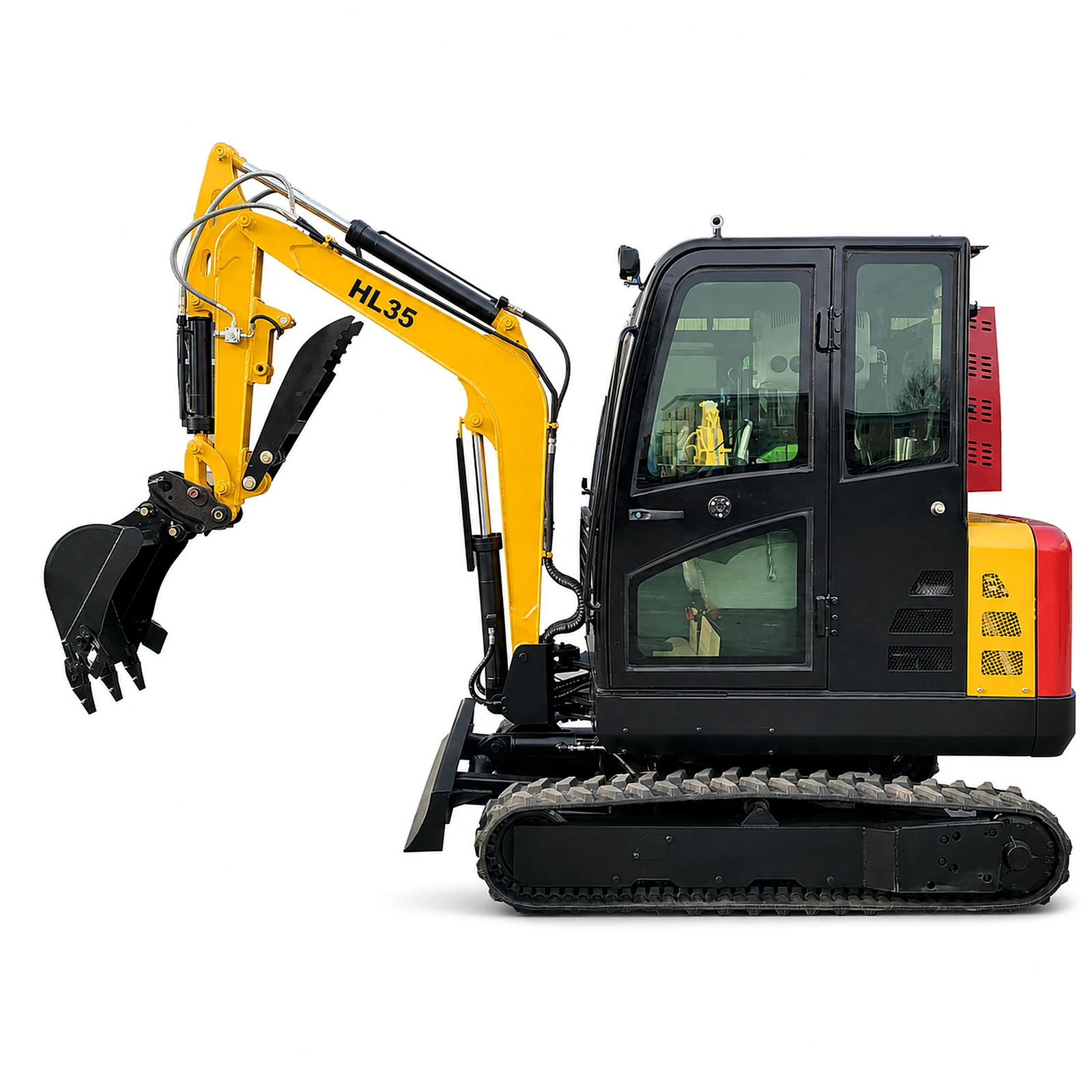
Catalog operating weight: 2.5 t | Digging bucket: 0.1 m³ | Overall width: 1,500 mm | Maximum digging depth: 3,058 mm
The Hongli HL35 is a small excavator supplied by Tai’an Hongli Machinery Equipment Co., Ltd. Its English catalog lists a 2.5-tonne operating weight, a 0.1 m³ digging bucket, 1,500 mm overall width and 3,058 mm maximum digging depth. HL35 is a model designation, not a claim of 3.5-tonne operating weight. Engine and optional equipment must be identified in the quotation for the delivered configuration.
Send your destination country, excavation requirements, access dimensions, engine-document requirements, attachments and expected quantity. Request an HL35 configuration review before choosing between adjacent models.
The Engine Number Is Not a Hydraulic Performance Rating
The HL35 configuration sheet lists a Xinchai 490 engine reference at 36.8 kW and other engine choices with different power figures. Those entries do not establish that every HL35 has the same engine or that the figures use comparable speeds and power definitions. The current product record separately identifies Changchai 390. Resolve the actual supplied engine in writing rather than treating any one of these entries as a universal standard.
A higher engine-power number does not independently tell you how much usable flow an attachment receives. The engine supplies mechanical power; the pump, hydraulic settings, control circuit and attachment determine how that power can be used. An engine rating is not an auxiliary flow specification, a bucket breakout-force figure or a guarantee of faster cycles.
When comparing configurations, request the exact engine variant, rated speed, power definition, pump specification, hydraulic pressure settings and available auxiliary flow at the specified operating condition. Ask whether travel or other functions affect the attachment supply. If these records are unavailable, the honest conclusion is that the hydraulic comparison is incomplete.
This matters when buying a breaker, auger or grapple. A fitting that connects successfully does not prove that the attachment can work correctly. Match its required flow, pressure, return arrangement and control mode to the actual machine. Mechanical connection and hydraulic compatibility are separate checks.
For dealers, keeping the engine variant and hydraulic configuration in the order record also makes repeat orders and parts identification more reliable. Do not approve the next shipment simply because its exterior and HL35 model marking look familiar. Our engine buying guide explains the engine information to request.
Where the HL35 Fits—and Where It May Not
Consider the HL35 for small excavation, landscaping, drainage and farm-maintenance work when its actual working geometry, attachments and access envelope fit the project. These application labels are starting points for a specification discussion, not a substitute for the required trench dimensions or material conditions.
Do not buy it simply because you expect the number 35 to mean a larger digging envelope than the HL30. The supplied catalogs give these two models the same headline digging depth, radius and bucket capacity. If the HL30 already meets your requirements, the HL35 needs a documented configuration reason to justify the change.
Do not choose it for an access route that cannot accommodate the verified 1,500 mm overall width and maneuvering clearance. The 1,350 mm upper-body width is a separate dimension. Confirm overhead clearance for the actual cab or canopy as well as the width at the narrowest point.
If your purchasing decision depends on a specific lifting capacity, bucket digging force, continuous attachment duty or emissions approval, ask for the applicable evidence first. The supplied catalog does not give enough information to approve those requirements. A machine outside this model range may be the appropriate choice.
HL35 Reference Specifications
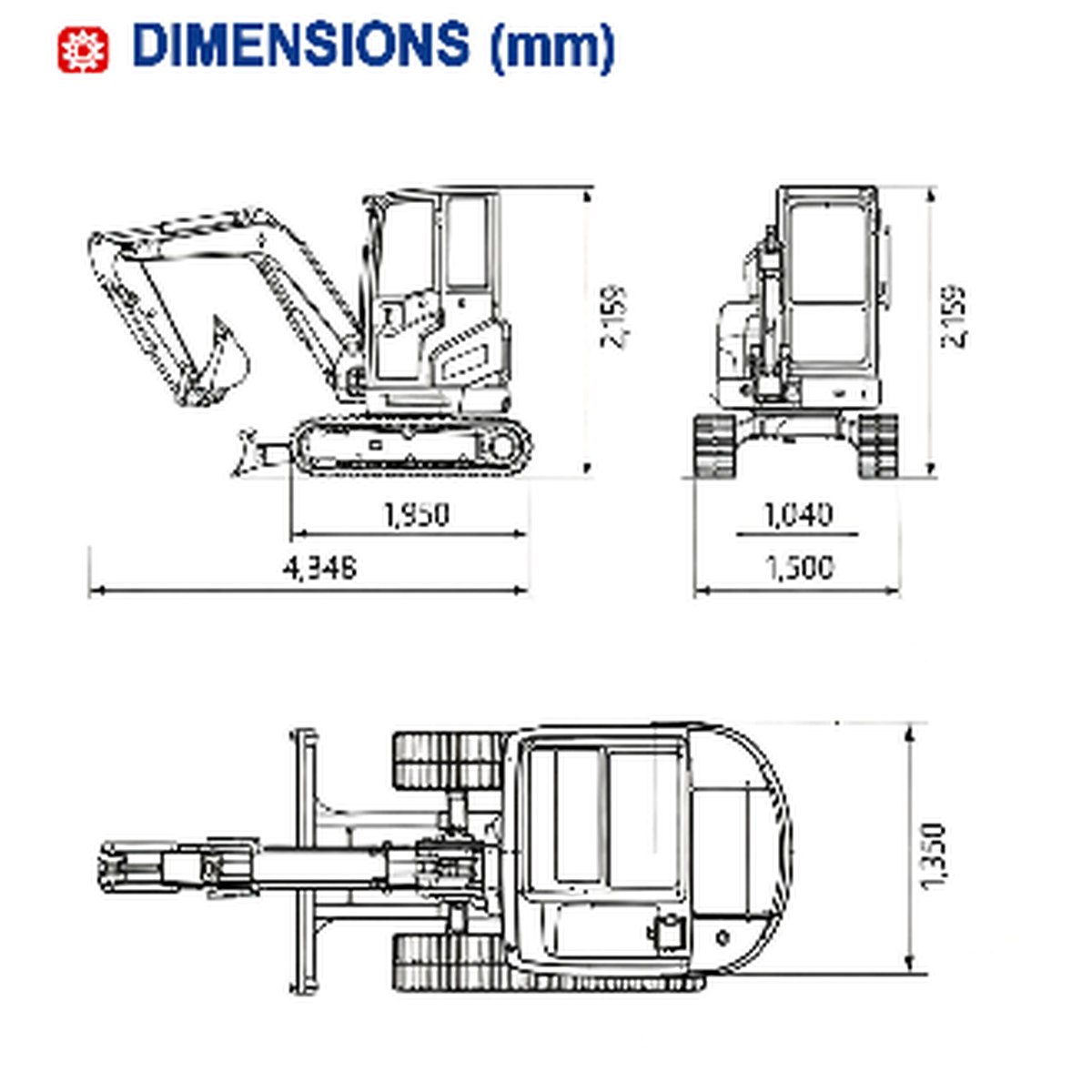
The dimensional and working-range values below follow the supplied English catalog, pages 13–14. Tank values are deliberately qualified because the catalog and configuration spreadsheet disagree. Confirm the final build before ordering.
| Item | Reference value | What to check |
|---|---|---|
| Model | HL35 | Model number is not machine weight |
| Operating weight | 2.5 t / 2,500 kg | Confirm what the stated weight includes |
| Digging bucket capacity | 0.1 m³ | Bucket volume, not payload or output |
| Bucket width | 500 mm | Spreadsheet excludes side teeth; confirm the actual cutting envelope |
| Overall length | 4,348 mm | Verify transport position and attachment |
| Overall width | 1,500 mm | Use overall width for initial access screening |
| Overall height | 2,159 mm | Verify the ordered cab or canopy |
| Upper-body width | 1,350 mm | Different from overall width |
| Body swing radius | 1,291 mm | Does not prove zero-tail-swing behavior |
| Body rotation | 360° | Check surrounding clearance |
| Boom swing, left / right | 45° / 55° | Confirm the direction convention |
| Maximum digging radius | 4,477 mm | Separate boundary from maximum depth |
| Maximum digging depth | 3,058 mm | Not a stated vertical-wall digging depth |
| Maximum digging height | 3,445 mm | Verify the required working position |
| Maximum unloading height | 2,203 mm | Check bucket clearance over the receiving vehicle |
| Minimum swing radius | 2,165 mm | Catalog label; distinct from body swing radius |
| Maximum blade digging depth | 297 mm | Not a lifting-capacity rating |
| Maximum blade lifting height | 230 mm | Reference blade geometry |
| Reference tracks | Rubber | Steel tracks listed as an option |
| Track width | 230 mm | Does not establish ground pressure alone |
| Track length | 1,950 mm | Not a verified ground-contact length |
| Fuel tank | Catalog: 41 L; spreadsheet: 40 L | Capacity discrepancy; confirm the ordered tank |
| Hydraulic tank | Catalog: 40 L; spreadsheet: 41 L | Capacity discrepancy; not auxiliary flow or total system volume |
The catalog lists 35° maximum grade ability. That value is not presented here as a safe working-slope or loading-ramp angle. Use the applicable operating instructions and site assessment.
Read the Geometry Before Promising a Job
Maximum depth, maximum radius and maximum unloading height describe different boundaries. They are not a single position that the machine can achieve simultaneously. For a trench beside a structure, specify the required wall profile and where the machine can stand. A 3,058 mm maximum depth alone does not prove that a vertical wall can be excavated to that depth from the available setback.
For truck loading, identify the discharge height, required reach and available machine position. The 2,203 mm unloading-height reference does not guarantee useful clearance over a particular truck side. Check the actual bucket path rather than comparing one catalog number with the vehicle’s height.
The catalog’s body swing radius also should not be used to declare this model zero tail swing. Check the rear clearance relative to the actual undercarriage throughout the required rotation. If working beside a wall is a purchase-critical constraint, request a measured demonstration of the selected configuration.
The working-range and dimension drawings are reference documents, not lifting charts. Bucket and coupler changes may alter the working geometry. They must be included when assessing the delivered machine.
Select Options for the Constraint They Solve
The English catalog lists an operator cab, air conditioning, offset boom and steel tracks as options. Confirm whether a feature is included or optional in the actual quotation: the same catalog also provides boom-swing angles, so the drawing alone does not establish the commercial equipment package.
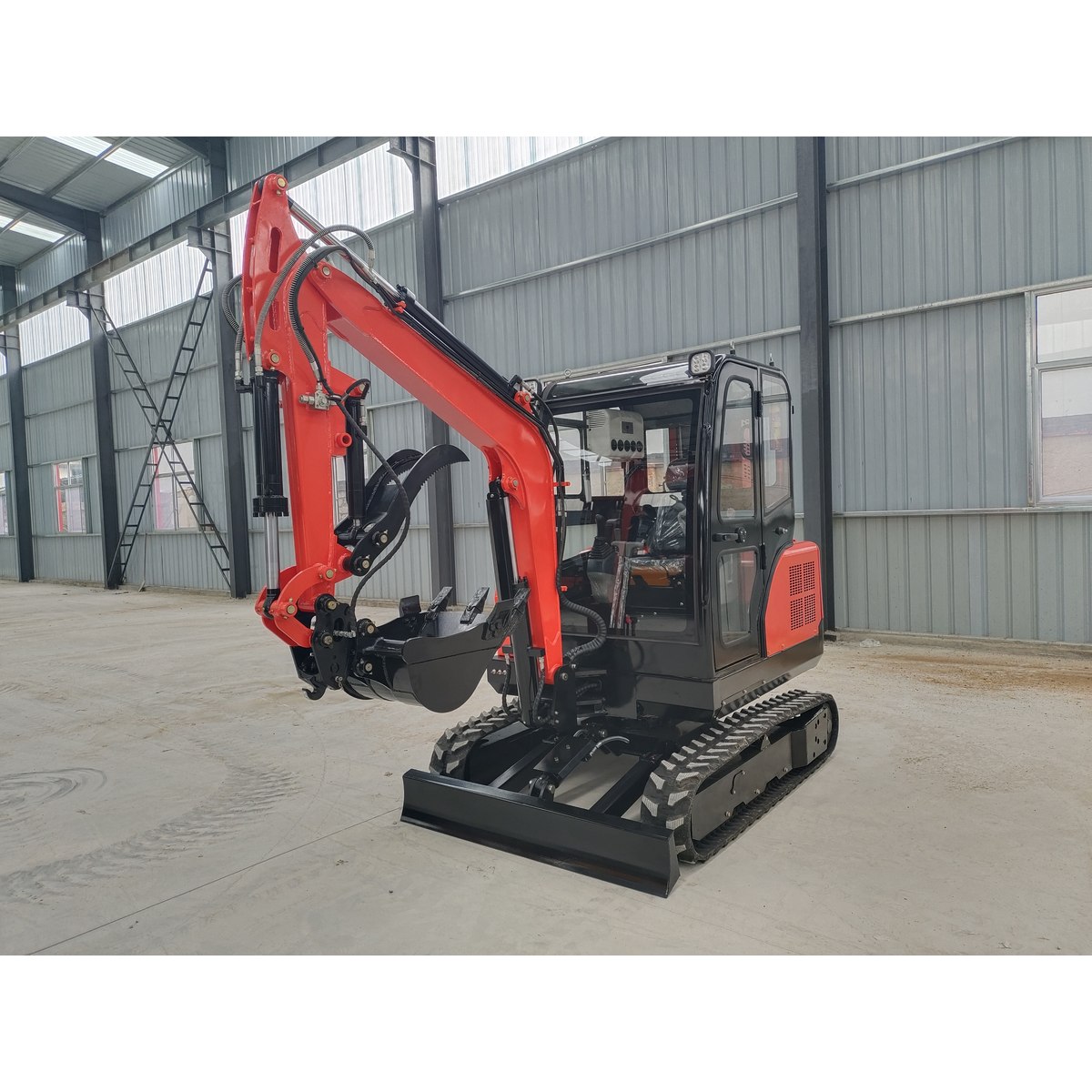
A photographed enclosed cab does not prove that every order includes it or that air conditioning is fitted. Record the cab arrangement, cooling equipment, visibility requirements and overall dimensions. The factory photograph on this page illustrates a supplied example, not the specification of every HL35.
For track selection, describe your surfaces and material conditions. Rubber tracks do not guarantee damage-free travel, and steel tracks are not automatically the better choice for every excavation task. Assess the actual route, operating conditions and transport implications.
The reference 500 mm bucket may be suitable for some tasks and unnecessarily wide for others. Request an approved bucket suited to the finished excavation geometry. Confirm its mass and mounting dimensions rather than choosing by nominal machine tonnage. Use our bucket compatibility checklist before ordering replacements.
Engine selection must include the destination-market requirements and exact variant. A brand name, or an emissions label used loosely in a configuration list, is insufficient evidence of compliance for the shipped unit. Ask for the identification label and applicable documents before approving the order.
HL35 Compared With HL30 and HL35U
The HL30 catalog lists 2.4 t operating weight, compared with 2.5 t for the HL35. Both list a 0.1 m³ bucket, 1,500 mm overall width, 4,348 mm overall length and 3,058 mm maximum digging depth. These close headline values make configuration evidence more useful than the model-number difference.
The HL30 catalog lists a 20 L fuel tank, while the HL35 sources list 40 or 41 L. That is a tank-capacity distinction to verify; it does not establish fuel efficiency or working hours. The HL35 engine references also differ from the HL30 configuration list, but incomplete power-rating information does not support a percentage-performance claim.
The HL35U is another candidate when dimensions or rear clearance are important. Compare the actual machine drawings, rear clearance, working geometry and equipment package. Do not infer zero-tail-swing behavior or a performance advantage solely from the U suffix. Our size-selection guide covers the broader selection process.
Frequently Asked Questions
Does HL35 mean a 3.5-tonne excavator?
No. The supplied English catalog lists 2.5 t operating weight. Obtain the weight and its definition for the ordered configuration instead of interpreting the model digits as tonnes.
Does the HL35 dig deeper than the HL30?
The supplied catalogs list 3,058 mm maximum digging depth for both. They also share the listed maximum radius and bucket capacity. Compare actual configurations and working geometry rather than assuming a deeper reach from the HL35 name.
Is Xinchai 490 the standard HL35 engine?
The configuration sheet lists Xinchai 490, while the current product record identifies Changchai 390 and other choices appear in the supplied materials. These records do not establish a universal standard engine. The quotation must name the exact supplied variant and supporting technical documents.
Does the higher listed engine power make a breaker work faster?
The engine-power entry alone cannot answer that question. Confirm the actual auxiliary flow, pressure, return arrangement, operating condition and breaker requirements. Without those specifications and applicable duty evidence, a production comparison would be unsupported.
Is the fuel tank 40 L or 41 L?
The English catalog lists 41 L fuel and 40 L hydraulic tank capacity; the spreadsheet lists 40 L fuel and 41 L hydraulic capacity. Confirm both tanks for the actual order. Neither number establishes fuel consumption, runtime or total hydraulic-system oil volume.
Can I plan transport using the 2,500 kg operating weight?
Use it only as a reference starting point. Establish the weight definition, actual cab, tracks, attachments and loose cargo, and obtain the loaded transport mass. Check usable trailer payload and the relevant gross, axle, hitch and towing-vehicle limits. Operating weight alone is not a trailer approval.
Request an HL35 Configuration Review
For a useful assessment and quotation, send:
- Destination country and delivery location.
- Excavation dimensions, wall profile and material conditions.
- Access width, overhead clearance and available working area.
- Loading height or lifting requirements, if applicable.
- Required engine documents and local service preferences.
- Cab, cooling, track, bucket and powered-attachment requirements.
- Transport constraints, intended use and expected quantity.
Send your HL35 requirements to Hongli. Tai’an Hongli Machinery Equipment Co., Ltd. can review the available information and identify the evidence needed for the proposed configuration. If the HL30 already meets the task, or another machine class is required, settle that before choosing by model number.
About the Author
Avicii Meng, Head of Technical Engineering | Hongli Machinery
Avicii Meng works with Tai’an Hongli Machinery Equipment Co., Ltd. on export equipment configurations and technical purchasing questions for international buyers.