
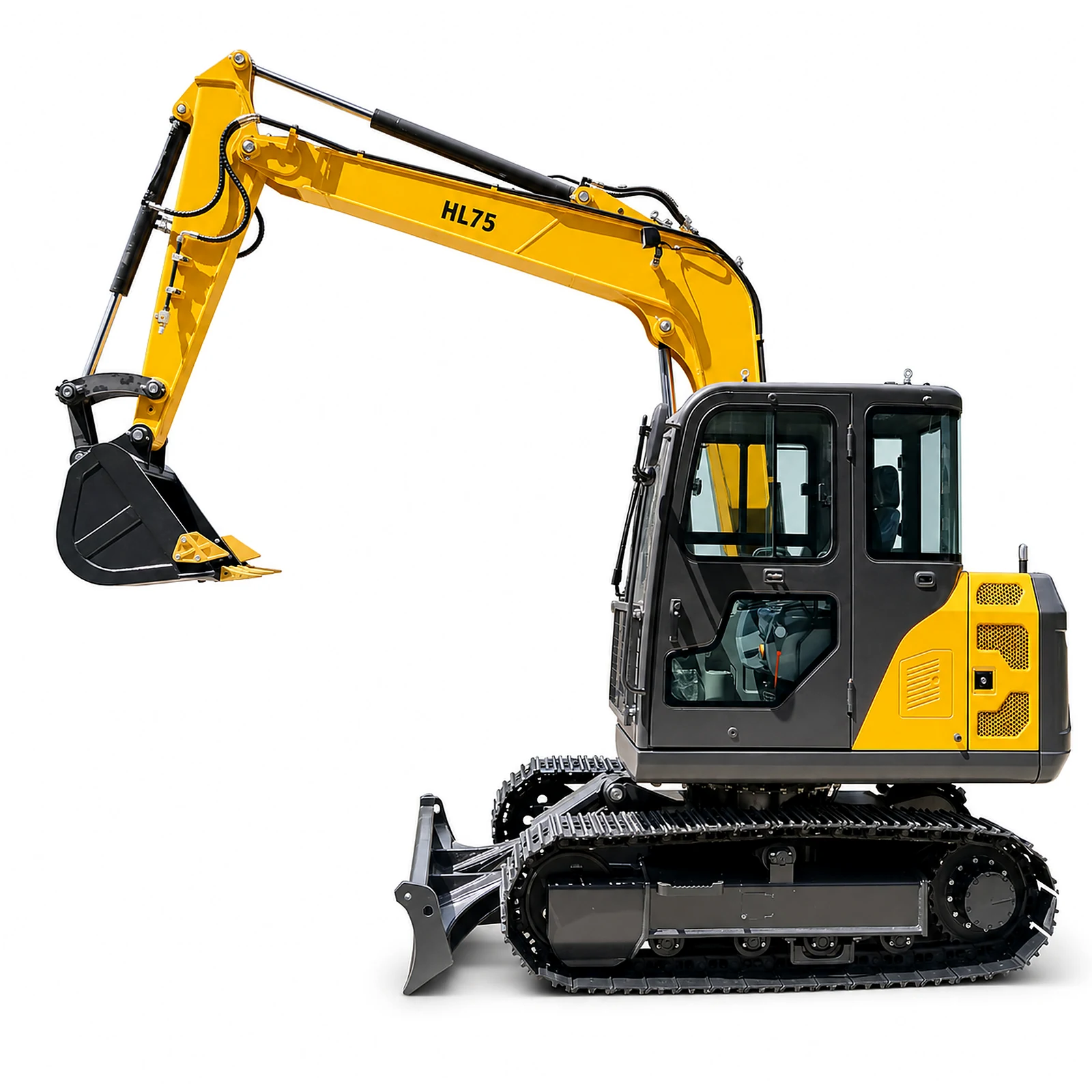
Two catalog references: 0.28 m³ / 0.4 m³ buckets | Maximum digging depth: 3,898 / 4,015 mm | Operating weight: confirm for the quoted build
The Hongli HL75 is a small excavator offered by Tai’an Hongli Machinery Equipment Co., Ltd. The supplied English catalog contains two HL75 specification sets. One lists a 0.28 m³ bucket and 3,898 mm maximum digging depth; the other lists a 0.4 m³ bucket and 4,015 mm maximum digging depth. Their dimensions, working ranges and force entries differ. Neither set states operating weight, so this page does not identify the HL75 as a 7.5-tonne machine.
Current production availability must be confirmed at quotation. Hongli must identify which HL75 specification set applies to the quoted build before an order is agreed. Until then, the two catalog references are shown separately and should not be combined.
Send your destination country, excavation geometry, material, loading requirements, access constraints, attachments and expected quantity. Ask Hongli to identify the appropriate HL75 specification before comparing quotations or planning transport.
Do Not Build a Machine From the Best Number in Each Column
Two specification sheets can share a model name without describing the same ordered machine. Combining the smaller reference’s dimensions with the other reference’s larger bucket or deeper vertical digging figure creates a specification neither sheet supports.
For clarity, this page calls the catalog references A and B. These are editorial labels for the two published sets, not confirmed factory package names. Reference A identifies the 0.28 m³ specification set. Reference B identifies the 0.4 m³ specification set. Ask which current build, engine and attachments a quotation actually covers.
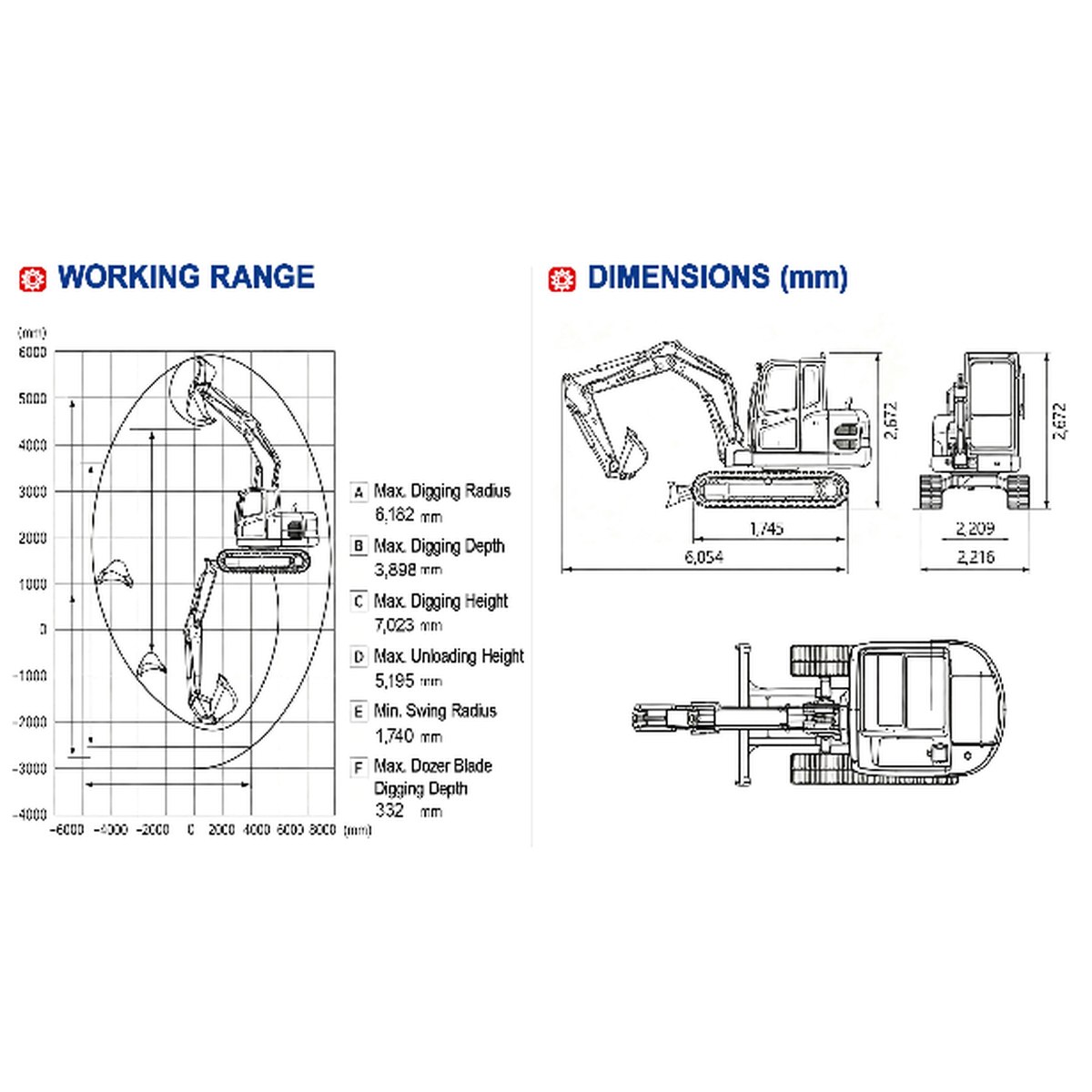
The distinction matters especially for trench work. Reference A lists 3,898 mm maximum digging depth but 2,968 mm maximum vertical digging depth. That is a 930 mm difference between two different limits. Reference B lists 4,015 mm maximum depth and 3,550 mm vertical depth, a 465 mm difference. These differences are arithmetic descriptions, not safety margins or approved trench designs.
If your requirement concerns a vertical wall, using maximum depth alone can produce the wrong selection. Define the wall profile, machine setback and attachment, then confirm the appropriate working envelope. Do not substitute Reference B’s vertical depth into Reference A’s smaller overall dimensions.
The same discipline applies to buying a bucket. A 0.4 m³ bucket reference does not prove that this bucket can be installed on the 0.28 m³ reference machine with unchanged performance. Verify the actual mounting, attachment mass, working geometry and applicable limits. Our bucket compatibility checklist explains the connection measurements to obtain.
Who Should Consider the HL75?
Assess the HL75 when the HL65’s 3,506 mm maximum digging depth does not cover your required working envelope: the HL75 references list 3,898 and 4,015 mm. For vertical-wall work, check the separate vertical-depth values and actual machine setback rather than relying on those maximum depths.
It is also worth reviewing when the task calls for a bucket specification beyond the HL65’s 0.23 m³ reference: the HL75 sets list 0.28 and 0.4 m³. Confirm that the chosen attachment suits the material and working position; these volumes do not establish higher output or an approved payload.
The site must accommodate the HL75 references’ roughly 2,215–2,216 mm overall width, compared with 2,000 mm for the HL65. Buyers who can accommodate the additional width and can verify the transport requirements have a reason to investigate the applicable build. These are selection scenarios, not a promise that either catalog set is currently available.
Do not approve a quotation that lists only “HL75” while leaving the specification reference unresolved. Request one consistent order specification covering the engine, bucket, dimensions, working range and equipment. If that cannot be established, the comparison with another machine is incomplete.
If a smaller machine already meets the task, the larger bucket or model number is not itself a reason to change. Conversely, lifting objects, continuous attachment duty or a particular production target requires evidence beyond the catalog figures shown here.
HL75 Catalog References Side by Side
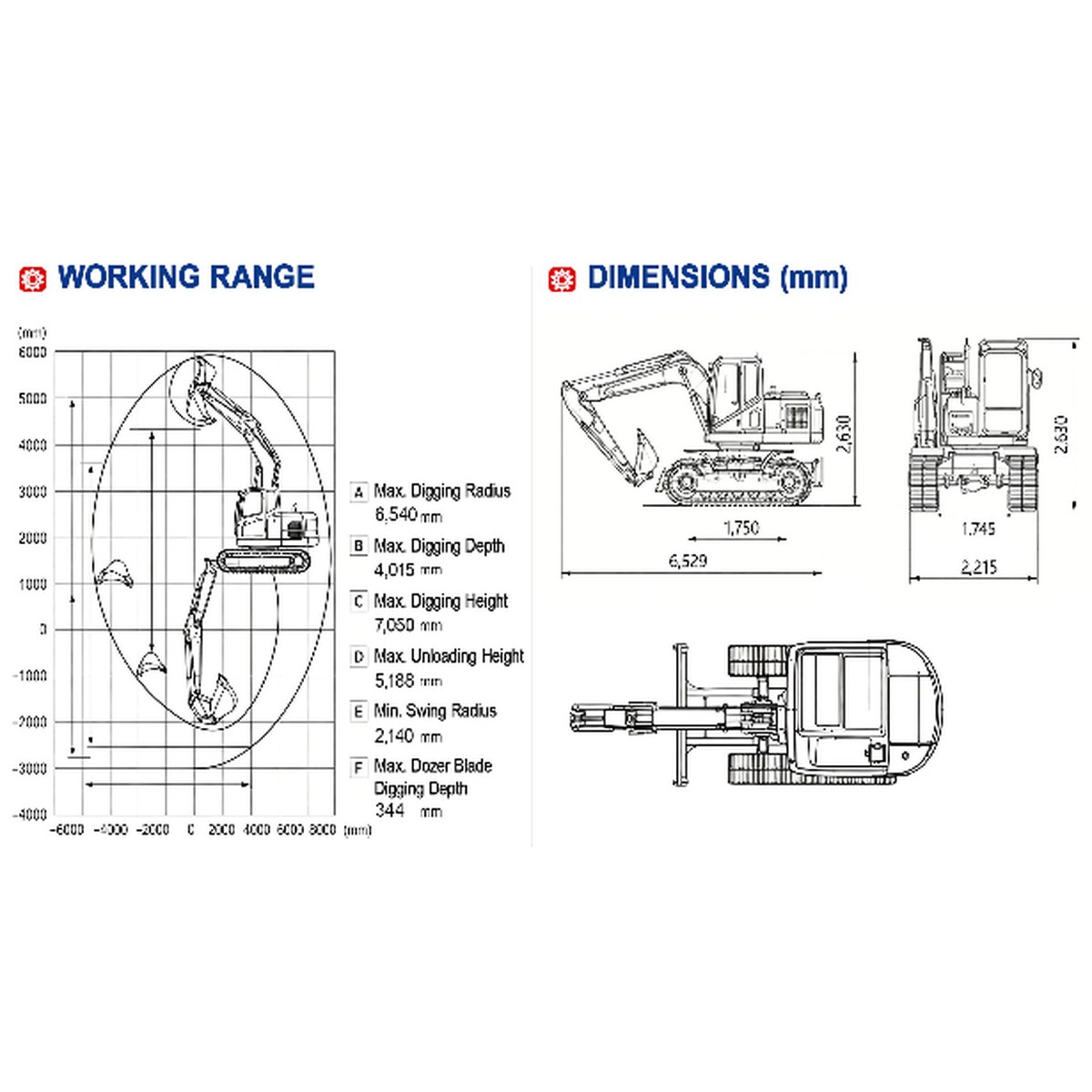
The following table keeps each source set intact. It is not a list of independently selectable options. Reference values must be tied to the quoted build before ordering.
| Item | Reference A: 0.28 m³ set | Reference B: 0.4 m³ set |
|---|---|---|
| Operating weight | Not stated | Not stated |
| Bucket capacity | 0.28 m³ | 0.4 m³ |
| Overall length | 6,054 mm | 6,529 mm |
| Overall width | 2,216 mm | 2,215 mm |
| Overall height | 2,672 mm | 2,630 mm |
| Maximum digging height | 7,023 mm | 7,050 mm |
| Maximum dumping height | 5,195 mm | 5,188 mm |
| Maximum digging depth | 3,898 mm | 4,015 mm |
| Maximum vertical digging depth | 2,968 mm | 3,550 mm |
| Maximum digging radius | 6,182 mm | 6,540 mm |
| Minimum swing radius | 1,740 mm | 2,140 mm |
| Tail swing radius | 1,730 mm | 1,929 mm |
| Maximum bucket digging force | 56 kN | 58 kN |
| Maximum arm digging force | 38 kN | 40 kN |
| System pressure | 27 MPa | 27.5 MPa |
| Swing speed | 0–11 rpm | 0–12 rpm |
| Minimum ground clearance | 375 mm | 375 mm |
| Maximum blade lifting distance | 382 mm | 370 mm |
| Maximum blade cutting distance | 332 mm | 344 mm |
Both sheets list 35° gradeability. This page does not use that entry as a safe working-slope or loading-ramp angle. The source’s undercarriage labels and diagram dimensions also need clarification before they are used for detailed planning; the overall dimensions above follow each specification table.
Digging Force, Bucket Volume and Lifting Are Different Questions
The catalog separates maximum bucket digging force from maximum arm digging force. They describe different actions and should not be added together to create a combined force rating. Neither entry is a lifting-capacity chart.
The difference between the two bucket capacities also does not establish a proportional production increase. Material resistance, density, bucket fill, attachment geometry and the actual work cycle matter. A larger volume does not prove that the bucket will fill effectively or that the machine can handle a particular load at the required radius.
System pressure is another separate specification. The 27 and 27.5 MPa entries do not state auxiliary attachment flow, permitted return pressure or continuous operating capability. For a breaker, auger or grapple, request the supply and control requirements of the attachment and match them to the actual machine circuit.
If a coupler is fitted, include it in the configuration review. Its connection and geometry matter as well as its weight. The same model name and nominal bucket size are not sufficient evidence of compatibility.
Check the Full Working Position
Reference A’s maximum dumping height is 5,195 mm, while Reference B lists 5,188 mm. The larger bucket set therefore does not have the larger number for every dimension. This is another reason to compare the actual task rather than choose a column by model assumptions.
For vehicle loading, give the receiving height, discharge position and available machine setback. Maximum height and maximum radius are separate boundaries, not one simultaneously available position. Check the actual bucket path and attachment.
For access, obtain measured dimensions of the ordered unit. The one-millimetre difference between the two listed widths is not a practical clearance allowance. Reference B is listed as 475 mm longer, while Reference A is 42 mm taller. Those values describe the catalog sets; they do not establish the transport position of an unspecified build.
Tail swing also differs between the sets. Neither the model name nor a single minimum swing-radius entry substitutes for checking the rotating outline beside an obstacle. Request the relevant drawing and configuration-specific clearance information.
Confirm Engine, Cab and Attachments Before Comparing Prices
The two technical sets do not provide a complete engine identification, rated power with speed and definition, emissions evidence or hydraulic attachment specification. Request these documents for the proposed build. Do not borrow the HL65’s engine packages simply because the model is adjacent in the range.
The quotation should identify the cab and cooling equipment, undercarriage, boom and arm, bucket, coupler and any hydraulic options. Ask which of those items are included and which are optional. Photos and videos should show the actual proposed configuration, with identification evidence where relevant.
Our engine buying checklist explains the documentation request. An engine brand name does not independently establish the delivered variant or destination-market compliance.
HL75 Compared With HL65
The HL65 catalog provides a stated 6.6 t operating weight, a 0.23 m³ bucket, 2,000 mm overall width and 3,506 mm maximum digging depth. Both HL75 reference sets list greater overall width, bucket volume and maximum digging depth, but the missing HL75 weight prevents a verified operating-weight comparison.
Those geometric differences are reasons to investigate whether an HL75 configuration resolves your requirement. They do not establish a lifting advantage, production increase or better transport suitability. If the HL65 meets the required envelope, identify the specific reason for moving to another configuration. Use the size-selection guide to organize that discussion.
Transport Requires the Missing Weight Information
Before arranging transport, obtain the actual configuration mass and what it includes. Account for fitted and loose attachments without double-counting. Distinguish operating weight, loaded transport mass and packed shipping gross mass.
Confirm the transport position, actual external dimensions and carrier requirements. Trailer gross rating is not the same as usable payload, and operating weight alone does not approve the vehicle, axles, hitch or loading arrangement. The catalog dimensions do not independently establish container fit or a securing plan.
Frequently Asked Questions
Is the HL75 a 7.5-tonne excavator?
The supplied catalog does not state operating weight for either HL75 set. Confirm the weight of the quoted build; do not derive it from “75.”
Why are there two HL75 bucket capacities?
The catalog contains a 0.28 m³ set and a 0.4 m³ set with other differing specifications. This page labels them A and B for clarity. Those labels are not confirmed factory package names. Ask which complete specification applies to your quotation.
Can I combine the smaller dimensions with the larger bucket?
Not on the evidence available here. The two source sets must remain separate. A different bucket or configuration needs its own approved fitment and performance information.
Which digging-depth figure matters for a vertical wall?
The catalog separately lists maximum vertical digging depth: 2,968 mm for A and 3,550 mm for B. Confirm the wall profile, machine setback and attachment. Do not use maximum digging depth as a substitute for vertical-wall capability.
Is 58 kN the machine’s lifting capacity?
No. It is Reference B’s listed maximum bucket digging force. Lifting capacity requires the applicable load information for the actual configuration and working position.
What information is needed before a transport quotation?
Identify the build, measured machine and cargo masses, weight definition, transport position and dimensions. For shipping, also obtain packing dimensions and gross mass. Neither the model code nor bucket size supplies the missing weight.
Request an HL75 Configuration Review
- Destination country and delivery location.
- The catalog reference or supplier specification being quoted.
- Material, trench dimensions and required vertical-wall profile.
- Receiving-vehicle geometry and available machine setback.
- Access and transport constraints, including any weight limit.
- Engine-document requirements, cab, tracks and attachments.
- Intended use and expected quantity.
Send your HL75 requirements to Hongli. Tai’an Hongli Machinery Equipment Co., Ltd. can review the available information and identify the configuration records needed before an order. Resolve the missing weight and specification identity before committing to transport or a performance-dependent purchase.
About the Author
Avicii Meng, Head of Technical Engineering | Hongli Machinery
Avicii Meng works with Tai’an Hongli Machinery Equipment Co., Ltd. on export equipment configurations and technical purchasing questions for international buyers.