
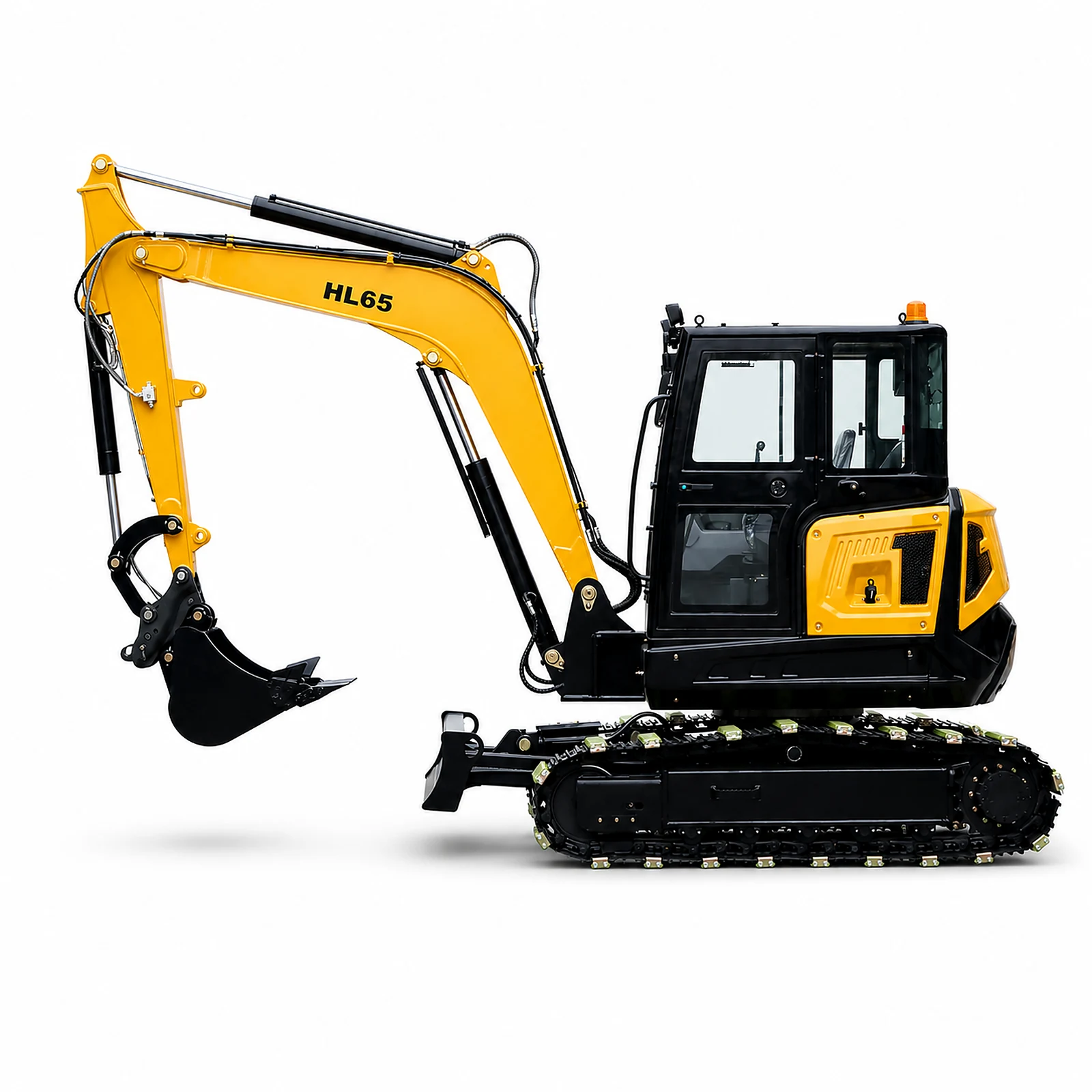
Catalog operating weight: 6.6 t | Digging bucket: 0.23 m³ | Bucket width: 700 mm | Overall width: 2,000 mm | Maximum digging depth: 3,506 mm
The Hongli HL65 is a small excavator supplied by Tai’an Hongli Machinery Equipment Co., Ltd. Its English catalog lists a 6.6-tonne operating weight, a 0.23 m³ digging bucket, 2,000 mm overall width and 3,506 mm maximum digging depth. Maximum digging radius is 6,044 mm and maximum unloading height is 3,692 mm. These are separate working-range limits. The engine, cab, tracks and attachments must be identified for the ordered configuration.
Send your destination country, material, excavation dimensions, receiving-vehicle geometry, access limits, attachments and expected quantity. Ask Hongli to assess the HL65 for your work.
Bucket Volume Is Not an Approved Working Load
The HL65’s 0.23 m³ bucket is a volume reference. It does not tell you how much mass the machine can safely handle at a particular radius or height. Material density, actual fill and the attachment itself matter.
As a hypothetical arithmetic example, 0.23 m³ of material at 1,200 kg/m³ weighs 276 kg. The same volume at 1,800 kg/m³ weighs 414 kg. These assumed densities are not measurements of your soil, an approved HL65 material-density range or a lifting assessment. They simply show why the same bucket volume can correspond to different material masses.
The attachment also has its own mass and geometry. A coupler or different bucket can change the load and its position. Consequently, neither bucket volume nor machine operating weight substitutes for the applicable load information. The supplied HL65 catalog does not provide a lifting chart, bucket digging-force value or tested production rate.
Before specifying a bucket, describe the material, required cut, loading position and intended duty. Confirm the approved attachment, its mounting and mass. For lifting objects rather than excavating, obtain the configuration-specific lifting information and approved equipment for that operation. Do not treat a digging bucket as evidence of a rated lifting arrangement.
This distinction also prevents an expensive purchasing mistake: ordering a larger bucket to obtain more output when the actual limitation is material resistance, the loading position, truck clearance or access. A larger nominal volume does not demonstrate that the machine can fill it effectively or work faster. Choose the attachment around the task, not a volume target alone.
Where the HL65 Is Worth Assessing
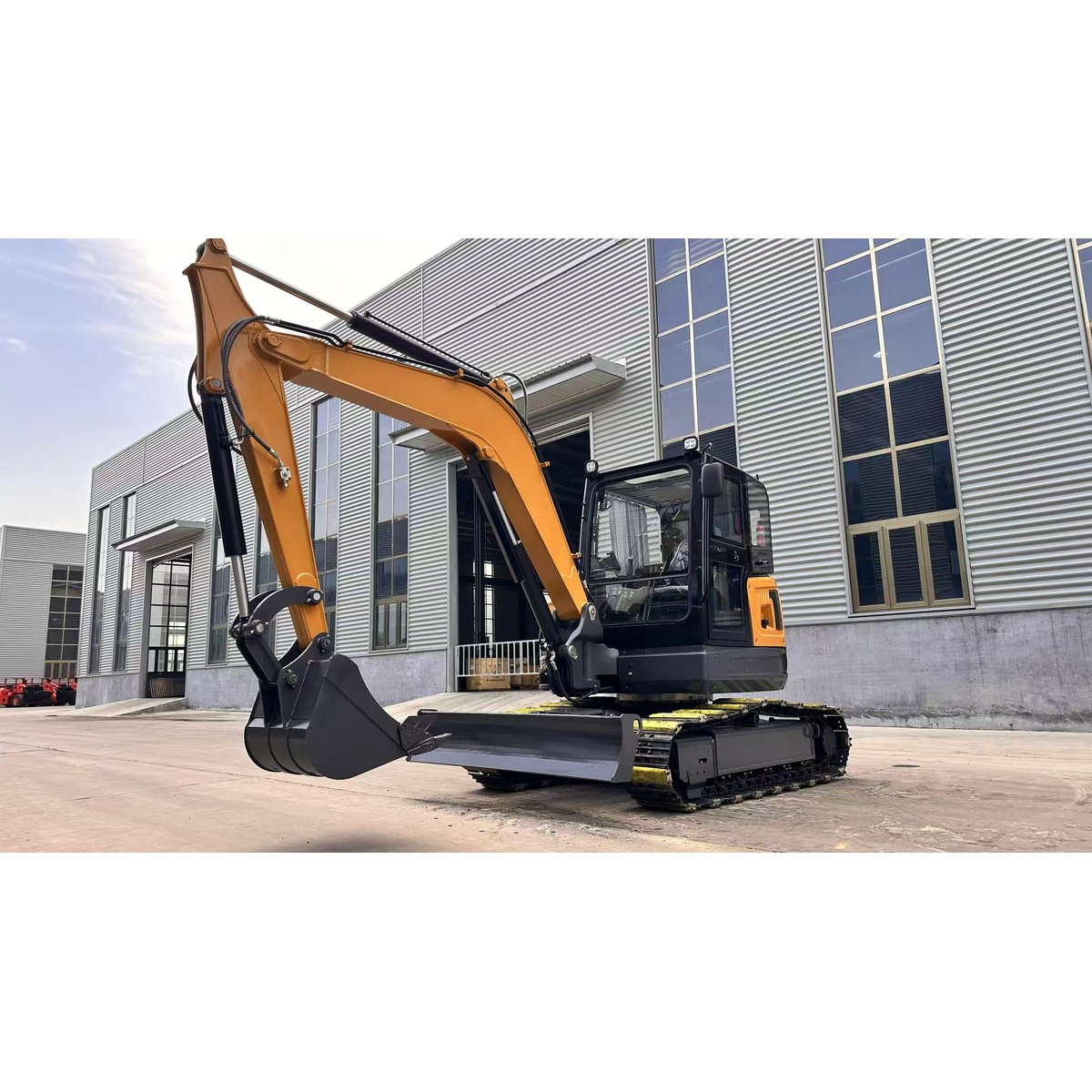
Consider the HL65 for excavation, utility work, farm maintenance and site loading when the defined task fits its verified configuration and working geometry. The reference bucket and reach make it a candidate to investigate, not a guarantee that every task in these application categories is suitable.
Do not buy it if access cannot accommodate the confirmed 2,000 mm overall width and the space needed to maneuver. The upper-body width is 1,780 mm; that narrower number is not an overall gate-clearance dimension. Check turns, obstacles and overhead clearance as well as a straight opening.
Do not select it solely for a quoted bucket size if the required trench is substantially narrower. The reference bucket is 700 mm wide; the spreadsheet excludes side teeth from this measurement. Ask which approved bucket can produce the required excavation profile without unnecessary removal, backfill and reinstatement.
If your decision depends on heavy lifting, a particular digging force or continuous powered-attachment duty, obtain the relevant evidence first. We cannot approve those requirements from the supplied reference specifications. A different machine class may be necessary, or a smaller machine may already meet the task with fewer access and transport constraints.
HL65 Reference Specifications
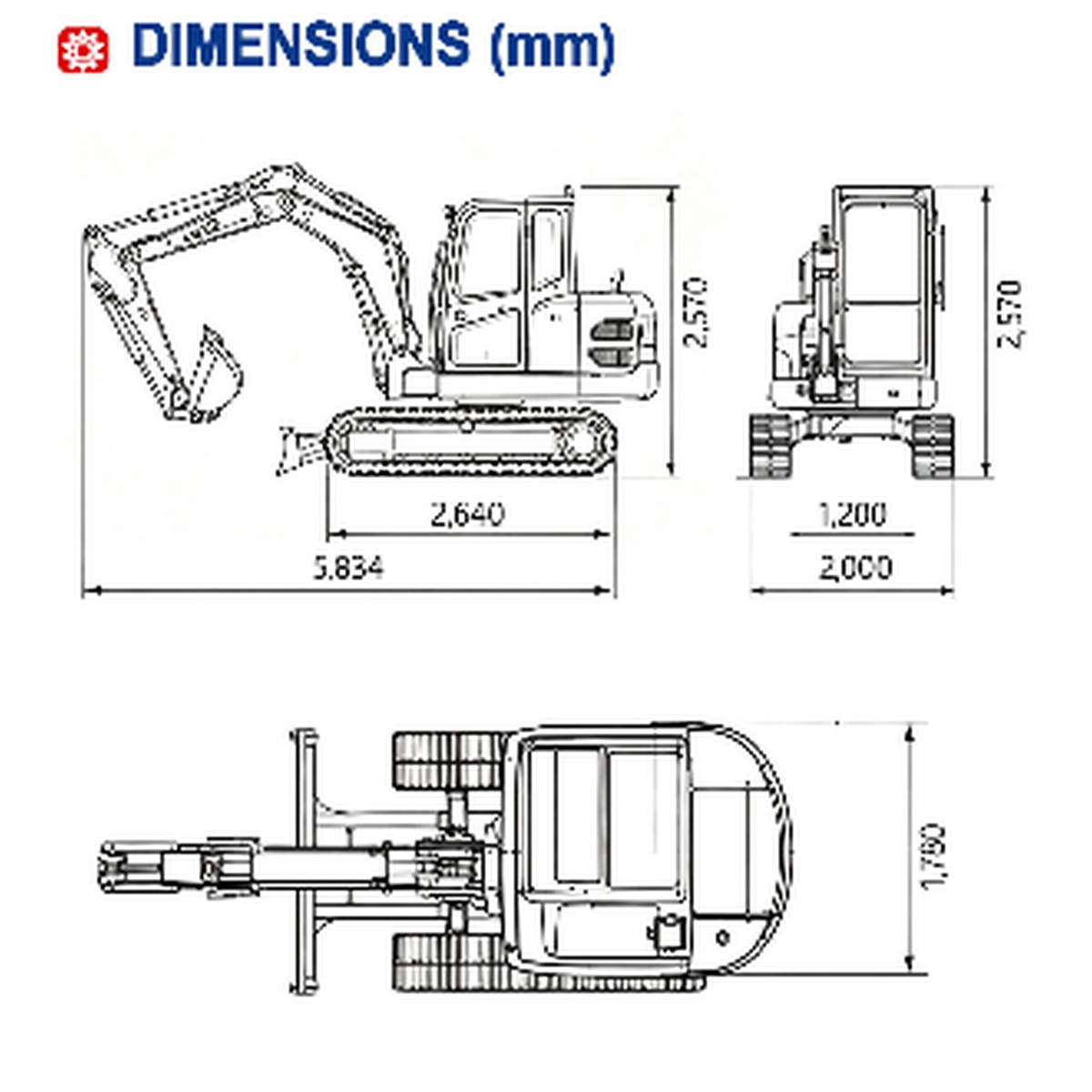
The principal specifications below follow the supplied English catalog, pages 17–18, and agree with the model spreadsheet. They remain reference values to confirm for the delivered configuration.
| Item | Reference value | Purchasing interpretation |
|---|---|---|
| Model | HL65 | Model digits are not a weight specification |
| Operating weight | 6.6 t / 6,600 kg | Not verified loaded transport or packing mass |
| Digging bucket capacity | 0.23 m³ | Volume, not payload or hourly output |
| Bucket width | 700 mm | Spreadsheet excludes side teeth; check actual cutting envelope |
| Overall length | 5,834 mm | Verify actual transport position and attachment |
| Overall width | 2,000 mm | Distinct from upper-body width |
| Overall height | 2,570 mm | Confirm the actual cab and transport arrangement |
| Upper-body width | 1,780 mm | Not overall access width |
| Body swing radius | 1,180 mm | Confirm actual rear clearance |
| Body rotation | 360° | Surrounding clearance still required |
| Boom swing, left / right | 45° / 55° | Confirm the fitted arrangement and directional convention |
| Maximum digging radius | 6,044 mm | Separate limit from maximum depth |
| Maximum digging depth | 3,506 mm | Not a specified vertical-wall digging depth |
| Maximum digging height | 5,157 mm | Reference envelope boundary |
| Maximum unloading height | 3,692 mm | Verify bucket clearance at the required discharge point |
| Minimum swing radius | 3,022 mm | Not the same measurement as body swing radius |
| Maximum blade digging depth | 369 mm | Not a lifting or load-support rating |
| Maximum blade lifting height | 253 mm | Reference blade geometry |
| Reference tracks | Steel tracks | Confirm the ordered undercarriage |
| Track width | 400 mm | Insufficient by itself to calculate ground pressure |
| Track length | 2,640 mm | Not a verified ground-contact length |
| Fuel tank capacity | 30 L | Does not establish consumption or working hours |
| Hydraulic tank capacity | 41 L | Not auxiliary flow or total system oil volume |
The catalog also lists 35° maximum grade ability. This is not used here as a safe working-slope or loading-ramp angle. Apply the actual operating instructions and site assessment.
Loading a Vehicle Requires the Bucket Path
The 3,692 mm maximum unloading height is useful for initial screening. It does not prove that the HL65 can load every vehicle whose side is lower than that figure. The bucket needs useful clearance at the discharge position, while the machine must stand in an appropriate location.
Provide the receiving-vehicle height, required horizontal position and available machine setback. Include the actual bucket and any coupler. Confirm that the relevant working position is available rather than combining the 6,044 mm maximum radius with the maximum unloading height as if both occurred simultaneously.
The same principle applies to trenching. Maximum digging depth is different from vertical-wall depth, and the required wall profile may depend on the machine’s setback and attachment geometry. Define the excavation before approving the model.
For rear clearance, compare the actual rotating outline with the site obstacles. Do not interpret the 1,180 mm body swing radius as a zero-tail-swing claim. The 3,022 mm minimum swing-radius entry is another catalog measurement, not a substitute for checking the whole operating envelope.
Engine and Hydraulic Configuration Need Separate Records
The model spreadsheet lists Yanmar engine references and Kubota V2607, with power entries of 36.3, 42.4 and 42.5 kW for different described packages. It does not provide a complete, consistently defined set of engine variants, rated speeds and power definitions. Those entries do not establish one universal standard engine or support a percentage comparison of usable performance.
Request the exact engine identification, rated power with its speed and definition, applicable emissions documents and parts information. Descriptions such as an emissions stage or “dual certification” in a spreadsheet are not substitutes for evidence applicable to the shipped engine and destination. Our engine buying guide explains the documentation questions.
The spreadsheet describes a piston pump, load-sensing valve arrangement and two-speed travel references of 2.2 / 4.2 km/h. Confirm those details for the quotation. Pump or valve descriptions do not establish auxiliary flow, pressure, digging force or tested production. Travel-speed references do not guarantee a particular relocation time on your route.
For a breaker, auger or grapple, request the attachment requirements and confirm the actual hydraulic supply, return arrangement and control circuit. A mechanical connection that fits does not prove hydraulic compatibility. The bucket compatibility guide covers the separate mounting checks for buckets and couplers.
Confirm the Cab and Equipment Package
The catalog lists a fully enclosed cab, air conditioner, side storage compartment and offset boom as optional accessories. The spreadsheet describes a reference package with cab, cooling and boom swing. Resolve what is included in the actual order; neither a photograph nor a drawing establishes the commercial package.
A cab should be assessed for the actual working environment, visibility and overhead clearance. Confirm the cooling arrangement and fitted dimensions. Do not assume every advertised cab contains the same equipment or that a pictured machine represents every shipment.
The catalog identifies steel tracks. Discuss the site surfaces, ground conditions and route before settling the undercarriage. Track width alone does not establish low ground pressure or damage-free operation. No confirmed contact area is provided here, so this page does not calculate a ground-pressure value.
HL65 Compared With HL35U and HL75
The HL35U catalog lists 3.8 t operating weight, 1,700 mm overall width and a 0.11 m³ bucket. The HL65 reference is 2.8 t heavier and 300 mm wider. Its listed depth increases from 3,071 mm to 3,506 mm, radius from 5,251 mm to 6,044 mm and unloading height from 3,382 mm to 3,692 mm.
These changes identify what to investigate for the actual task. They do not establish a proportional improvement in lifting capacity, cycle time or output. If the HL35U meets your geometry and attachment requirements, the larger machine needs a practical reason to justify its additional space and transport demands.
The HL75 is another model to assess if the HL65 does not meet a documented requirement. Do not infer its operating weight from “75” or assume that the next model code guarantees a particular capability. Compare verified configuration records. Our size-selection guide provides the broader selection framework.
Transport and Shipment: Use Actual Configuration Mass
The 6,600 kg operating weight is not a confirmed loaded transport mass. Establish what the reference includes, then account for the actual cab, tracks, coupler, fitted bucket, loose attachments and other cargo without counting an included item twice.
Check usable trailer payload separately from its gross rating. The trailer’s own mass, axle and hitch limits, towing vehicle and applicable route requirements also matter. The model’s catalog weight does not approve a trailer or loading arrangement.
For export shipment, request the final packing dimensions and gross mass. These can differ from the local transport configuration. Catalog length and height do not independently establish container fit, a ramp arrangement or a securing plan.
Frequently Asked Questions
Does HL65 mean a 6.5-tonne excavator?
The supplied English catalog lists 6.6 t operating weight. The model name is not the weight definition. Confirm the actual configuration and what the stated weight includes.
How much material can the 0.23 m³ bucket carry?
Volume alone cannot establish an approved load. Material density, actual fill, attachment mass, working position and the applicable machine limits must be considered. The hypothetical density calculation above is not an HL65 lifting approval.
Is a 700 mm bucket always right for trenching?
No. Match the approved bucket to the required trench profile and material. The reference width excludes side teeth in the spreadsheet. Confirm the actual cutting envelope, mounting and bucket mass before ordering a different bucket.
Can the HL65 unload at 3,692 mm while reaching 6,044 mm?
The catalog gives those as separate maximum limits. It does not establish that both are available at the same working position. Check the actual working-range drawing, bucket and receiving-vehicle geometry.
Which engine and cab are supplied?
The materials describe several engine packages and identify cab equipment differently as reference or optional. The quotation must specify the engine variant, applicable documents, cab and cooling equipment. A photograph does not replace that specification.
Does the 30 L fuel tank tell me the daily fuel cost?
No. Tank capacity does not establish consumption. Daily fuel cost requires fuel use for a defined duty and hours of work, plus the actual local fuel price. We do not derive runtime or cost from the tank size.
Request an HL65 Configuration Review
- Destination country and delivery location.
- Material, trench dimensions and required wall profile.
- Receiving-vehicle height, discharge position and available machine setback.
- Access width, overhead clearance and ground constraints.
- Required engine documents, cab and track configuration.
- Buckets, coupler and powered attachments.
- Transport arrangement, intended use and expected quantity.
Send your HL65 requirements to Hongli. Tai’an Hongli Machinery Equipment Co., Ltd. can review the reference information and identify the evidence needed for the proposed build. If a smaller machine already meets the task, or the job requires a different class, settle that before choosing by bucket size or model number.
About the Author
Avicii Meng, Head of Technical Engineering | Hongli Machinery
Avicii Meng works with Tai’an Hongli Machinery Equipment Co., Ltd. on export equipment configurations and technical purchasing questions for international buyers.