If you are buying construction equipment for export or import, you will encounter two sets of emission standards that sound related but are not the same thing.
Tier 4 Final is the United States standard, administered by the EPA. Stage V is the European Union standard. They are separate regulatory frameworks with different testing procedures, different certification processes, and different documentation. A machine certified to one is not automatically compliant with the other.
This causes real problems. Buyers see "Tier 4" in a specification and assume it covers Europe. Suppliers quote "Stage V compliant" to buyers importing into the United States. Machines arrive at ports and are held because the documentation does not match the destination’s requirement.
This guide explains both systems, how they relate, what the terminology actually means, and how to verify what a specific machine carries before you pay for it.
The Two Systems at a Glance
| United States | European Union | |
|---|---|---|
| Standard name | EPA Tier 1 → Tier 4 Final | Stage I → Stage V |
| Administered by | US Environmental Protection Agency | European Commission |
| Current standard | Tier 4 Final | Stage V |
| Applies to | Non-road diesel engines | Non-road mobile machinery (NRMM) |
| Documentation | Certificate of Conformity, emission label, engine family number | EU type-approval, emission label |
| Mutual recognition | No — separate certification required | No — separate certification required |
The critical point in that table is the last row. There is no automatic mutual recognition between the two systems. An engine manufacturer can certify the same engine design to both standards, and many do — but that is two separate certifications, not one certification that covers both.
What the Tier System Means
The EPA introduced progressively stricter emission limits for non-road diesel engines in stages, each targeting specific pollutants — primarily particulate matter (PM) and oxides of nitrogen (NOx).
Tier 1 through Tier 3 brought progressive reductions using engine design changes: improved fuel injection, combustion chamber design, and turbocharging.
Tier 4 Interim and Tier 4 Final required substantially deeper reductions in particulate matter and oxides of nitrogen. The EPA standards specify emission limits and test procedures rather than mandating particular hardware — but meeting those limits drove widespread adoption of after-treatment technologies such as diesel particulate filters and selective catalytic reduction, although the exact technology used depends on engine power category and engine design.
Tier 4 Final is the current standard and requires the deepest reductions in the series.
A note on terminology
"Tier 4 Final" and "Tier IV Final" are the same thing. The EPA uses Arabic numerals; Roman numerals appear in some documentation and in common usage, particularly outside the United States. If a supplier quotes "Tier IV Final", they mean Tier 4 Final.
"Tier 4" without a qualifier is ambiguous. It could mean Tier 4 Interim or Tier 4 Final, and those are different standards with different limits. Always ask which.
Tier requirements vary by engine power
This is the detail that catches buyers out. The Tier standards are not a single limit applied to all engines — requirements are set by engine power band, and the implementation timeline differed between bands.
For small engines typical of mini excavators and compact equipment, the requirements and the technology needed to meet them differ substantially from those applied to larger machines. Do not assume that because a large machine in a category needs a particular after-treatment system, a small one does — or the reverse.
What this means practically: confirm the requirement for the specific engine power output of the machine you are buying, not for the category in general.
What the Stage System Means
The European Union operates its own framework for non-road mobile machinery, progressing from Stage I through to the current Stage V.
Stage V applies to engines placed on the EU market and covers a broader range of engine power categories than earlier stages. It also introduced a particle number limit in addition to particle mass limits for certain categories — a technical difference from the EPA approach that affects how compliance is demonstrated.
Type-approval is the mechanism. An engine type is approved, and machines using that engine type are placed on the market with documentation referencing that approval.
The UK operates its own arrangements following its departure from the EU. If you are importing into the UK, confirm the current requirement separately rather than assuming EU documentation is sufficient.
How the Two Systems Relate
They do not, formally. But in practice there is significant overlap in what the standards require, which is why engine manufacturers can and do produce engines certified to both.
What this means for a buyer:
An engine family may hold both certifications. Many established engine manufacturers certify their products for both markets, because both are significant. A dual-certified engine is genuinely useful if machines may move between markets or be resold internationally.
But dual certification is a specific thing, not an assumption. The engine must actually hold both approvals, and the documentation must exist for both. A supplier saying "it meets Tier 4 and Stage V" should be able to produce reference numbers for both certifications.
A machine can be compliant in one market and not the other. This is the most common source of import problems. An engine certified only to Stage V, arriving in the United States, does not satisfy EPA requirements regardless of how clean it actually is.
Emission performance and certification are not the same thing. An engine might technically produce emissions within another standard’s limits while not holding certification for that standard. Certification is a regulatory and documentary status, not just a performance characteristic. Regulators and customs authorities enforce compliance through the required documentation, and the documentation is what gets checked.
Official references: the EPA publishes nonroad compression-ignition engine standards and certification data for the United States. The EU framework for non-road mobile machinery is set out in Regulation (EU) 2016/1628. Checking the source regulation is worthwhile if you are importing regularly rather than as a one-off.
Why This Matters When You Buy
Machines can be held at the border
Importing a machine without conforming engine documentation into a regulated market risks the machine being detained, refused entry, or requiring costly remediation. This is not a theoretical risk, and it falls on the importer.
"Kubota engine" is not a compliance statement
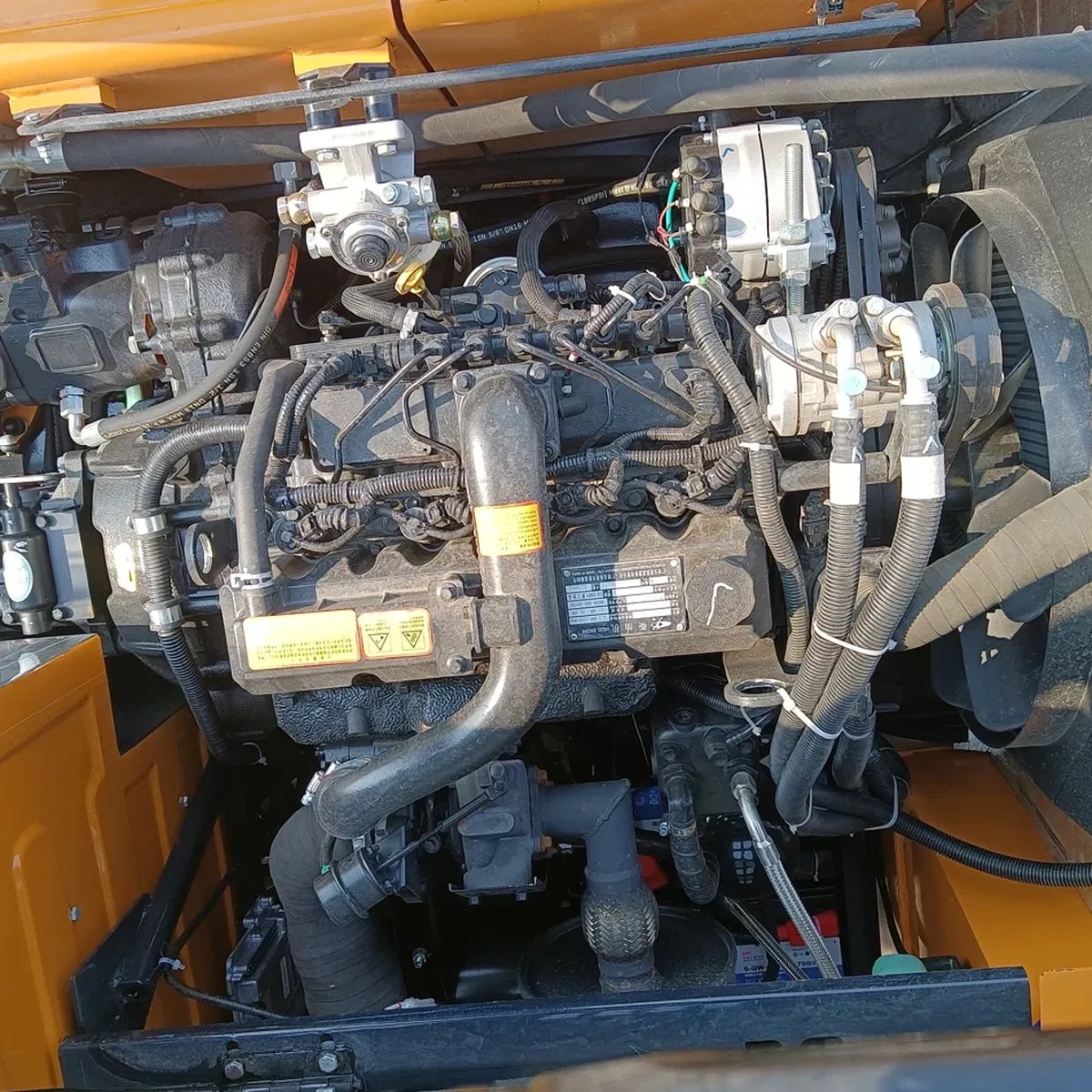
This is the single most common misunderstanding we encounter. Kubota, Yanmar, Perkins and other established manufacturers produce engines in many configurations, including ones not certified for regulated markets. The brand tells you who made the engine. It does not tell you what certification that specific engine holds.
What establishes compliance: the engine family number, the model year, the emission label physically on the engine, and the certificate covering that configuration for your destination.
Non-regulated markets exist, and buying certification you do not need costs money
Many markets do not require EPA or EU documentation for non-road machinery. Requirements are set country by country, and they change — some are tightening. Check your specific destination’s current requirement.
Where certification is not required, specifying a certified engine adds cost without adding capability. That is money that could go toward a hydraulic upgrade, an additional attachment, or simply staying in the budget. There is nothing virtuous about paying for a certificate you will never be asked to produce.
How to Verify What a Machine Actually Carries
Ask for these four things, in writing, before payment:
1. The exact engine model designation. Not the brand — the model. "Kubota" is not an answer; a specific model designation is.
2. The engine family number. This is the identifier under which the engine is certified. It appears on the emission label and in certification records.
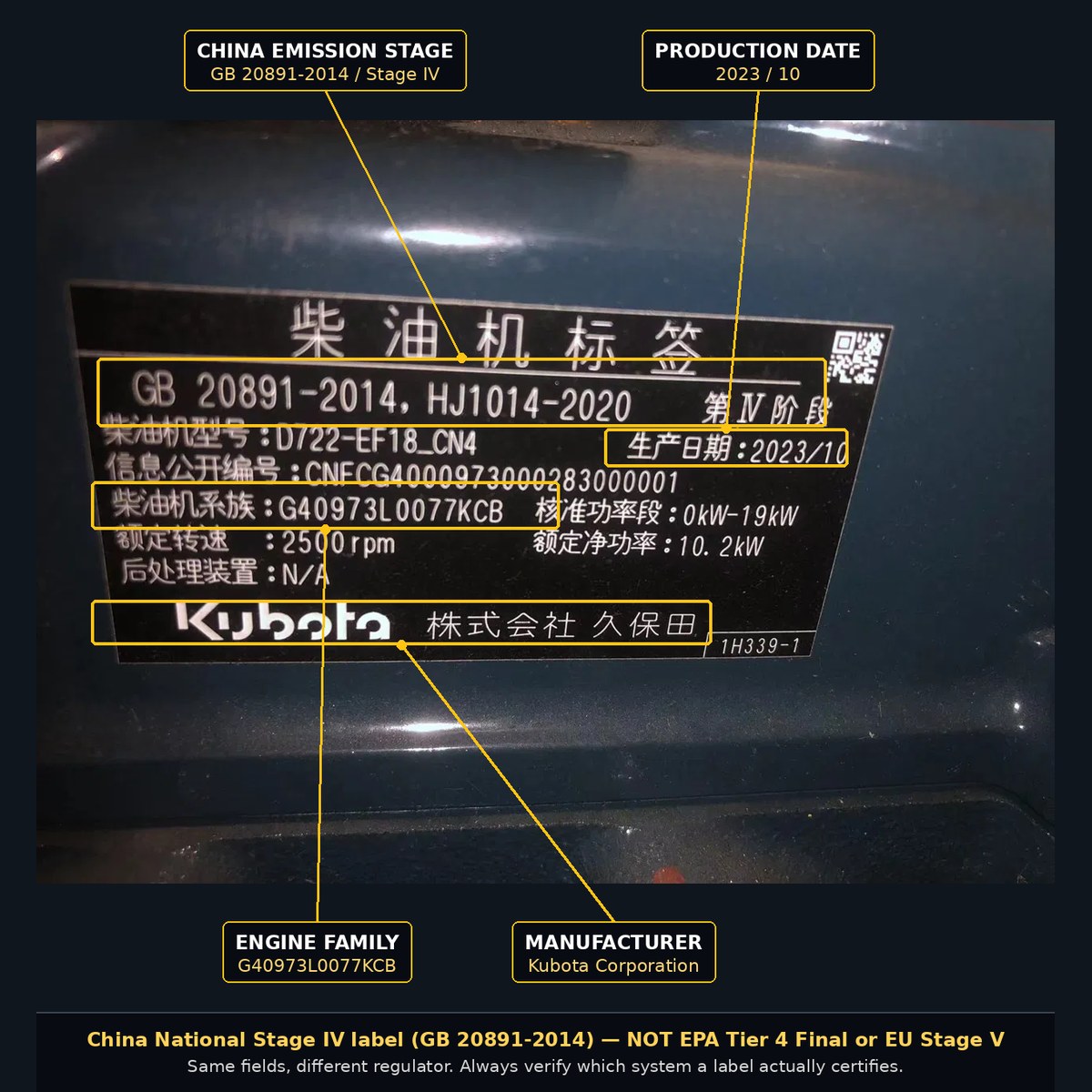
3. A photograph of the emission label on the actual engine. Not a stock image or a certificate for a similar engine — the label on the unit being shipped to you. The label carries the fields that matter:
- Engine family — the identifier the certification is held under
- Model year — certification is year-specific
- Emission standard — what the engine is certified to
- Manufacturer — who holds the certification
These are the four fields to check before shipment. If any of them do not match what was quoted, raise it before payment rather than after arrival.
4. The certificate reference for your destination market. EPA Certificate of Conformity for the United States, or EU type-approval reference for the European Union. Verify the reference against the relevant regulator’s records — the EPA publishes annual certification data that can be searched by engine family.
If a supplier cannot produce these quickly, that is information. A manufacturer routinely shipping to regulated markets has this documentation to hand. One that treats the request as unusual may not be shipping to those markets as often as claimed.
For a fuller treatment of the verification process, see our guide to EPA-compliant excavators.
What This Means for Equipment Specification
If your destination requires EPA Tier 4 Final: specify an engine configuration certified for it, confirm the engine family and certificate, and budget for the cost difference over a non-certified configuration.
If your destination requires EU Stage V: the same process, with EU type-approval documentation. Do not accept EPA documentation as a substitute.
If your machines may move between or be resold across regulated markets: a dual-certified engine family is worth the premium for the flexibility it preserves. Confirm both certifications exist.
If your destination requires neither: specify the engine that suits your operating conditions and budget. Our comparison of Laidong and Kubota engine options covers what the upgrade actually costs and when it is worth paying for.
Our guide to mini excavator engine brands covers the engine options available across configurations.
Frequently Asked Questions
Is Tier 4 Final the same as Stage V?
No. Tier 4 Final is the United States EPA standard and Stage V is the European Union standard. They are separate regulatory frameworks with different testing procedures and separate certification processes. There is no automatic mutual recognition — an engine certified to one is not automatically compliant with the other, though many engine families hold both certifications separately.
What is the difference between Tier 3 and Tier 4 Final?
Tier 4 Final requires substantially lower emissions of particulate matter and oxides of nitrogen than Tier 3. Tier 3 was generally achieved through engine design improvements; Tier 4 Final typically requires after-treatment systems on most engine categories. The specific requirements vary by engine power band.
Is Tier IV Final the same as Tier 4 Final?
Yes. They are the same standard written with Roman rather than Arabic numerals. The EPA uses Arabic numerals; Roman numerals appear in some documentation and in common international usage.
What does Tier 4 compliant mean for equipment?
It means the engine in the machine holds EPA certification to the Tier 4 Final standard for its power category. It is a property of the engine and its certification, not of the machine chassis. When buying, verify the engine model, engine family number, emission label, and certificate — a machine described as “Tier 4” without that documentation has not demonstrated compliance.
Do I need a Tier 4 Final engine?
Only if your destination market requires it. Requirements are set country by country and change over time. If you are importing into the United States, you generally need a conforming configuration. If your market does not require EPA or EU documentation, paying for certification you will not be asked to produce adds cost without adding capability. Confirm your specific destination’s current requirement before specifying.
How can I check if an engine is really certified?
Request the engine model designation, engine family number, a photograph of the emission label on the actual engine, and the certificate reference for your destination. Verify the certificate reference against the relevant regulator’s records. Brand name alone does not establish compliance.
Specifying for Your Market
Emission requirements should be settled before an order is placed, not discovered at the port. To receive a quotation with the correct engine configuration for your destination:
Destination country and port:
Emission standard required (EPA Tier 4 Final / EU Stage V / other / unsure):
Machine model or size class:
Intended application:
Expected quantity:
If you are unsure what your destination requires, say so — we would rather establish it at quotation than have a machine held at customs. We can also quote certified and non-certified configurations side by side so you can see exactly what the requirement costs.
Contact: hongli@hongli-mach.com · WhatsApp +86 131 0548 1184
About the Author
Avicii Meng is Head of Technical Engineering at Tai’an Hongli Machinery Equipment Co., Ltd., where he works on export-oriented excavator configurations, engine compliance requirements, and OEM manufacturing projects for international markets. Hongli manufactures mini and compact excavators, skid steer loaders, forklifts, and backhoe loaders for export to global markets. Contact: hongli@hongli-mach.com | hongli-mach.com