
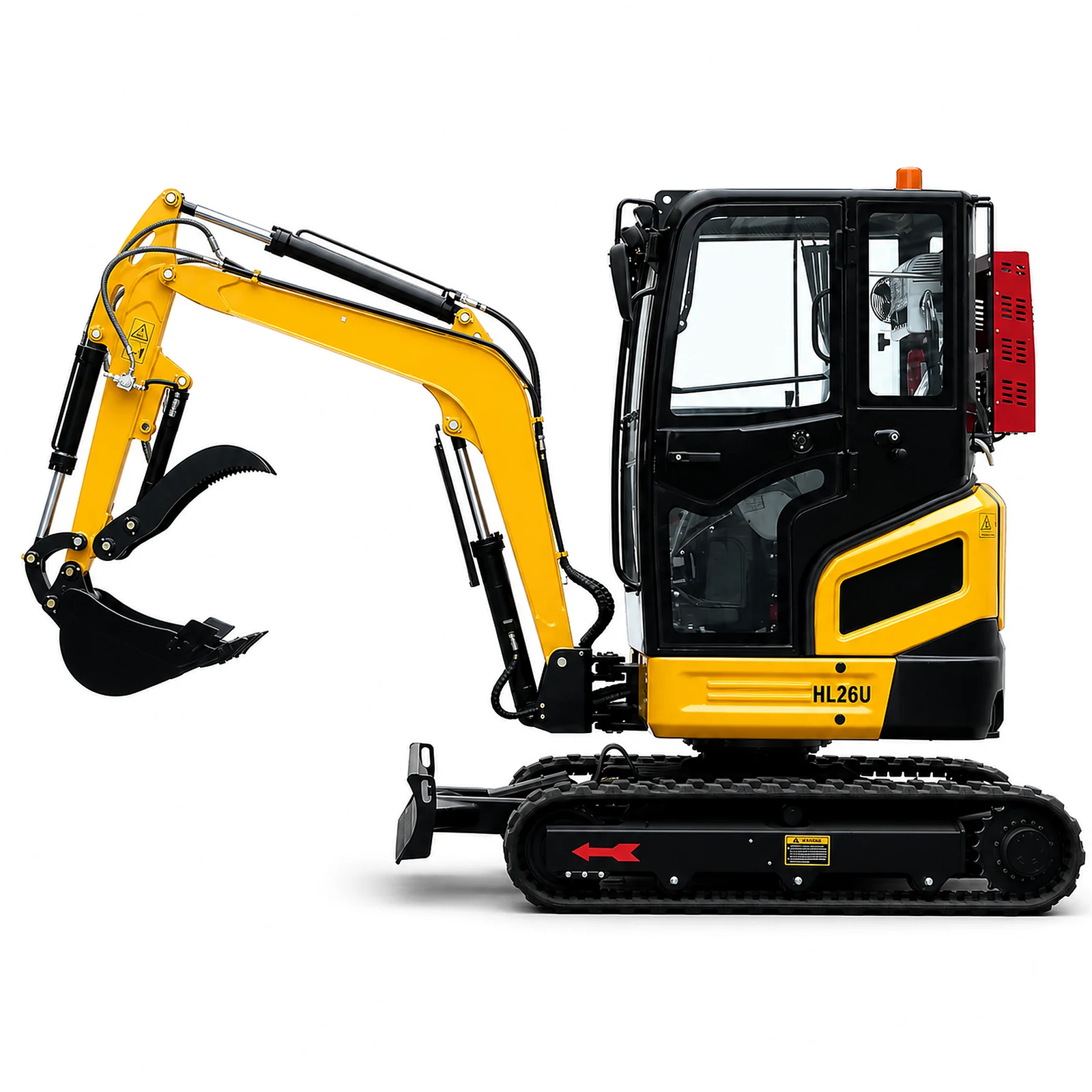
2,500 kg catalog operating weight · 1,500 mm overall width · 2,745 mm maximum digging depth · 0.075 m³ bucket
The Hongli HL26U small excavator has a catalog operating weight of 2.5 tonnes, an overall width of 1,500 mm and an overall length of 4,185 mm. Its listed maximum digging depth is 2,745 mm, maximum digging radius is 4,350 mm and maximum unloading height is 2,366 mm. Tai’an Hongli Machinery Equipment Co., Ltd. supplies the HL26U with engine, cab, track and attachment configurations confirmed for the individual order.
This page covers the full specification, how to check rotation clearance and which optional configurations are worth specifying. The supplied catalog identifies Kubota, Perkins and Changchai engine choices. A separate configuration sheet describes a Changchai build. Confirm the exact engine rather than treating one brand as standard for every HL26U.
Ask us to check your HL26U configuration. Send your destination country, narrowest access width, working-space measurements, required engine documentation, cab preference, attachments and expected quantity. Contact hongli@hongli-mach.com or WhatsApp +86 131 0548 1184.
What Tail Swing Actually Means for Your Site
The counterweight’s path determines whether the machine can rotate beside a wall, fence, parked vehicle or other obstruction. Access width and rotation clearance are separate measurements. Passing through an entrance does not establish that the excavator can complete its working cycle once inside.
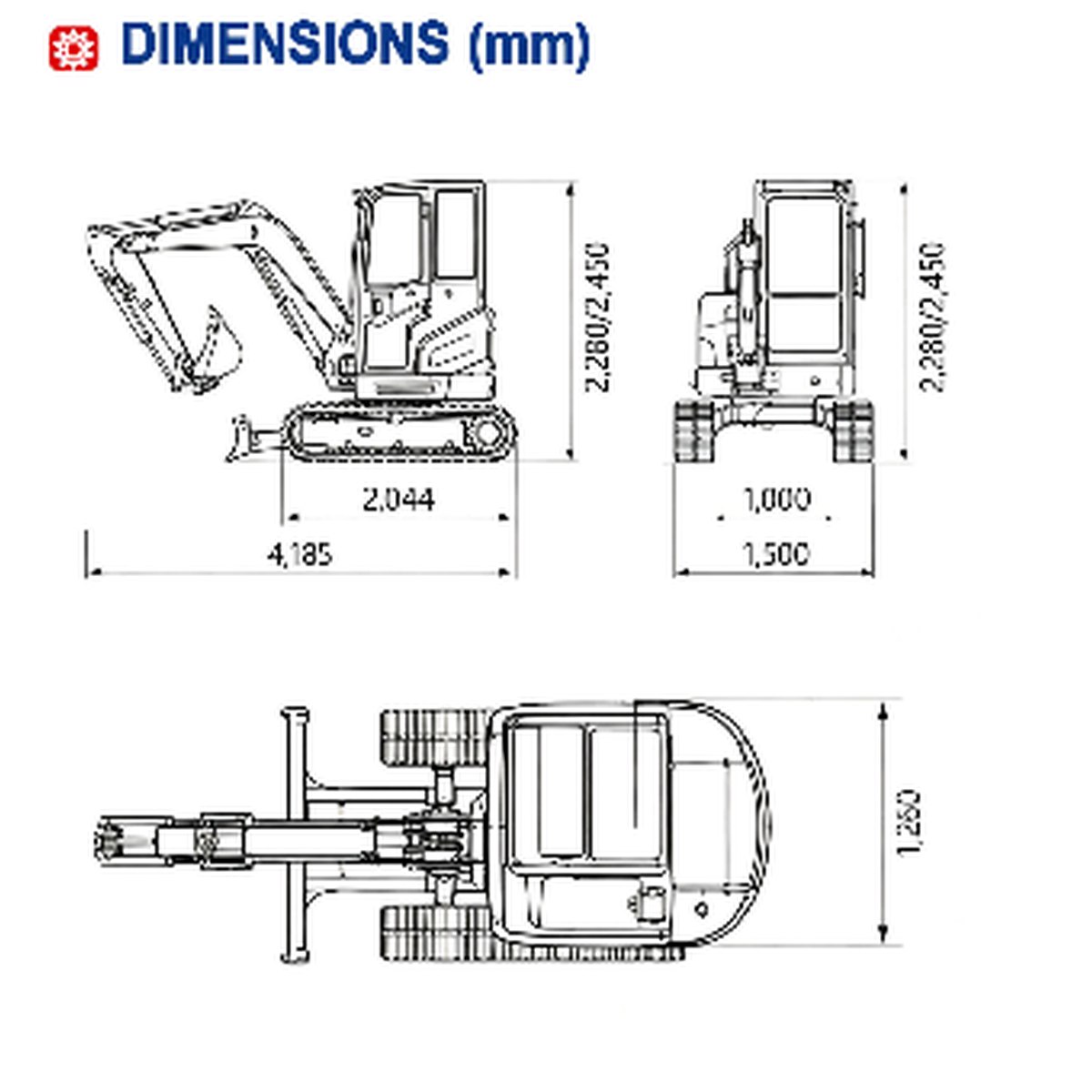
For the HL26U, the catalog lists a body swing radius of 892 mm. The accompanying configuration sheet identifies this as the rear swing radius. It also lists 1,260 mm body width and 1,500 mm overall width. Comparing 892 mm directly with the full body width does not prove that the tail stays inside the tracks. A radius starts at the rotation axis, so the relevant comparison is the distance from that axis to the track edge.
For a centered rotation axis and a 1,500 mm overall track width, that distance is 750 mm. On those assumptions, the listed 892 mm rear radius would imply approximately 142 mm of rear overhang. This is a dimensional check, not a certified clearance measurement for every configuration. It shows why we do not describe the HL26U as a verified zero-tail-swing machine from its model name or these figures alone.
Before ordering for a restricted site, request a dimensioned top view showing the rotation center, rear radius and track width for the actual undercarriage position. Include the working attachment and any changes to the counterweight. Check the boom, bucket, hoses and spoil-discharge path as well as the rear. A shorter rear profile does not remove the space needed in front of the machine.
Our guide to tail swing and the whole working envelope explains the separate checks. The practical question is whether the quoted machine can complete your required movement with suitable clearance.
Who the HL26U Is For
Urban and municipal contractors. The HL26U is a candidate for sites where its 1,500 mm width is acceptable and the verified working envelope fits the available space. Provide a site sketch before choosing it for work between existing structures.
Utility crews and foundation contractors. Its listed depth and reach provide useful starting points for trench and footing selection. The shape of the excavation, required bucket width and spoil location determine whether those maximum figures suit the work.
Landscaping contractors on established properties. Consider it where access accommodates the actual build and the work needs this size class. Check corners, overhead restrictions and the operating area, rather than measuring only the gate opening.
Where the HL26U Is Not the Right Machine
If your route is narrower than the confirmed machine width, do not choose the HL26U on the assumption that an optional retractable chassis will solve the problem. Its minimum retracted width and permitted working positions need separate confirmation. A narrower HL18 or HL20 may fit the route better.
If the job requires a verified zero-tail-swing machine, a lifting capacity beyond the supplied load chart or productive excavation outside the confirmed working range, the HL26U is not established as suitable by this catalog. Tell us those constraints before requesting a price. We would rather recommend a different machine than supply one that cannot complete the work.
Full Technical Specifications
| Specification | Catalog value |
|---|---|
| Model | HL26U |
| Operating weight | 2,500 kg / 2.5 t |
| Digging bucket capacity | 0.075 m³ |
| Bucket width | 500 mm |
| Overall length | 4,185 mm |
| Overall width | 1,500 mm |
| Overall height | 2,280 / 2,450 mm; confirm the configuration |
| Body width | 1,260 mm |
| Body swing radius | 892 mm |
| Upperstructure rotation | 360° |
| Boom swing, left / right | 55° / 45° |
| Maximum digging radius | 4,350 mm |
| Maximum digging depth | 2,745 mm |
| Maximum digging height | 3,453 mm |
| Maximum unloading height | 2,366 mm |
| Minimum swing radius | 2,159 mm; catalog label |
| Maximum dozer blade digging depth | 293 mm |
| Maximum dozer blade lifting height | 191 mm |
| Track type | Rubber tracks |
| Track shoe width | 250 mm |
| Track length | 2,044 mm |
| Fuel tank | 16 L |
| Hydraulic tank | 26 L |
| Engine configurations | Kubota / Perkins / Changchai; exact build to be confirmed |
Values are from the supplied HL26U English catalog. Confirm the specification sheet for the ordered configuration. The catalog’s 35° maximum gradeability entry is not presented here as a safe working-slope recommendation.
Reading the Working Range
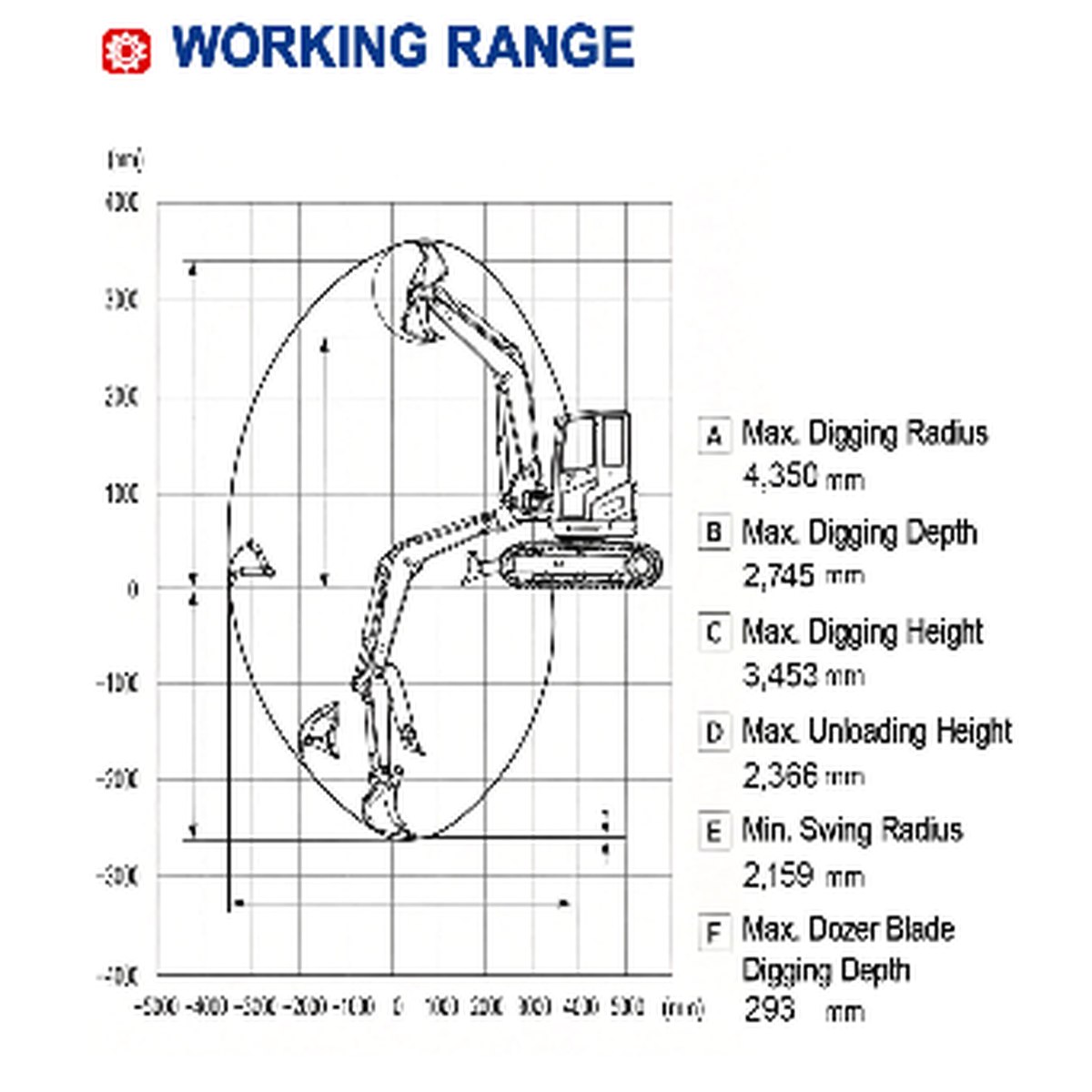
2,745 mm maximum digging depth describes an extreme of the working envelope. It does not mean the excavator can form a vertical trench wall or work productively across the entire excavation at that depth. Match the drawing to your trench section, pipe diameter, bedding and required bucket movement.
4,350 mm maximum digging radius and 3,453 mm maximum digging height are separate limits. They do not describe one bucket position available at both maxima. For loading, check the 2,366 mm maximum unloading height against the receiving vehicle, including where the bucket must clear its side and discharge.
892 mm body swing radius and 2,159 mm minimum swing radius answer different questions. The first concerns the rear body in the supplied configuration sheet. The second is another catalog working-range dimension. Neither should become a single number for the clearance of the complete machine and attachment.
26 L hydraulic tank capacity identifies reservoir size. It does not establish auxiliary flow, cooling performance or suitability for continuous breaker operation. Request the circuit’s flow, pressure, return requirements and attachment approval for the intended duty.
250 mm track shoes and 2,044 mm track length describe parts of the undercarriage. Total track length is not necessarily ground-contact length. These figures alone do not support a ground-pressure calculation or a promise that the machine will protect finished paving or turf.
2,280 / 2,450 mm overall height gives two catalog figures. Confirm which applies to the quoted canopy or cab, together with any transport preparation. The provided drawing does not explicitly assign each height to a particular enclosure.
Optional Configurations Worth Specifying
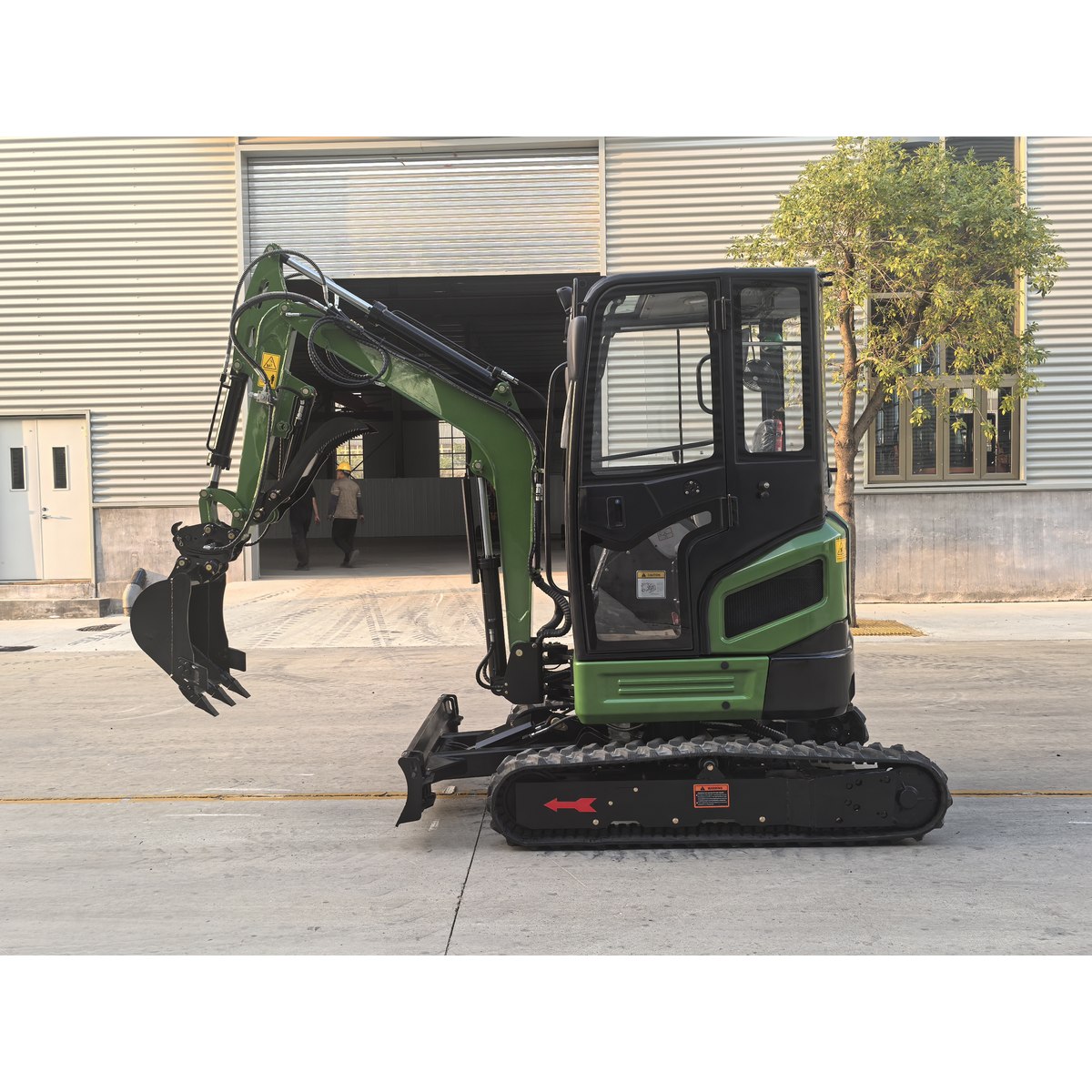
Enclosed cab and air conditioning. The catalog lists these options. Check the quoted enclosure, overall height and climate-control equipment for your work. The workshop photograph shows one enclosed-cab machine, not the equipment included with every order.
Hydraulic pilot control. Ask which functions use pilot control on the proposed build. The configuration sheet describes hydraulic travel control, but that alone does not confirm the complete control arrangement. Choose the layout after checking its operation and service requirements.
Hydraulic quick coupler. This can be useful when the job involves attachment changes. Check attachment compatibility, the locking procedure and hydraulic connections. A coupler changes the geometry between the arm and bucket, so the direct-mounted bucket’s range and force should not be assumed unchanged.
Retractable chassis. The option appears in the supplied materials, but a verified minimum and maximum width are not stated in the specification table. Ask for measured widths, blade arrangement and instructions for allowed operating positions. Do not plan access around an unconfirmed retracted width.
Boom side swing. The catalog lists 55° left and 45° right. This helps position the digging equipment relative to the tracks. Rear clearance, front clearance and the full excavation geometry still need checking.
Steel tracks. Confirm their availability, operating weight and suitability for your ground. Rubber tracks can also damage surfaces under some conditions. Track choice should follow the surface, traction requirement and permitted use, not a blanket claim of surface protection.
Engine and Documentation
The English catalog shows Kubota and lists Perkins and Changchai choices. The separate HL26U configuration sheet describes a Changchai 390 build and lists other engine variants. These documents support discussing engine options, but they do not establish one universal base engine.
Request the exact engine model, rated power with its speed and measurement basis, emissions label and applicable documentation for the destination. We have not used the sheet’s differing power figures to rank the engines because the rating conditions are not supplied. A brand name or an emissions description in a configuration list is not enough to verify the delivered machine.
Our mini excavator engine guide covers the questions to ask about service and configuration. Settle the engine and supporting documents before confirming the order.
HL26U Compared With Adjacent Models
The HL20 lists 1,060 mm overall width and 2,418 mm maximum digging depth. Compared with the HL26U’s 1,500 mm width, it is a more relevant starting point when access is the binding constraint. Confirm the actual machine widths before making that choice.
The HL22 lists 1,350 mm overall width and 2,752 mm maximum digging depth. Its listed depth is only 7 mm greater than the HL26U’s. That small catalog difference does not establish a practical production advantage. Compare access, working geometry, engine build, controls and attachments instead.
The HL26U lists 2.5 tonnes operating weight, a 0.075 m³ bucket and a 26 L hydraulic tank. These figures describe its configuration. They do not independently prove greater stability, faster digging or longer continuous hydraulic duty than an adjacent model. Request a load chart for lifting work and configuration-specific evidence for the task you intend to perform.
Our mini excavator size chart explains how width, depth and weight guide the initial selection.
Frequently Asked Questions
Is the HL26U actually a zero-tail-swing excavator?
The supplied documents do not establish that claim. They list an 892 mm rear/body swing radius and 1,500 mm overall width. With a centered rotation axis, these imply approximately 142 mm of rear overhang. Request a dimensioned clearance drawing for the actual build. The U suffix alone is not proof of zero tail swing.
How deep can the HL26U dig?
The catalog lists 2,745 mm maximum digging depth and 4,350 mm maximum digging radius. These are separate limits. Check the working-range drawing against the required trench section rather than assuming both maxima occur together.
What engine does the HL26U use?
Kubota, Perkins and Changchai choices appear in the supplied materials. The catalog shows Kubota, while a separate configuration sheet describes a Changchai build. Confirm the exact engine model and required documents on the quotation and delivered machine.
Can the HL26U pass through a narrow gate with retractable tracks?
Its listed overall width is 1,500 mm. A retractable chassis is offered, but the verified retracted width and the widths of other projecting parts need confirmation. Do not assume a particular gate clearance from the option name.
How tall is the HL26U?
The catalog gives 2,280 / 2,450 mm. Confirm the value for the ordered canopy or cab and any transport arrangement. Check the complete route, including overhead obstructions and turns.
Is 2,500 kg the weight to use for transport planning?
It is the catalog operating weight, not a verified packed or transport weight. Confirm the actual machine, fuel condition, coupler, bucket, other attachments and packing. Use the resulting transport load for vehicle and loading planning.
Request a Quotation
Send Tai’an Hongli Machinery Equipment Co., Ltd. the following information so we can check the HL26U against your work:
- Destination country and port.
- Narrowest access width and height, turns and working-space measurements.
- Required digging depth, trench width, loading arrangement and any lifting task.
- Engine preference and required documentation.
- Canopy or enclosed cab, including air-conditioning preference.
- Rubber or steel tracks and whether a retractable chassis is needed.
- Required buckets, coupler and hydraulic attachments.
- Expected quantity and whether the order is for your own work or resale.
Request an HL26U configuration check and quotation. Email hongli@hongli-mach.com or WhatsApp +86 131 0548 1184. Pricing, packing weight and delivery timing are confirmed against the agreed build.
About the Author
Avicii Meng, Head of Technical Engineering | Hongli Machinery. Avicii works with buyers to check machine configuration, site requirements and export documentation before an order is confirmed.